
Many yoga, Pilates, fitness, and lifestyle apparel brands begin with a simple product idea.
It may be a sports bra that feels more aligned with your brand, a pair of leggings designed for your target customer, a matching activewear set, or a product direction inspired by studio-to-street styling.
But turning an idea into a ready-to-produce activewear style is not as simple as sending a reference image to a factory.
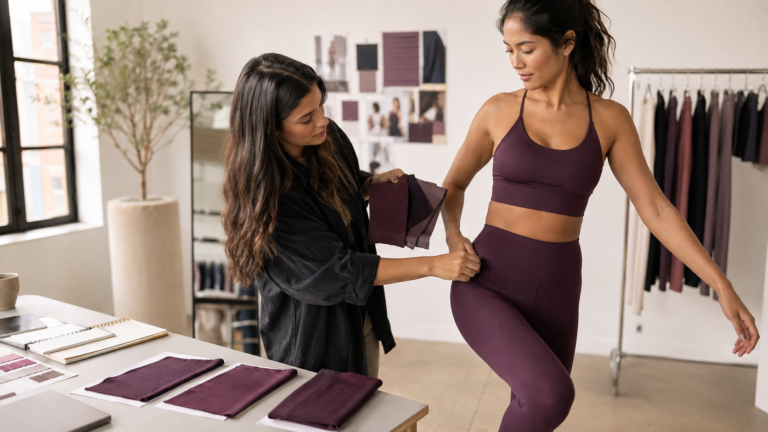
A producible activewear style requires clear product direction, suitable fabric decisions, pattern and fit communication, size planning, logo placement, sampling, and production preparation. If these details are unclear, the development process can become longer, more expensive, and more difficult to control.
For new and growing activewear brands, understanding the activewear product development process can help you choose the right route: ready-to-custom styles, small-batch custom development, or bulk custom production.
Below are the key steps to turn an activewear idea into a style that can move toward real production.
Activewear product development is the process of turning a product idea into a ready-to-produce style with clear design, fabric, sampling, and production decisions.
1. Turn Your Product Idea into a Clear Product Direction
Many brands start with a broad idea such as:
“I want to create a premium yoga set.”
Or:
“I want to develop a Pilates-inspired sports bra.”
These are useful starting points, but they are not yet clear product requirements.
Before development begins, the idea needs to become more specific. You should define:
Product type: sports bra, leggings, top, shorts, skirt, jacket, or jumpsuit
Use scenario: yoga, Pilates, gym training, lifestyle, or multi-scene wear
Target customer: studio users, fitness customers, lifestyle buyers, or niche communities
Wearing needs: support, comfort, shaping, coverage, stretch, or breathability
Visual style: minimal, feminine, performance-driven, elegant, sporty, or street-inspired
The clearer your product direction is, the easier it becomes to make decisions about design, fabric, fit, logo placement, packaging, and production route.
A strong activewear idea is not only about appearance. It should connect product function, brand positioning, customer needs, and production feasibility.
2. Decide Which Production Route Fits the Idea
Not every activewear idea needs to be developed from zero.
Some ideas are better suited for ready-to-custom styles. Others require original product development because they involve special fabric, custom colors, fit adjustments, or pattern changes.
Before starting sampling, brands should first decide which production route matches their current stage.
Ready-to-Custom Activewear Styles
This route is suitable if:
You want to test the market faster
You can accept existing fabrics, available colors, and existing patterns
You mainly need logo, hang tag, logo packaging bag, and shipping bag customization
You want to reduce starting risk
You need a lower starting quantity for your first collection
With Battlerobe’s Small-Batch Ready-to-Custom route, brands choose from existing activewear designs and customize brand elements such as logo, hang tags, logo packaging bags, and shipping bags.
For this route, fabric customization, color customization, and pattern cutting changes are not supported.
The MOQ starts from 20 pieces per design, with mixed sizes and available colors supported. The minimum order quantity per order is 60 pieces.
Small-Batch Custom Development
This route is suitable if:
You have a clear original product idea
You need pattern, fit, or structure adjustments
You want custom fabric, custom color, or specific design details
You are ready for sampling, communication, and refinement
You want a more differentiated product line
If your brand needs original style development, you can learn more about Battlerobe’s Small-Batch Custom Development route.
Bulk Custom Production
This route is more suitable if:
You already have mature samples or technical specifications
You have stable order volume
You need a more complete bulk production process
You care more about cost control, timeline, and stable delivery
For larger-volume projects, you can visit Bulk Custom Production.
Choosing the right route early can prevent wasted time and reduce unnecessary development cost. You can also compare all options on the Solutions page.
3. Prepare More Than One Reference Image
Many brands send a supplier one reference image and say, “I want something like this.”
A reference image can be helpful, but it is usually not enough.
To make activewear product development smoother, you should prepare more complete references, such as:
Front, back, and side views
Design details you want to keep
Design details you do not want
Target fabric feel
Wearing scenario
Logo placement
Size range
Estimated quantity
Expected launch timeline
For example, instead of saying:
“I want a Pilates sports bra like this.”
A clearer request would be:
“I want to develop a sports bra for Pilates and light training. The front neckline should not be too low, the straps should look clean, the back design should be simple, support should be light to medium, and the style should pair well with high-waist leggings.”
This kind of communication helps the development team understand your real product intention, not just the visual reference.
Clear input creates a better starting point for sampling and production planning.
4. Define the Key Style Details
Activewear products are highly detail-driven. A small design change can affect comfort, fit, support, movement, appearance, and production difficulty.
When developing sports bras, leggings, tops, shorts, skirts, or jumpsuits, brands should think carefully about details such as:
Neckline height
Strap width
Back structure
Hem width
Waistband height
Length
Pocket design
Lining or removable pads
Seam construction
Logo placement
Size range
For a sports bra, support level, strap stability, cup structure, lining, and back design all matter.
For leggings, waistband height, crotch construction, stretch recovery, opacity, seam placement, and movement comfort are important.
For tops and tanks, neckline, armhole shape, body length, and layering use can affect both function and styling.
New brands do not always need to start with complex designs. A simple, comfortable, well-fitting product can often perform better than an over-designed style with too many untested details.
5. Choose Fabric Based on Product Scenario
Fabric should support the product scenario.
Yoga and Pilates apparel usually needs softness, stretch, comfort, and freedom of movement. Gym and training styles may need more support, durability, compression, and recovery. Lifestyle activewear needs to balance appearance, touch, and daily wearability.
When choosing fabric for custom development, brands should consider:
Does the hand feel match the brand positioning?
Is the stretch suitable for the activity?
Is the thickness appropriate?
Is the fabric too sheer?
Does it wrinkle easily?
Does it fit the target price range?
Is it suitable for stable production?
Fabric affects not only comfort, but also product structure, cost, production stability, and customer experience.
For ready-to-custom styles, the fabric is usually already decided by the existing design. In this case, the brand should focus on whether the existing style fits the target customer and collection direction.
For original activewear product development, fabric choice becomes a much deeper decision and should be confirmed carefully before sampling and bulk production.
6. Understand That Sampling Is a Validation Process
Sampling is not just about making a product. It is about testing whether the product idea can become a real, wearable, producible style.
A sample helps confirm:
Whether the style proportion is correct
Whether the fit matches expectations
Whether the fabric performs well
Whether the product is comfortable to wear
Whether the size range makes sense
Whether the logo placement looks natural
Whether the construction can be produced consistently
The first sample may not be perfect. Its purpose is to identify what needs to be improved.
However, brands should also understand that every round of revision adds time and cost. The clearer the product requirements are at the beginning, the more efficient the sampling process can become.
This is why preparation matters. Clear references, clear product direction, and clear development goals can reduce unnecessary sample revisions.
7. Confirm Production Details Before Moving Forward
After the sample is approved, the product can move toward production preparation.
Before production begins, brands should confirm:
Final style
Final fabric
Final color
Size ratio
Logo method
Hang tags
Packaging bags
Order quantity
Production timeline
Quality requirements
Shipping plan
For activewear products, production confirmation is especially important because fit, fabric, color, logo, packaging, and size details all affect the final customer experience.
Once production starts, frequent changes are not practical.
This is why brands should check all key details before placing the production order. A clear confirmation process helps reduce mistakes and improves delivery efficiency.
For more about production quality, brands can also read related articles in our Quality & Manufacturing section.
8. Reduce Development Risk as a New Brand
For new activewear brands, the biggest development risk is often not a lack of ideas. It is having too many ideas at once.
Many brands want to customize fabric, create special colors, adjust patterns, develop multiple styles, and build a full collection immediately. While this can create a more unique product line, it also increases cost, timeline, sampling work, and inventory pressure.
A more practical approach is to develop in stages.
You can start by asking:
Do we already know what our customers want?
Do we need an original product, or can we test with ready-to-custom styles first?
How many styles do we really need for the first launch?
Which product category is most important?
What quantity can we realistically sell?
What feedback do we need before developing more styles?
If your brand is still validating the market, ready-to-custom activewear styles may help you test product direction faster.
If you already have a clear design concept and need deeper development, small-batch custom development may be a better next step.
If your product has already been tested and you have stable order volume, bulk custom production may be more suitable.
The goal is not to choose the most complicated route. The goal is to choose the route that fits your current stage.
9. Use Product Development to Build a Stronger Collection
Activewear product development should not only focus on one isolated style. It should also support your collection strategy.
A sports bra may need matching leggings or shorts. A tank top may need to pair with a skirt or jacket. A jumpsuit may become a signature product if it fits your brand style.
When planning development, consider how each product connects with the rest of the collection.
Ask:
Can this style be paired with other products?
Does it support our brand look?
Can it be reordered later?
Can it be expanded into more colors or related categories?
Does it help customers understand our brand direction?
A ready-to-produce style should not only be technically possible. It should also make sense inside your product line.
You can explore Battlerobe’s activewear product categories to see how sports bras, tops, shorts, leggings, skirts, jackets, and jumpsuits can work together in a brand collection.
Conclusion
Turning an activewear idea into a ready-to-produce style requires more than inspiration.
It requires clear product direction, the right production route, detailed design communication, suitable fabric decisions, sampling, confirmation, and production planning.
For new yoga, Pilates, fitness, and lifestyle apparel brands, the key is not to make the first product overly complex. The key is to make every step clearer and more controllable.
If you are preparing to develop sports bras, leggings, tops, shorts, skirts, jackets, or jumpsuits, Battlerobe can help you review your product idea, target quantity, customization needs, and timeline.
Explore our Products, compare the right production route, or send your project details through Start Your Project.