


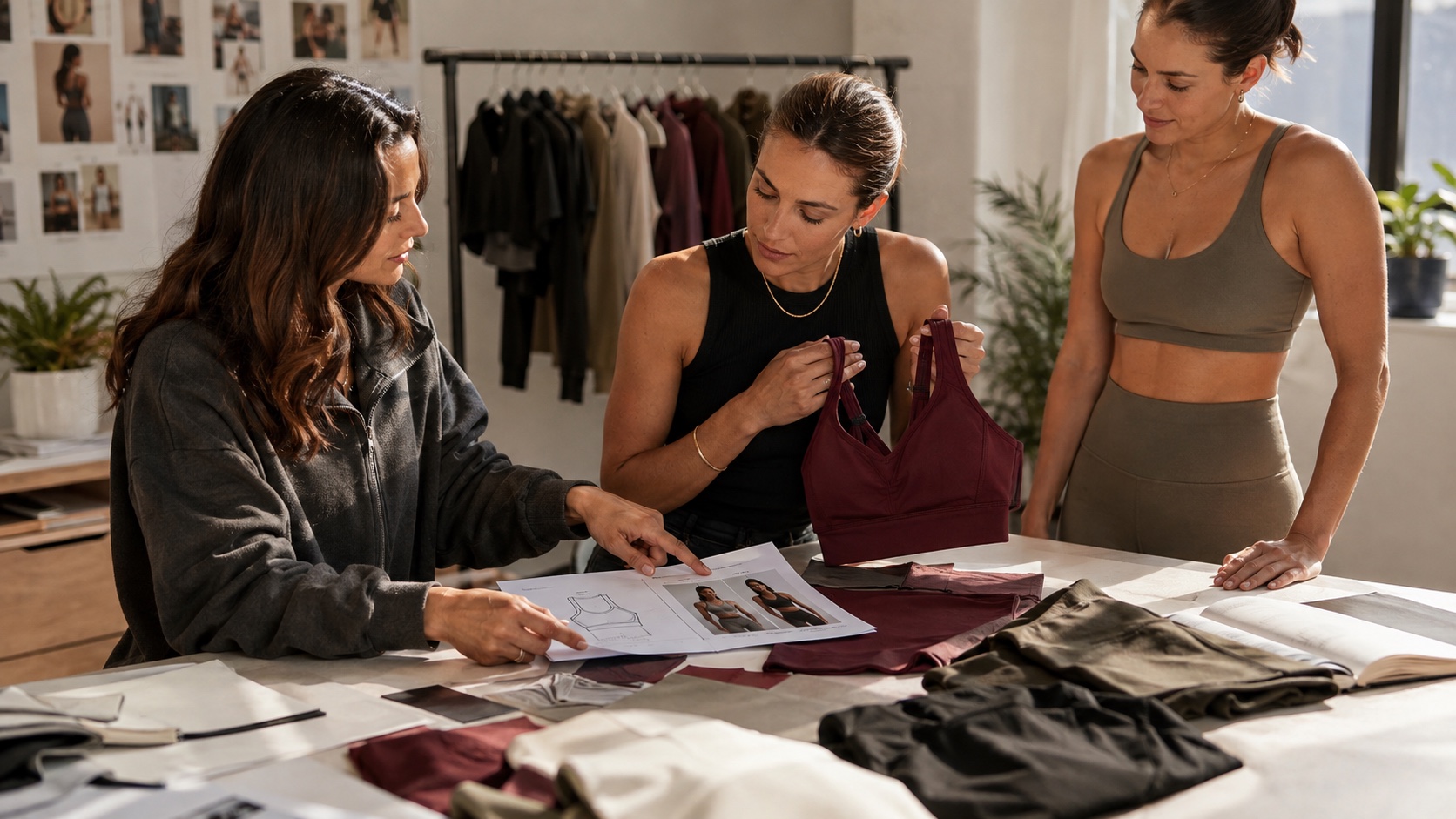
An activewear manufacturer cannot sample “premium, flattering, and a little different” without making a long list of guesses.
Three screenshots do not explain which neckline must stay, whether the waistband should feel firmer, how much coverage the customer expects, or which details are merely mood-board inspiration. The phrase “buttery but supportive” does not identify a fabric either. It describes a reaction you hope the customer will have.
A complete tech pack can resolve much of that ambiguity. Current industry guides from Techpacker and Maker’s Row describe documents containing technical drawings, materials, measurements, construction details, colorways, artwork placement, and revision records. Those records become especially important as a style approaches production.
But a founder who is still defining the product faces an earlier job: start a useful conversation without disguising unknowns as specifications.
Do not send a polished-looking file full of invented decisions. Send a clear brief that shows what is fixed, what can move, and what still needs an answer.
A Starting Brief and a Tech Pack Do Different Jobs
The first document does not have to tell the factory how to make every stitch. It does need to reveal the project clearly enough for the supplier to identify the route, ask intelligent questions, and explain what must be decided before sampling.
| Document | Main job | What it should prevent |
|---|---|---|
| Starting brief | Define the product direction, priorities, known facts, and open decisions | A quotation or sample based on the wrong type of project |
| Development record | Capture decisions and revisions as the sample changes | Old comments, images, and specifications competing with one another |
| Production tech pack | Freeze the approved product in executable detail | Bulk production relying on memory or a chain of messages |
Maker’s Row’s guide separates development, fit, and production packs for a similar reason: the document becomes more complete as the physical product becomes more certain. The exact workflow varies by supplier. The useful principle is simpler—documentation should become more precise as decisions become real.
If your design and measurements are already professionally developed, send the tech pack. If they are not, a one-page brief is more honest than a twenty-page document padded with assumptions.
First Decide What You Are Asking the Manufacturer to Do
Before describing the garment, decide whether you want to select, modify, or develop it.
- Select: You can use an existing silhouette, size set, and available color, then add branding.
- Modify: You like a starting direction, but a meaningful part of the cut, fit, fabric, color, or construction must change.
- Develop: The product requires an original pattern or a new combination of features built around a defined wearer.
This distinction controls the rest of the inquiry. A founder asking to “make this but raise the waist, reshape the back seam, change the flare, and use another fabric” is no longer selecting an existing product. Those changes affect the garment itself.
If that boundary is still unclear, use the five questions in our Ready-to-Custom vs Custom Activewear Development guide before contacting a supplier.
The Nine Details an Activewear Manufacturer Brief Needs
1. Name the wearer and the moment of use
“Women’s activewear” gives the factory almost nothing. “A low-impact Pilates set for women who want secure front coverage and a studio-to-street silhouette” begins to create product priorities.
The use occasion changes the questions. A running bra, a reformer-Pilates top, and an airport-to-studio layer may all look fitted in a photograph, yet they do not need the same support, coverage, pocket placement, or layering behavior.
Write one sentence: This product is for [wearer], during [activity or occasion], and must make [one functional or emotional result] easier.
2. Describe one product, not the whole brand dream
Start with the physical item: high-rise flare legging, longline bra, fitted jacket, tennis dress. Then add the two or three features that make the concept worth developing.
A manufacturer cannot quote a lifestyle. “Quiet luxury wellness collection” is positioning; “matte high-rise flare with a clean front waist and enough length for a 32-inch inseam test” is a product conversation.
3. Sort every reference into Keep, Change, or Inspiration
Reference images are useful when each one has a job.
- Keep: the general neckline depth and front coverage.
- Change: remove the back cut-out and widen the underband.
- Inspiration only: the muted color mood and styling.
Never make a folder called “references” and expect the factory to discover which details matter. Also avoid asking for a close copy of another brand’s distinctive product. Pull apart the problem you want to solve, then create your own combination.
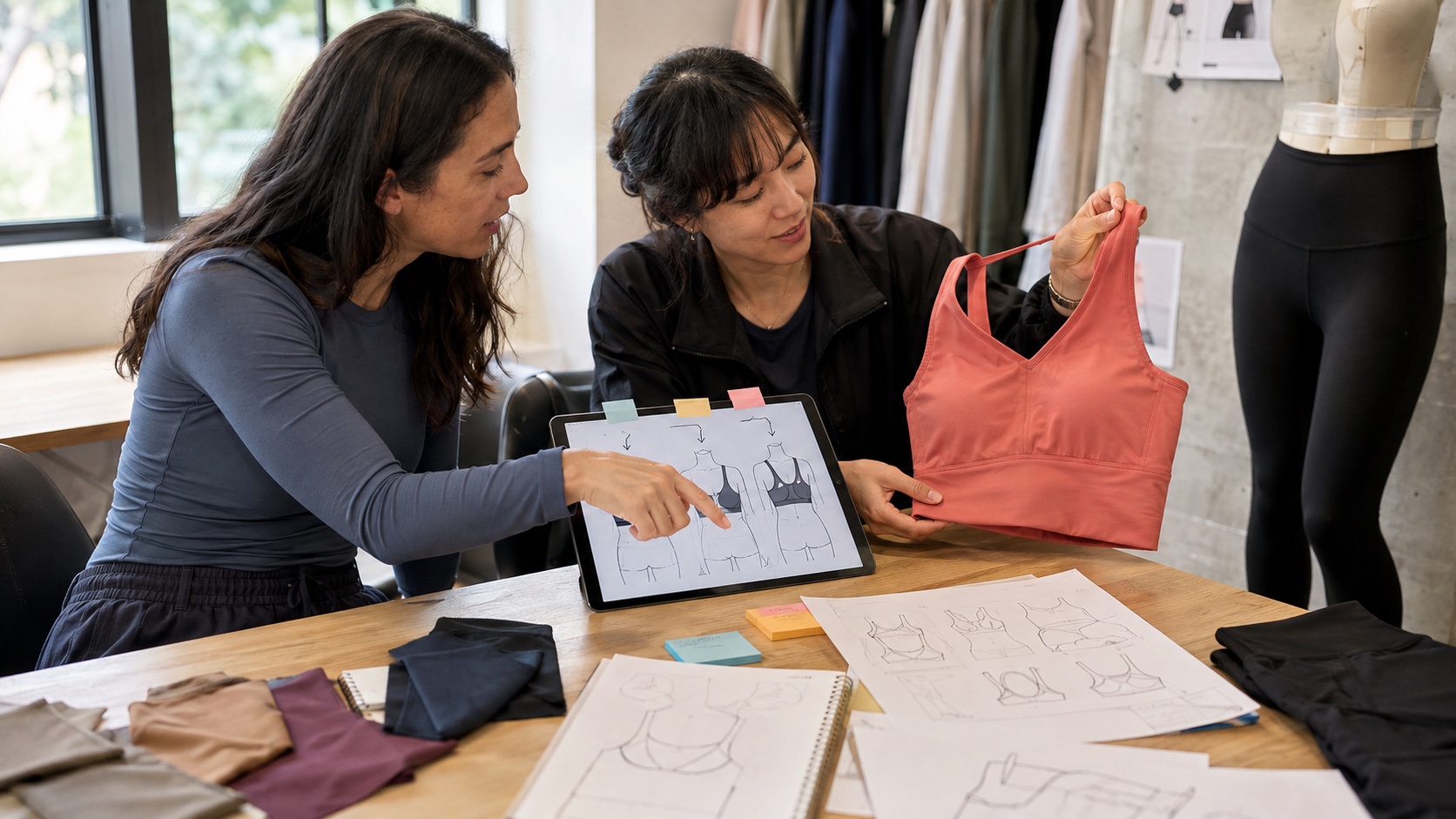
4. Show the garment from more than one direction
A front screenshot cannot explain the back, side seam, crotch construction, inner bra, pocket entry, hem finish, or how a strap connects. Add back and side references when available. Use arrows and short notes instead of a paragraph floating below six images.
If a view is unknown, label it unknown. That gives the product developer permission to propose an option instead of quietly assuming one.
5. Give the fit an anchor
Words such as “snatched,” “relaxed,” and “true to size” are too elastic to control a sample.
A better starting point is one of these:
- a physical garment whose fit you can explain;
- the wearer’s body measurements plus the size being tested;
- a few critical garment measurements taken consistently;
- a clear comparison, such as “same waist position as the reference, but less pressure at the leg opening.”
You do not need to invent an entire graded size chart to begin the conversation. You do need to say who will wear the first sample and what good fit means on that person. Before production, measurements and grading must become controlled information.
6. Replace fabric adjectives with a comparison
“Buttery,” “cooling,” “premium,” and “strong compression” sound precise until two people touch the same fabric and disagree.
Describe the intended use first. Then provide a reference garment or swatch when feel matters. Note what you like about it—surface, thickness, stretch, hold, coverage, drape—and which characteristic matters most. The supplier can narrow mature available options; the garment sample still decides whether the fabric works with the pattern and intended movement.
A fiber percentage alone cannot make that decision for you.
7. Include branding and destination-market facts early
Show the logo artwork if it exists. Mark approximate placement and size. List the main label, size label, care/composition label, hangtag, and packaging you expect, even if the artwork is unfinished.
Also name the country where the product will be sold. Label requirements vary by market. For example, the U.S. Federal Trade Commission’s apparel guidance says most covered textile products need fiber content, country of origin, and responsible-company identity, while the Care Labeling Rule guidance addresses care instructions. Treat this as a prompt to confirm the rules for your destination—not as a complete compliance checklist.
8. Give the commercial context without demanding a final quote
State the expected quantity range, number of styles, color count, size range, selling market, target launch window, and whether this is a test or a repeatable program.
That information helps the supplier judge route and feasibility. It does not entitle either side to a reliable final price before fabric, construction, branding, quantities, and sample requirements are confirmed.
If your budget depends on a particular retail price, share the target. Just do not ask the factory to protect an impossible margin by guessing away important product details.
9. Give the first sample one job
A first sample cannot prove customer demand, perfect every size, confirm bulk consistency, and resolve every aesthetic preference at once.
Choose the main uncertainty. For example:
The first sample must show whether the wider underband stays secure during Pilates movement without creating uncomfortable pressure.
That sentence tells everyone where to look. Secondary comments still matter, but the project has a center.

Use Three Statuses: Fixed, Flexible, Unknown
This is the simplest way to stop missing information from becoming accidental instruction.
| Status | Meaning | Pilates flare example |
|---|---|---|
| Fixed | Changing this would damage the customer promise | High waist, clean front, matte appearance, secure coverage during bending |
| Flexible | The supplier may suggest a workable option | Exact seam finish, stock black fabric choice, logo application method |
| Unknown | The decision requires advice, a swatch, or the first sample | Final waistband firmness, flare opening, exact logo size |
“Unknown” is not an admission of incompetence. An unlabeled unknown is dangerous; a labeled unknown becomes part of the development plan.
Send one current version of the brief. Put the date or version in the filename. When a decision changes, update the document instead of sending a correction that lives only in a WhatsApp thread.
What Can Remain Open at the First Inquiry?
The exact answer depends on the manufacturer and route, but an early conversation can reasonably leave room for:
- the supplier’s recommended stock-ready fabric options;
- construction details that do not define the customer promise;
- the final sample measurements when fit development is part of the project;
- logo method after artwork, fabric, placement, and quantity are reviewed;
- final care wording until material and destination requirements are confirmed;
- price and timing until the project scope is real.
Open does not mean forgotten. Every unresolved item needs an owner and a point at which it will be approved.
When a One-Page Brief Is No Longer Enough
Use a professional tech pack—or develop the documentation into one—when the garment is expected to be produced from settled specifications rather than explored through supplier-assisted development.
That threshold arrives sooner when:
- the construction is unusual or contains several interacting details;
- fit and measurement standards are already proprietary;
- multiple suppliers, teams, or languages are involved;
- the product will be reordered and must survive staff or factory changes;
- you need a controlled record for costing, approvals, inspection, and production.
The brief opens the project. It should not remain the only source of truth after the product has become specific.
How to Start the Conversation With Battlerobe
At Battlerobe, the same one-page brief can lead to two different discussions.
If the fixed requirements can be met by an existing silhouette, predefined sizes, available colors, and confirmed branding options, the Small-Batch Ready-to-Custom route may be the appropriate starting point. Send the preferred product direction, size and color needs, branding files, packaging requirements, and expected quantity. Do not request pattern or fit changes under this route.
If the garment itself must change—or the concept needs an original pattern—the Small-Batch Custom Development route is the relevant conversation. Battlerobe’s current process can begin by reviewing sketches, mood boards, reference images, an incomplete tech pack, or a physical sample. A finished tech pack is not mandatory for the first review.
That does not make every request feasible. Small-batch fabric and color choices remain tied to suitable stock-ready options, and the project still requires confirmation of pattern scope, materials, sample work, MOQ, price, and timing.
Put the nine details above into one folder and include the Fixed / Flexible / Unknown table. That gives Battlerobe enough context to identify what can be selected, what needs development, and what must be answered before a useful quotation or sample can exist.
A Clear Brief Is Allowed to Show Uncertainty
You do not need to know every stitch before speaking with an activewear manufacturer. You do need to stop the supplier from guessing which parts of the idea matter.
Write down the wearer, the use moment, the product, the references, the fit anchor, the material direction, the branding, the commercial context, and the first sample’s job. Then label every important decision Fixed, Flexible, or Unknown.
That is not a substitute for product development. It is how product development begins without pretending it has already finished.
For the larger sequence after the first brief, read Activewear Product Development: From Idea to Production.