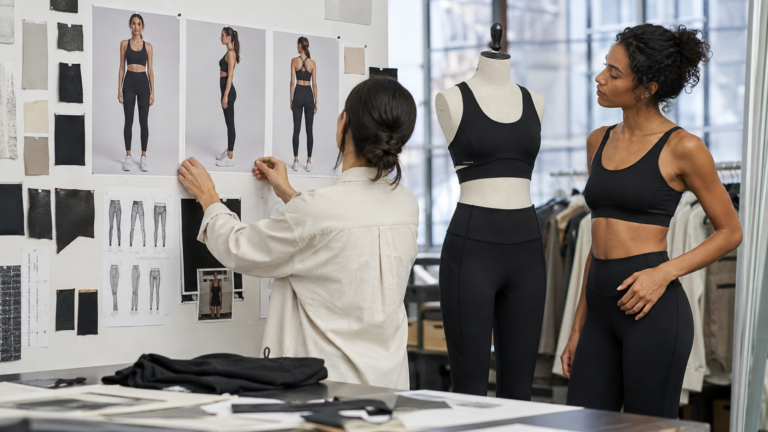


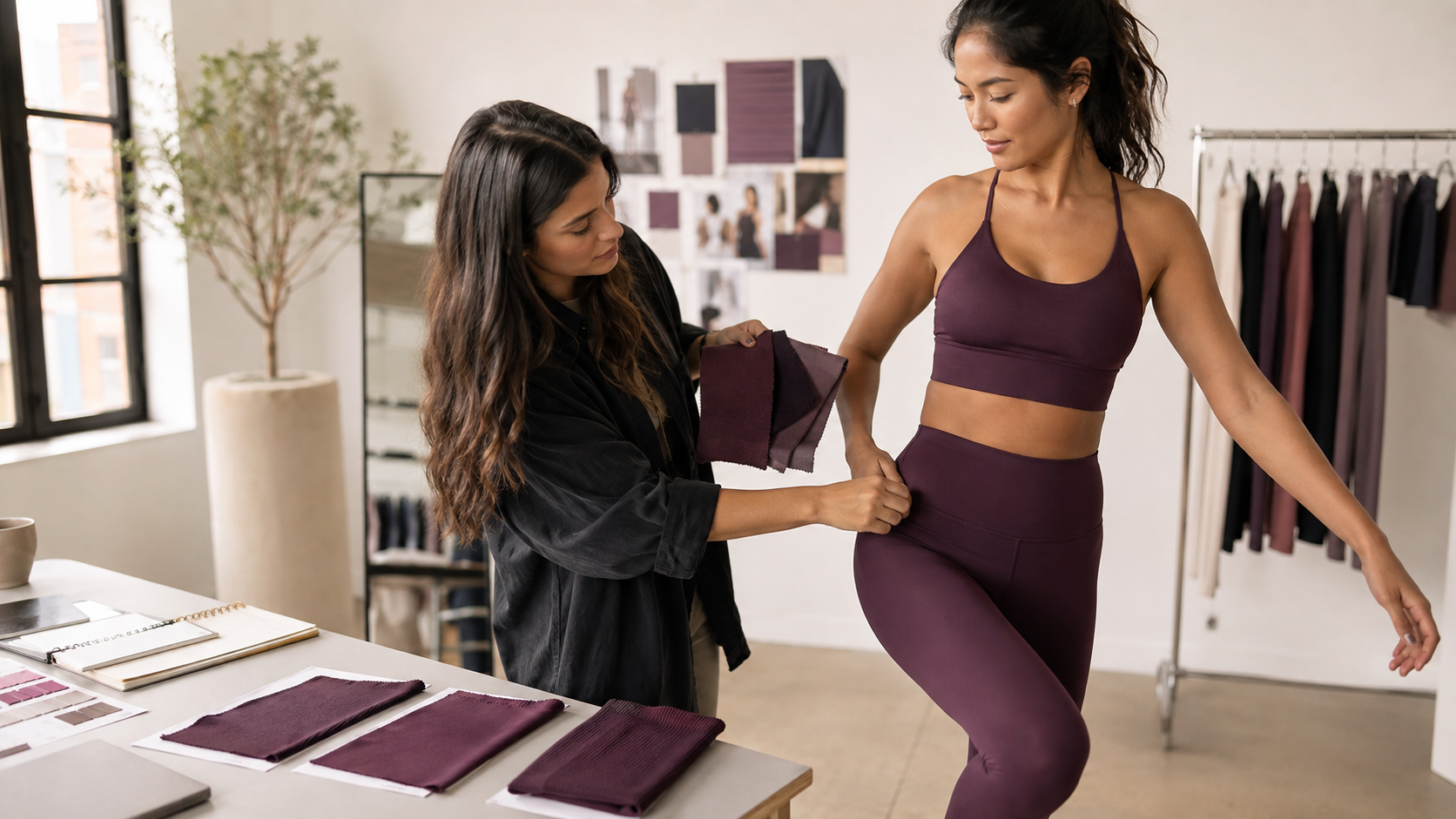
“We want the fabric to feel soft but still supportive” sounds like a useful direction until two people touch the same swatch and describe it differently.
Small activewear brands do not need to develop a new textile to make a good product decision. They need to narrow the choice, compare mature available options against a real reference, and judge the finished garment on the intended wearer.
This guide explains how to choose activewear fabric and fit without turning an ordinary Pilates, yoga, or studio garment into a laboratory project.
Choose the use case before choosing the fabric
Start with what the garment must survive and how the customer should feel in it. A low-impact studio set, a running short, a training legging, and a studio-to-street top may all be called activewear, but they create different priorities.
| Use case | First questions to answer |
|---|---|
| Pilates or yoga | Does it move comfortably, stay covered in bends, and feel pleasant against the body? |
| Training | Does it stay secure during repeated movement and feel sufficiently held without restricting the wearer? |
| Running | Does it remain comfortable during longer movement, manage the intended layering, and carry essentials if needed? |
| Studio-to-street | Does the surface, shape, and drape work both during activity and ordinary wear? |
Fast rule: do not ask a swatch to answer a use-case question it cannot answer. A swatch helps with hand feel and surface. The sample helps with coverage, construction, fit, and movement.
Replace vague adjectives with a comparison card
Before looking at options, write what your words mean in practice. Use a reference garment whenever possible.
| Vague word | Useful comparison |
|---|---|
| Soft | Softer against the skin than the reference legging after five minutes of wear |
| Supportive | Stays where expected during the intended movement without feeling restrictive |
| Premium | Surface, drape, seams, and branding look consistent with the target price and customer |
| Cooling | Feels comfortable in the stated use and climate; confirm through a sample and wear test |
| Opaque | Remains acceptably covered in the exact stretch and movement the customer will use |
None of these descriptions becomes an objective guarantee just because it appears in a brief. They become useful working criteria for a sample.
Compare only a small number of mature options
Too many swatches create the illusion of careful research while delaying the decision. Begin with two or three relevant, available options. Compare them on:
- hand feel against the skin;
- surface appearance under the light where product photos will be made;
- stretch and recovery in the direction the garment needs;
- coverage when held or stretched;
- weight and drape in the intended silhouette;
- how the material behaves around seams, waistbands, or lining.
Do not select a fabric because its fiber percentage looks impressive. Fiber content is useful information, but it does not by itself determine the finished hand feel, opacity, fit, or recovery of a garment.
Small reward: when two options feel close, choose the one that makes the next sample easier to judge. A clear sample is more valuable than a theoretical “best” fabric you cannot confidently compare.
Fit is a relationship, not a property of the fabric alone
The same legging pattern can feel different when the fabric changes. The same fabric can also feel different when the rise, seam placement, waistband, lining, or size changes. That is why “this fabric is supportive” is an incomplete development decision.
When reviewing a fit sample, ask:
- Does the garment sit where the brief says it should?
- Does it stay there during the intended movement?
- Does the wearer feel covered and comfortable?
- Are the seams, waistband, straps, or leg openings creating a local problem?
- Is the issue caused by the fabric, the pattern, the construction, the size, or a combination?
Take front, side, and back photos in a neutral stance, then record the movement that exposes the issue. A fit sheet can help track measurements and changes between rounds; Techpacker’s fit-quality guide explains the role of fit sheets in documenting sample changes.
Run a simple fabric-and-fit test
You do not need a testing lab to make an early product decision. You need a repeatable routine that matches the garment.
Before the movement
Check the garment on the intended wearer from the front, side, and back. Note where the hem, waistband, neckline, straps, and seams sit. Take a close look at coverage under the actual light used for product photography.
During the movement
For a studio legging, use a forward fold, seated twist, squat, leg extension, and a few minutes of ordinary walking. For a top, add an overhead reach and arm rotation. For a training garment, include repeated bending and the movement that makes the wearer most likely to adjust the garment.
After the movement
Ask the wearer:
- Where did you adjust the garment?
- Where did you stop trusting it?
- What felt different after moving for several minutes?
Then classify the issue. “The fabric feels wrong” may mean the garment is too firm, too warm for the use, too transparent when stretched, or simply not the right hand feel for this customer. Make the next comment specific.
When the fabric feels wrong, do not immediately change everything
Change one major variable at a time when possible. If you change fabric, pattern, waistband, length, and size together, the next sample may look better without teaching you why.
Use this decision order:
- If the silhouette is wrong, correct the product shape first.
- If the sample is comfortable but lacks coverage or hold, compare a relevant mature fabric or construction change.
- If the fit is right but the hand feel misses the brief, compare fabric swatches against the approved reference.
- If the problem appears only during movement, record the movement and location before choosing a technical solution.
A subjective preference deserves a physical comparison, not a stronger adjective.
Keep fabric discussion within the real project
For most early brands, the practical job is selecting from suitable existing options and confirming the choice through a sample. It is not custom yarn research, and it is not an exact replication of another brand’s fabric.
When working with Battlerobe, send the intended use, reference garment or swatch, target hand feel in plain language, coverage and hold expectations, and the sample question. Battlerobe can help compare suitable mature options within the project, but fabric feasibility, availability, price, MOQ, and timing need confirmation. A subjective result should remain a sample decision.
If the garment itself is already suitable and you only need available branding options, Ready-to-Custom may be enough. If the fabric choice is connected to a new cut, fit, or construction change, discuss Custom Development.
Make a fabric-and-fit comparison card
Before approving a direction, record:
- intended use and movement;
- approved reference garment or swatch;
- the two or three options compared;
- what changed when the material was stretched or worn;
- the wearer’s comfort and adjustment notes;
- the one change required for the next sample;
- what remains subjective and still needs confirmation.
This card keeps a fabric decision from drifting into memory. It also helps a manufacturer understand whether you are asking for a material change, a fit change, or a clearer comparison.
The sensible way to choose
Choose the use case first. Narrow mature options. Compare with a real reference. Test the finished sample on the intended wearer. Change one major variable when you can. Stop treating adjectives as approvals.
A good fabric decision is not the one with the most technical language. It is the one that lets you say, “This is the option we chose, this is why it fits the product, and this is what the sample still needs to prove.”