


SET Active did not become interesting because matching workout sets were a new invention.
They were not.
The more important question is why a relatively simple product idea became powerful enough to support a recognizable brand, repeated collection drops, a loyal customer base, physical stores, proprietary fabric families, and a community that expects to participate in what comes next.
The answer is deeper than “good colors” or “strong social media.”
The SET Active brand strategy connected four activities that many young fashion businesses keep separate:
a clear everyday customer problem, a product system that reduces decision-making, a community that generates product intelligence, and a launch calendar that turns demand into an event.
That combination is what makes SET Active useful to study. The company did not simply sell clothes to a community it already had. It used the community to decide what to make, used the product to create anticipation, and used each launch to produce another round of feedback.
This is a case study in how a product-led DTC brand can create momentum without pretending that every customer wants to be an athlete.

1. SET Active Found a Gap Between Technical Activewear and Real Life
Lindsey Carter launched SET Active in 2018 after working in social media and spending her days moving between meetings, coffee, errands and workouts in Los Angeles. Her own frustration was specific: existing activewear could be functional, but it did not always make her feel put together when she was not exercising.
In interviews with Hypebae and Shopify, Carter describes the original idea as clothing that could move through the whole day without requiring a complete change of identity or outfit.
That positioning mattered because SET was not initially trying to win a narrow performance category. It was speaking to what Carter later called the “girl on the go”: a woman who wanted comfort and function, but also wanted to feel polished, coordinated and confident.
This was a useful gap in 2018. Many brands were still communicating through specific sport identities: running, yoga, training or gym performance. SET approached activewear as a daily wardrobe system.
What this reveals
The first strategic decision was not “make matching sets.” It was choosing a customer whose problem crossed occasions.
That distinction is important for an emerging brand. If a product is designed only for one activity, the brand may have to keep finding new reasons to be relevant. If it solves a repeated daily problem, the customer may encounter it several times a week.
What a new brand can test
Before developing a collection, define the customer through four connected elements:
Activity + customer + daily context + emotional result.
“Women’s activewear” is too broad. “Pilates clothing” is more specific, but still incomplete. A stronger brief might be:
Activewear for women who move between studio classes, errands and social plans, and want to feel composed without styling a new outfit each time.
That sentence can guide product, photography, creators, colors, packaging and retail partners.
The risk is assuming that a broad lifestyle message automatically creates differentiation. It does not. The daily problem still needs a product expression that customers can recognize quickly.
2. The Matching Set Was a Product Architecture, Not Just a Styling Choice
Carter’s explanation of matching sets is deceptively practical. She wanted to make it easier for customers to feel dressed without spending time coordinating separate pieces. A monochromatic top-and-bottom combination created an immediate visual answer.
SET’s current product pages still make this logic explicit. Its Lux High-Rise Leggings page includes a “Build a Set” feature that recommends pieces that work together. The site is not only selling a legging; it is helping the shopper complete a look.
This changes the economics and the behavior around the product.
A single legging is one item.
A coordinated set is:
- a faster purchase decision;
- a stronger visual unit in photography and video;
- a reason to buy a second matching piece;
- a natural basis for color drops;
- and a clearer way to merchandise a collection.
The matching set therefore performs several jobs at once. It solves a wardrobe problem, increases visual recognition and creates a path toward a higher-value basket.
The transferable lesson
Young brands often think in individual SKUs. Stronger brands think in product relationships.
Instead of asking only, “Can we sell this bra?” ask:
What does this bra connect to, and what does that connection make easier for the customer?
A useful first collection might contain three commercial anchors and one visual hook:
- a dependable legging or short;
- a bra or tank with a clear fit promise;
- a layer that extends the wearing occasion;
- and one product with a distinctive silhouette or styling moment.
The goal is not to manufacture a huge number of options. It is to make the first products explain one another.

The boundary
Matching sets can also create inventory risk. Every color and style combination multiplies the number of variants a brand must forecast. A color that sells in leggings may not sell equally well in bras or tops.
That means a young brand should test color and set behavior before committing to a wide size-and-style matrix. A beautiful collection can still become an expensive inventory problem if the product architecture is not matched by disciplined planning.
3. SET Turned Community Feedback Into Product Intelligence
Many brands say they listen to their customers. SET Active provides stronger evidence of what that can mean operationally.
In its early stage, Carter used a small social following to ask about colors, styles and cuts. She also shared customer reviews and used feedback to shape the products. Shopify’s founder profile describes this process as central to how the early brand developed.
The more recent system is larger but follows the same principle. In a 2026 Entrepreneur interview, Carter described a founder broadcast channel called Linny’s Circle, with about 20,000 members, alongside DMs to the brand’s social accounts. The company’s customer service team tracks recurring reactions, frustrations and requests.
This is where the SET Active brand strategy becomes more sophisticated than ordinary community marketing.
The community is not only an audience for content. It is a distributed product-research department.
Why this works
Activewear has many problems that customers can describe more clearly after wearing the product:
- Does the waistband roll during movement?
- Is the fabric too warm for everyday use?
- Does the color photograph well but feel difficult to style?
- Does the matching top work for different bust sizes?
- Is the product comfortable enough to wear after the workout?
A brand that waits for formal market research may receive this information too slowly. A brand that reads every message without organizing the themes may receive it too chaotically.
The valuable middle ground is to turn conversations into a repeatable system.
A practical feedback system for an emerging brand
Tag every meaningful customer message under a small set of categories:
Fit, fabric, color, missing product, price, use occasion, complaint, return reason and repeat request.
Then review the data monthly:
- Which requests appeared repeatedly?
- Which fit problems are concentrated in one size or construction?
- Which products are customers trying to wear together?
- Which colors are requested but not yet offered?
- Which complaints are isolated, and which cross a meaningful threshold?
This produces better decisions than treating every loud comment as a product brief.
The important caution
Community feedback is evidence, not automatic truth. The loudest customers may not represent the most profitable customers. A frequently requested product may have low repeat potential or high production cost.
The job is to combine qualitative feedback with sales, returns, reorder behavior and margin. SET’s model is useful not because customers decide everything, but because customer signals enter the decision process early.
4. The Brand Made Transparency Part of the Product Experience
SET’s About page describes the company as “community first and a brand second.” It also emphasizes behind-the-scenes access to production planning, photoshoots, business decisions, successes and difficulties.
That positioning is easy to imitate with a few factory videos. The harder part is making transparency useful rather than decorative.
When customers see a color being discussed, a sample being tested or a delay being explained, they gain context around the final product. They are not only seeing an item at the end of the process; they are watching an idea become real.
This creates emotional ownership before purchase.
It also changes the cost of marketing. A production meeting, fit session or color review can become both an internal decision-making moment and a piece of content.
The lesson for product development
Product development and content development should not always be treated as separate departments.
For an emerging activewear brand, a sample review can generate content around:
- why a waistband changed;
- how two fabrics compare;
- what a new color looks like in daylight;
- how a style moves on different bodies;
- why a product is delayed;
- and what the team learned from the last collection.
This is not a reason to expose private supplier information or manufacture fake intimacy. It is a reason to document the decisions that genuinely improve the product.
For customers, the difference between “new leggings available” and “we changed this fit because you told us where it failed” is substantial.
5. Drops Turned Product Releases Into Shared Time
SET Active’s growth is closely associated with collection drops, anticipation and limited colorways. Its 2026 strategy shows how far that system has developed.
In the 2026 Entrepreneur account, Carter said SET planned drops around eight months in advance. She reported that the “No Service” drop generated $1 million in sales in 40 minutes, while “City of Valentine” generated $1 million in four minutes during early access. These are founder-reported figures, not audited financial statements, and the second figure refers to early access before public release.
The numbers are attention-grabbing, but the mechanism matters more than the headline.
A drop creates:
- a known date;
- a reason to follow the brand between purchases;
- a concentrated moment for content and conversation;
- a way to reward loyal customers with early access;
- and a clearer production calendar than continuous, undifferentiated uploading.
The collection becomes an event rather than a product page.

Why unexpected details matter
Carter attributed the City of Valentine performance partly to unexpected color combinations and details such as customer interior tags in the sweats. That suggests an important principle: limited-edition value does not require expensive technical innovation.
It can come from a detail that makes a familiar product feel specific to one moment.
The challenge is that scarcity can quickly become manipulation. If everything is “limited,” the language loses credibility. If demand regularly exceeds supply, customers may eventually experience excitement as frustration.
A safer drop system for a smaller brand
An emerging brand does not need to imitate SET’s scale. It can run a smaller test:
- Announce one collection story three to four weeks in advance.
- Show the product on real bodies, not only polished campaign images.
- Ask the community to choose between a limited number of colors or details.
- Offer a short early-access window to a small loyalty group.
- Track sell-through, size gaps, returns, waitlist requests and repeat purchases.
- Use the results to decide whether the next release should deepen the same product family.
The goal is not merely to sell out. The goal is to learn whether the audience wants the product, the color, the story, the access system or all four.
6. Loyalty Became Participation, Not Just a Discount
SET’s current Rewards program uses TYB to reward both purchases and participation. The program advertises 5% cashback in SET coins, early access to drops, free shipping on drop days, gifts and exclusive wear-testing opportunities. It also includes multiple loyalty levels.
This is strategically different from a basic discount code.
A discount reduces the price of a transaction. A participation program gives customers reasons to return before they are ready to buy again.
They may join a challenge, test a style, vote on a product, wait for early access or watch a behind-the-scenes update. Each activity increases familiarity and gives the brand another behavioral signal.
The strongest part of the model is wear testing. It connects loyalty directly to product quality instead of treating the customer only as a source of revenue.
What an emerging brand should avoid
Do not launch a points system before the brand has a reason for customers to care. Loyalty software cannot create emotional relevance by itself.
First create a product people want to discuss. Then give the most engaged customers meaningful access:
- early sampling;
- fit trials;
- first look at colors;
- studio or community events;
- and honest feedback channels.
The reward should feel like participation in the brand’s next chapter, not only a coupon.
7. SET’s Product System Became More Defensible Than One Viral Color
SET’s current assortment is broader than its early matching-set image. The website organizes products across activewear, basics, sweats, sleep, accessories and several named fabric families, including Luxform, Formcloud, Sportbody and Aeraline.
Its Core Collection keeps a stable base of products and colors, while limited-edition releases refresh the brand and create moments of urgency. The product page for Luxform leggings also explains that the fabric uses 75% nylon and 25% Lycra and is designed with medium-to-high compression. These are product claims made by the brand, not independent laboratory findings.
The strategic value is not simply that SET owns fabric names. It is that the fabric names help customers navigate a growing assortment.
Instead of seeing hundreds of unrelated products, a customer can learn:
- which fabric feels smoothing or compressive;
- which fabric suits Pilates or cardio;
- which pieces are core;
- which colors are seasonal;
- and which items can be built into a SET.
That is a form of product education and a form of merchandising.
The transferable mechanism
A young brand should not trademark a fabric name just to look established. It should first understand whether its materials create meaningful differences in feel, performance or use occasion.
If they do, a clear fabric architecture can make future product expansion easier. If they do not, too many names may create confusion and unnecessary development cost.
8. Physical Stores Came After Digital Community Had Created Demand
SET’s current locations page lists locations in Austin, New York and Los Angeles. Earlier, the brand used a Melrose Place pop-up to give customers a chance to feel its fabrics and experience the community in person, as described by Shopify.
The sequence is important.
SET did not begin by relying on a large store network to explain the brand. It built digital familiarity and then used physical locations to deepen the relationship.
That is a more intelligent use of retail for an emerging brand. A store can function as:
- a fitting environment;
- a fabric education space;
- a content location;
- a customer-research channel;
- a community meeting point;
- and a way to reduce uncertainty before purchase.
The wrong pop-up is expensive inventory in a temporary room. The right one turns existing demand into a richer customer experience.
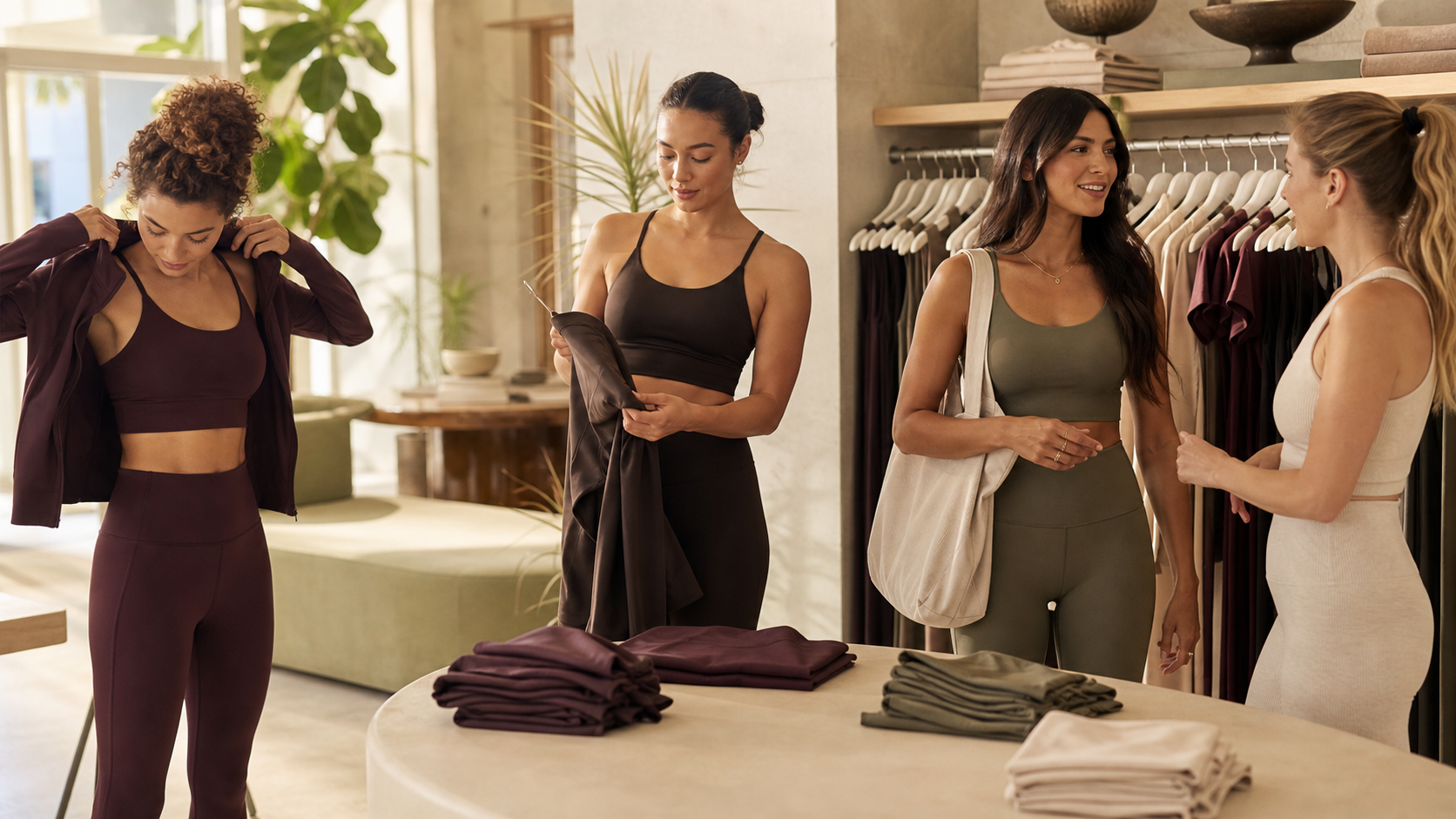
For a small brand, that might mean a weekend activation inside a partner studio, hotel, wellness club or carefully chosen boutique rather than a full store lease.
9. The Hidden Weakness in the Model Is Production Timing
SET’s success also reveals a problem that is less glamorous than community and color.
In the 2026 Entrepreneur interview, Carter said the production orders for the Valentine’s collection had been placed months earlier and were intended to support three to five days of inventory, not three to five minutes. When the collection sold faster than expected, the company could not simply triple production immediately.
This is not a minor operational detail. It is the point where demand creation meets physical reality.
A DTC brand can create urgency quickly. Fabric, dyeing, cutting, sewing, quality control and shipping still operate on lead times.
That creates three risks:
- Underproduction: the brand loses sales and disappoints customers.
- Overproduction: the brand commits cash to colors or styles before demand is proven.
- Fragmented production: too many fabrics, colors and constructions make replenishment slower and quality harder to control.
What a new brand should do differently
The production route should change as evidence improves.
When the brand is testing a silhouette or a collection story, it should preserve flexibility and limit the number of variables. When a specific fit, fabric, color or construction repeatedly earns demand, it becomes worth investing in a more deliberate custom development process.
Once the design is proven, the problem becomes consistency, replenishment, unit economics and quality control. That is where a manufacturing partner such as Battlerobe’s Bulk Custom Production can support confirmed activewear designs, custom fabrics and colors, fit development, branding and larger repeat orders.
The important idea is not to choose the biggest production order at the beginning. It is to match production commitment to the quality of the evidence.

10. What SET Active Actually Built
It would be easy to summarize SET Active as a matching-set brand with strong social media.
That explanation is too shallow.
SET built a loop:
A daily wardrobe problem created a clear product promise.
Matching sets reduced styling friction and created product relationships.
Community conversations generated information about colors, fit and future products.
Behind-the-scenes transparency made the development process visible.
Drops converted product releases into shared moments.
Early access and loyalty rewarded participation and concentrated demand.
Customer service became a real-time research channel.
Physical stores turned digital interest into touch, fitting and community.
Production planning became the constraint that determined how much of the demand could actually be captured.
The brand’s advantage is therefore not one color, one influencer or one matching bra-and-legging combination. It is the connection between these systems.
What Emerging Activewear Brands Should Copy—and What They Should Not
Do not copy SET’s color names, launch language or exact product silhouettes.
Do not assume a community exists because an Instagram account has followers.
Do not create artificial scarcity before you understand your customers.
Do not launch a loyalty platform before customers have a reason to participate.
Do copy the underlying sequence:
- Start with a repeated customer problem.
- Build a small product system rather than unrelated SKUs.
- Give customers structured ways to influence the next version.
- Treat support messages as product data.
- Create a launch rhythm that gives people a reason to return.
- Separate core products from limited experiments.
- Place production commitments after evidence, not before it.
- Use physical experiences only where they add trust, fitting or cultural meaning.
The strongest first test for a new brand is not “Can we sell a matching set?” It is:
Can we create one product family that customers understand, wear repeatedly, discuss with one another and ask us to extend?
If the answer is yes, the brand may have the beginning of a system. If the answer is no, more colors and faster drops will only make the uncertainty more expensive.
Final Takeaway
SET Active’s growth did not come from making activewear more complicated. It came from making the customer’s day simpler, then building a business around what happened after that first simplification.
The matching set made getting dressed easier.
The community made product decisions more informed.
The drop made the next collection worth waiting for.
The loyalty system gave customers a reason to participate before buying again.
And the production constraint made one lesson unavoidable: demand is valuable only if the brand can deliver the product consistently.
For an emerging activewear founder, the most useful question is not “How do I build a community like SET?” It is:
What customer problem can my product solve so clearly that customers want to help me make the next version?
That is where community stops being a marketing slogan and becomes a growth engine.