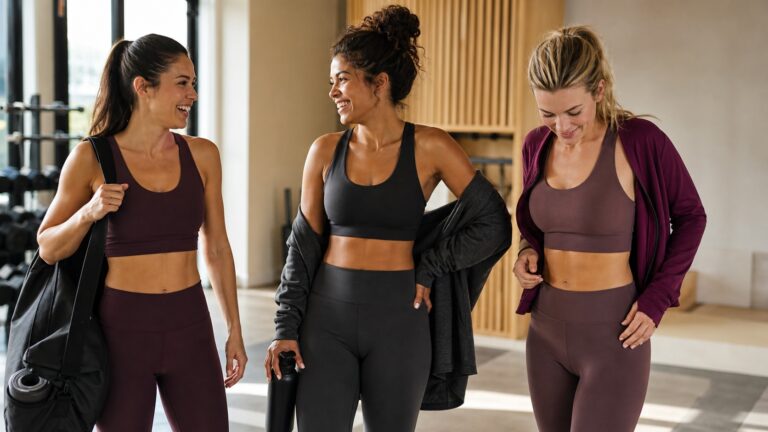



Girlfriend Collective did not make sustainability interesting by attaching a green adjective to ordinary leggings.
Its early proposition was more concrete: show what the garment was made from, explain who touched it, and make the customer part of a visible experiment. An early promotion offered leggings for the cost of shipping, while the company published unusually detailed information about recycled materials, factories, certifications, and production steps. That launch created attention, but attention alone would not have built a durable product relationship.
Today, the brand’s sampled Compressive High-Rise Legging is listed at $108, in sizes XXS through 6XL and three inseam options. The product page calls it a number-one seller, says it uses 25 recycled water bottles, and lists a 79% recycled PET and 21% spandex composition. The page showed a 4.7 rating from 18,553 reviews when researched. Those are current snapshots and brand-hosted signals, not independent proof of impact or causality.
The deeper lesson is this: Girlfriend Collective turned a material claim into a trust and product-development system. Transparency made the first product easier to talk about. A recognizable hero fabric made the claim tangible. Inclusive fit, product families, testing, and circularity efforts gave the promise somewhere to go. The same system also exposes the limits of recycled synthetics, which is why the brand is worth studying seriously rather than repeating as a sustainability success cliché.
The launch was a trust experiment, not just a discount
Secondary reporting on the early launch describes a free-leggings promotion with a $20 shipping charge, more than 10,000 orders on the first day, and a website crash on the second. Nylon’s interview with the founders recorded what happened next: customers received the product, word of mouth spread, and the founders moved toward a full collection of leggings and bras.
The offer was commercially clever because it reduced the risk of trying a new brand. It also created an unusually large sample of people who could judge the actual product rather than the campaign. But it would be a mistake to conclude that a free or near-free product is the engine. The promotion created trial; the product and the explanation had to convert trial into belief.
For an emerging brand, the transferable move is to design a proof event around the claim. If you say a bra is unusually supportive, let a defined group wear it through a defined workout. If you say a fabric survives repeated washing, publish the care protocol and show the result. The customer should be able to understand what is being tested and what would count as failure.
Low-cost proof test: take one hero style, one material claim, and one customer occasion. Offer a controlled early run or sample group. Collect photos and feedback only after use, with questions about fit, comfort, recovery, opacity, pilling, and care. Do not measure only likes. Measure whether the claim survives contact with the body.
“Made from bottles” became a product architecture
Girlfriend’s official About page says the brand’s core fabric families include Compressive, FLOAT, Reset, Luxe, and SuperTrack, and that 100% of its collections use over 75% recycled polyester. This is more strategically useful than a one-off eco capsule. The material idea is organized into a portfolio of sensations and use occasions.
The current Compressive legging is the clearest anchor. The brand describes it as supportive, sweat-wicking, four-way stretch, and designed for high-impact workouts. It adds a hidden pocket, three inseam choices, and a wide size range. These details matter because the material claim is not floating by itself. It is attached to a familiar, valuable garment with specific reasons to choose it.
The commercial insight is not that every product needs a sustainability story as long as this one. It is that a new material or construction should earn a role in the product system:
- Hero: the product that makes the promise understandable and earns trial.
- Companion: a bra, short, or layer that increases use and attach rate.
- Occasion extender: a different product that carries the same trust into another context.
- Proof product: a style where the performance or lifecycle claim can be measured clearly.
Transparency reduced a difficult information gap
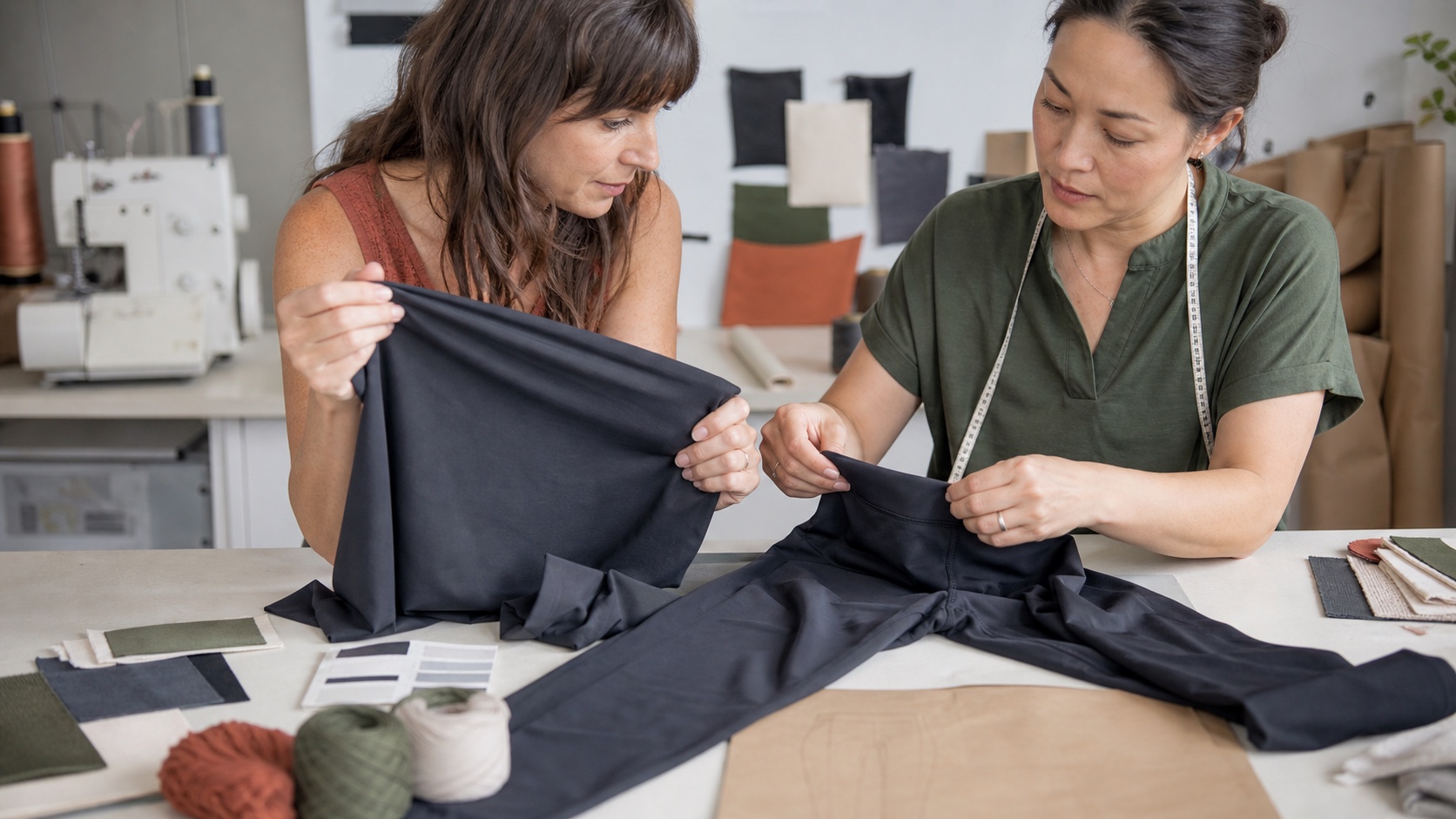
Girlfriend’s transparency is unusually specific in places. The brand says making a pair of leggings involves around 14 pairs of hands. It explains recycled PET, OEKO-TEX Standard 100 testing, PFAS and total-fluorine testing on core fabrics, and the absence of BPA and BPS in the stated recycled PET input.
An independent Nylon interview from the brand’s early period described a Taiwan factory, SA8000 certification, founder visits, and documentation covering recycling, dyeing, cutting, and sewing. It also quoted the founders describing ethical supplier selection as difficult because mills and factories do not always reveal how their processes work.
These sources do not prove that every current product has identical supply-chain conditions. They do reveal a useful trust mechanism: the brand gave customers more nouns and verbs. Instead of “we care,” it offered a fibre, a factory context, a certification, a test, a number of production hands, and a process that could be questioned.
Use this editorial rule: a sustainability page should answer what the material is, where it enters the product, what problem it solves, what trade-off remains, and which evidence is current. If the page cannot do that, the claim is probably still marketing language rather than a product advantage.
Inclusive fit made the trust claim physical
A sustainability promise can create attention, but the customer still has to live in the garment. Girlfriend’s product page offers XXS through 6XL and three inseams for the sampled legging. It also provides guidance for customers between sizes, noting that the compressive collection can feel snug and may relax with wear and washing.
This is an important part of the brand system. Inclusivity is not solved by printing more sizes on a page. It requires grading, fabric recovery, waistband behavior, inseam options, consistent colour, photography, customer support, and a returns process that learns from friction.
The review section provides both positive and negative evidence. Many verified buyers praise comfort, longevity, and fit. Other reviews on the same page describe the garment as too tight or difficult to put on. The 4.7 rating and large review count are meaningful customer signals, but they are hosted on the seller’s own platform and are not a representative market sample.
The actionable lesson is to treat fit feedback as product data, not reputation management. Sort returns and reviews by body measurement, height, activity, size purchased, and specific complaint. If “too tight” appears in one size block or one colour, investigate fabric recovery and grading before assuming the customer chose incorrectly.
The circular story is where the easy narrative breaks
Recycled polyester can reduce reliance on virgin input, but it does not turn a synthetic garment into a circular garment automatically. Spandex blends complicate fibre separation. Washing can release microfibres. Dyeing, transport, durability, care, and end-of-life all remain part of the product’s impact.
Girlfriend’s public materials acknowledge some of this complexity by discussing fabric testing, care, and take-back or upcycling initiatives. A press release about ReGirlfriend described collecting old Compressive products, working with a North Carolina partner, and offering a $15 store credit. The existence of a programme does not tell us its current scale, recovery rate, or total lifecycle benefit.
This is not a reason to dismiss the brand. It is a reason to raise the standard for new brands. The strongest sustainability claim is often narrower than the founder first wants to make. “Our core legging uses 79% recycled PET and is OEKO-TEX certified” is inspectable. “This is a zero-impact legging” is not a responsible claim without a much larger evidence base.
Decision rule: make one material commitment specific enough to verify, then publish the trade-off beside it. If your recycled fabric is less soft, disclose the use case. If elastane makes recovery possible but recycling harder, say so. Credibility increases when the customer sees the boundary.
Performance has to outrank the material headline
The brand’s own product page shows why. The Compressive legging is sold as a high-impact product with support, sweat-wicking, opacity, stretch, and a pocket. The recycled input is part of the value proposition, not the entire proposition.
This matters because a garment that does not fit or perform will be returned, replaced, or abandoned regardless of its fibre story. A responsible product system therefore has two gates:
- Performance gate: fit, recovery, opacity, seam strength, comfort, wash behavior, and activity suitability.
- Evidence gate: material percentage, certification, supplier process, claim wording, and end-of-life route.
Do not use a sustainability claim to excuse an unresolved fit problem. Do not use a good fit to hide a claim that cannot be supported. The product has to pass both gates.

What the Girlfriend case proves—and what it does not
The public evidence supports several conclusions:
- A specific material and process claim can make an unfamiliar product easier to understand and share.
- A hero product becomes stronger when the claim is attached to performance, fit, price, and use occasion.
- Transparency can function as customer education and risk reduction, not only corporate reporting.
- Inclusive sizing and material families turn a campaign idea into a repeatable product system.
It does not prove that recycled material caused all sales, that a free-legging launch creates durable loyalty, or that the brand’s current impact is lower across every dimension. Public sources used here do not provide audited revenue, cohort retention, current take-back volume, or product-level return rates. The early launch figures are reported by secondary sources and should be treated as historical signals.
The strongest alternative explanation is that the promotion created a large first wave and the product’s attractive, inclusive basics carried the brand forward. That explanation may be partly true. It makes the practical lesson stronger: material transparency should be tested alongside fit, construction, price, and retention rather than treated as the sole engine.
From a material idea to a production brief
A founder applying this lesson should start with one specific promise. Define the target customer and activity, then specify the fabric composition, handfeel, compression, stretch, recovery, opacity, care, and acceptable trade-offs. Decide which claims can be supported now and which require testing or certification.
Battlerobe can support the practical development conversation when the idea moves from material story to garment specification. Bring the fabric reference or required composition, the target size range, intended activity, construction details, branding, labelling needs, first quantity, and test plan. Small-batch custom development is the sensible route when the fit and fabric are still being proven; bulk production belongs after the approved product passes the performance and evidence gates.
Track:
- fit and return reasons by size and inseam;
- opacity, pilling, colourfastness, and recovery after defined washes;
- conversion on the material explanation page versus the product page alone;
- repeat purchase of the same fabric family;
- the percentage of customers who understand the claim without overstating it.
The decision
Girlfriend Collective’s real advantage was not owning the word “sustainable.” It made the customer feel that the product could be inspected. A recycled input, a named fabric, a size range, a factory explanation, a test, and a take-back effort each reduced a different kind of uncertainty.
This strategy suits a founder willing to make fewer, clearer claims and support them with product work. The first test is one hero product whose material, fit, performance, and evidence can all be explained on one page. Scale when customers buy the product for the intended use, return reasons improve, the claim survives scrutiny, and production can repeat the specification. Stop when the sustainability story requires more adjectives than evidence—or when the product cannot earn its place on the body.
Sources and evidence notes
- Girlfriend Collective: materials, manufacturing, testing, transparency and impact claims
- Girlfriend Collective: current Compressive High-Rise Legging product, price, size, reviews and composition snapshot
- Nylon: early launch, supplier transparency and founder interview
- iki Directory: historical account of the launch promotion and supply-chain overview
- ReGirlfriend press release: take-back and upcycling initiative description