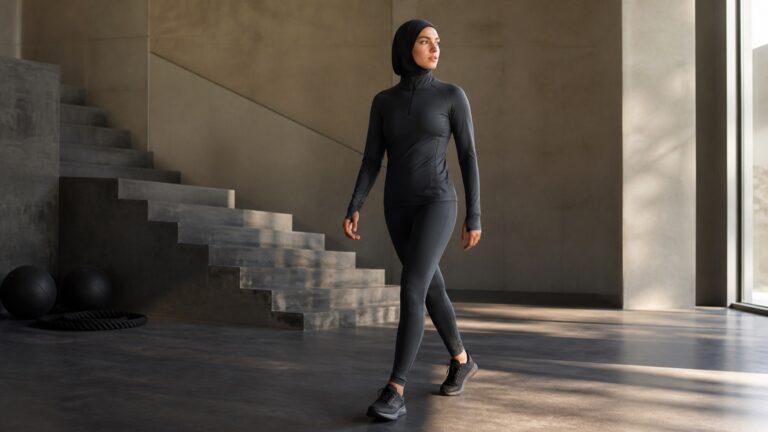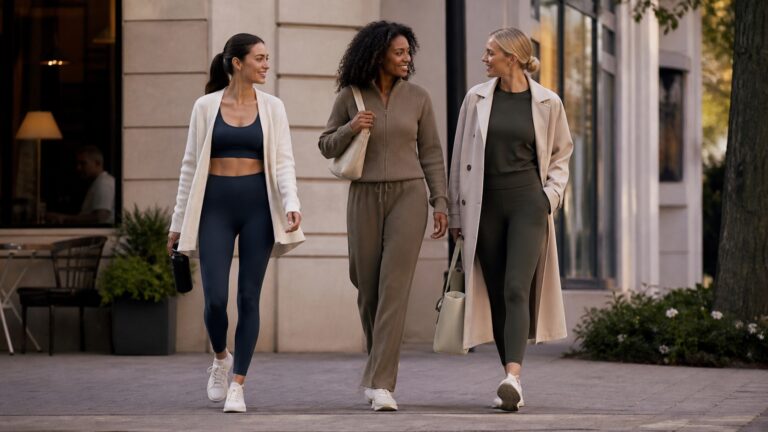


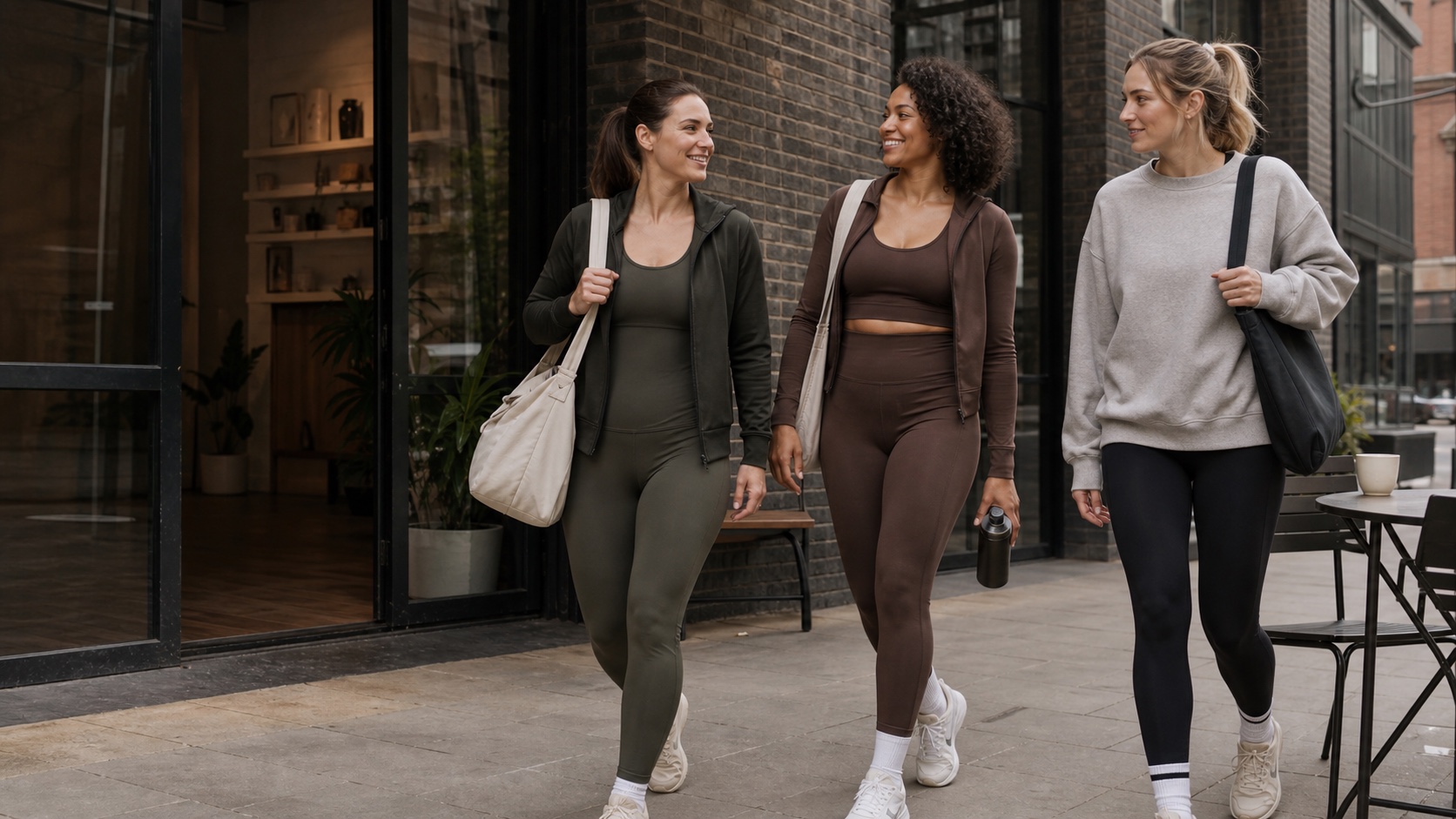
Adanola did not make leggings interesting by inventing a more complicated legging.
It made a simple activewear product unusually easy to repeat.
That is the central idea behind the Adanola brand strategy: turn a reliable core product into an everyday uniform customers can recognize, wear, and buy again.
That is the more useful way to read the Adanola brand strategy. The visible story is familiar: neutral colours, clean silhouettes, matching sets, celebrities, social media, and a soft studio-to-street mood. The deeper story is a commercial system that asks a better question than “Will someone buy this once?” It asks: Can one good product become the default answer for several moments of the customer’s week—and can the brand give her a reason to buy it again?
Adanola’s public evidence cannot prove that one tactic caused all of its growth. Its revenue, margins, retention, supplier relationships, and sell-through by SKU are not publicly disclosed. But the available record does reveal a coherent mechanism: a hero product, a restrained visual code, practical fit options, everyday versatility, social proof, selective expansion, and a loyalty layer that turns buying into an ongoing relationship.
That mechanism is what an emerging activewear founder can study. The lesson is not “make minimal leggings.” It is “design a uniform engine that makes the next purchase feel obvious.”
Adanola found the space between technical activewear and ordinary clothing
Adanola was founded in Manchester in 2015 by Hyrum Cook and his brother Josh, according to Vogue’s 2024 report. In a later Equinox interview, Cook described a gap between activewear and lifestyle: people wanted to invest in clothes they could wear for exercise, errands, and the rest of the day.
That gap sounds obvious now because the customer behaviour is already normalized. But it is strategically important. A performance-first brand usually optimizes for the activity: running, lifting, training, or yoga. A fashion-first brand may optimize for the look but leave the customer to solve movement, comfort, and recovery. Adanola’s proposition sits in the middle: the garment should work hard enough for everyday movement and look composed enough to remain in the outfit after the session.
The company’s own language makes this explicit. Its About page describes activewear and wardrobe essentials designed for “working out, hanging out and everything else in between.” Its current careers site goes further, calling the goal to become the “go-to destination” for an everyday uniform and describing a community that extends beyond activewear into real-life events.
The first reader payoff: define your opening as a conflict between two existing categories, not as a demographic. “For women aged 25–35” is a customer description. “Technical enough for a reformer class, polished enough for brunch” is a buying situation. The second description gives you a product and content brief.
There is also a boundary. “Studio-to-street” is now a crowded phrase, and a lifestyle claim does not automatically create demand. The customer still needs a reason to believe the garment fits, feels good, lasts, and can be worn in more than one context. Adanola’s advantage therefore cannot be explained by positioning language alone.
Adanola brand strategy: the hero product became a repeatable unit
Cook told Equinox that the Ultimate Leggings launched in 2020 as the brand’s first best-selling product and that more than one million pairs had been sold by the time of that interview. That number is a founder-reported claim, not an audited disclosure, but the sequence is revealing: Adanola had existed for several years before the product that clarified its wider opportunity.
The current US product page lists the Ultimate Leggings at $65, with regular, tall, and 7/8 lengths, sizes XXS through XXXL, a high-rise waistband, no front seam, medium compression, four-way stretch, and a 79% polyamide/21% elastane composition. These are brand-stated specifications; they are not independent lab results. Their strategic importance is that they reduce several forms of purchase friction at once:
- the customer can understand the main use case quickly;
- the product has a recognizable name and a stable family;
- length options acknowledge that one inseam does not serve every body or styling preference;
- the garment can be paired with a bra, tank, sweatshirt, or everyday layer;
- the same core idea can return in another colour without feeling like a completely new decision.
That is the difference between a hero SKU and a hero unit. A SKU is an item in a catalogue. A hero unit is an item that organizes the catalogue around itself.
Try this now: draw a three-ring product map before adding your next style. Put the acquisition product in the centre. Around it, add two products that increase the number of outfits, then one layer that extends the wearing occasion. If a proposed item does not strengthen the centre or open a valuable new occasion, it may be adding catalogue noise rather than customer value.

Simple design only works when it is operationally specific
Adanola’s visual language is deliberately quiet: streamlined shapes, neutral and earthy colours, minimal decoration, and a small number of recognizable branding treatments. Who What Wear’s 2025 product review described the brand as stripping activewear back to basics, with no unnecessary zips, straps, or drawstrings. Marie Claire similarly emphasized simple, elevated designs that mix and match.
“Simple” is often misunderstood as “easy to make.” In apparel, the opposite can be true. When the garment has fewer visible details, the customer notices the remaining details more intensely: waistband height, side seam placement, opacity under stretch, recovery after washing, length at the ankle, the softness of the hand, and whether a sweatshirt keeps its shape.
Adanola’s current product pages show the brand trying to make these details legible. The Ultimate Leggings page names the fabric family, compression level, stretch direction, rise, and length options. The current Ultimate Tank Bra lists bonded adjustable straps, removable padding, medium compression, a four-way stretch fabric, and the same broad XXS–XXXL size architecture. Again, these are product-page claims, not independent performance certification. But they show a useful merchandising discipline: the customer is given concrete reasons to understand what “everyday” means.
There is a product-development consequence here. A minimalist product should not be sampled only for appearance. It should be tested in the movements and moments that define the promise:
| Promise | What to test | Signal to record |
|---|---|---|
| Moves with the body | Squat, sit, walk, stretch, and transition between activities | Pulling, twisting, riding down, or restriction |
| Works across the day | Wear from class to commute or errands | Heat, pressure, transparency, comfort, and styling confidence |
| Can be bought again | Wash and repeat-wear cycles; compare colours and matching pieces | Recovery, pilling, colour consistency, and set attachment |
| Fits a broad audience | Multiple bodies and lengths, not one fit model | Return reasons, alteration needs, and size/length confidence |
The small reward: if your brand uses the word “premium,” replace it in the product brief with three observable behaviours. For example: “does not become sheer when stretched,” “keeps its shape after repeated washing,” and “does not need constant adjustment.” That forces the claim into a development test.
Colour and logo become a memory system
Adanola’s restraint is not the absence of branding. It is a controlled branding system. The current site organizes shoppers by product family, fabric, trend, and colour, including shades such as black, coffee bean, damson red, midnight blue, olive green, and grey. The site also groups the assortment into recognizable families such as Ultimate, Classic Seamless, Seamless, Pilates, and Yoga.
This creates a quiet signal. A customer can see a familiar tone, applique, silhouette, or fabric family in another context and connect it to the brand without needing a large logo. The signal becomes stronger when the product is worn repeatedly in public places: the class, the coffee shop, the airport, the supermarket, and the office commute.
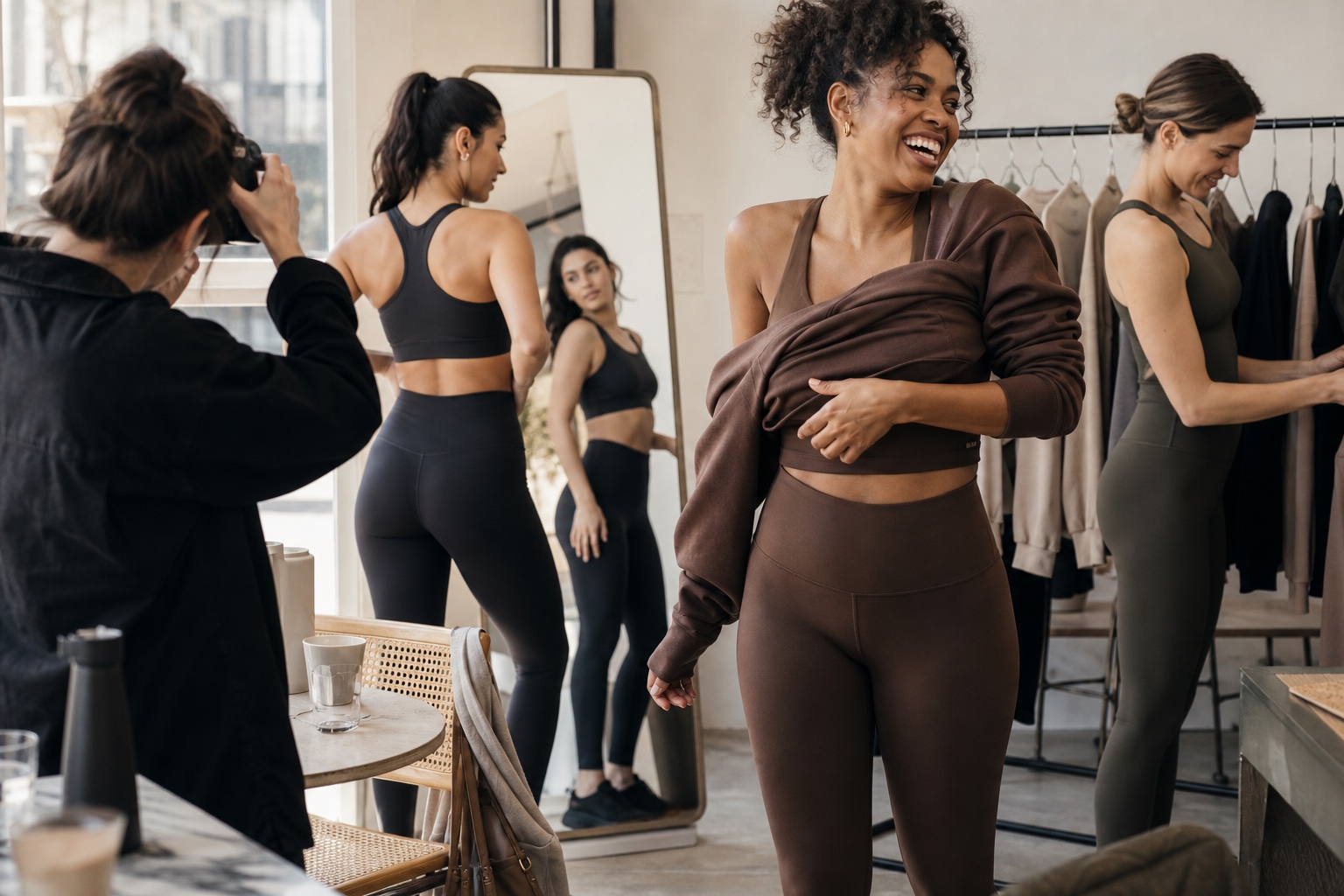
Colour also performs a commercial job. A black legging can be an entry purchase. A new seasonal colour can create a reason to return without forcing the customer to learn a new fit. A matching tank can be an attach purchase. A sweatshirt can extend the same visual code into a different temperature, occasion, or margin structure.
But the system has a cash risk. Eight sizes, three lengths, multiple colours, and several top shapes can create a large style × colour × size × length matrix. Breadth may improve the customer experience while quietly increasing the number of units that need to be forecast, replenished, photographed, stored, and quality-checked.
Use this decision rule: divide colours into core, seasonal, and experimental. Keep the core colours available on the hero product. Test seasonal colours on a narrower product set. Use experimental colours only when content or preorder evidence can justify the inventory risk. A broad colour menu is not automatically customer-centric if the most important sizes are repeatedly unavailable.
The growth loop is stronger than celebrity reach
Adanola has benefited from visible cultural distribution. Equinox’s 2025 interview mentions high-profile partners and appearances on Kaia Gerber, Emily Ratajkowski, H.E.R., and Kendall Jenner. Vogue reported that the brand worked with lifestyle influencer Stephanie Shepherd to build awareness in the United States. Marie Claire described celebrity approval, social-media growth, and fast sell-outs as part of the popularity story.
Those signals matter, but they should be separated into two jobs:
- Discovery: a recognizable person makes a simple garment worth noticing.
- Conversion and retention: fit, price, use occasion, availability, and brand memory give an ordinary customer a reason to buy and later return.
The distinction is important because a celebrity can make a product famous without making it repeatable. The more defensible hypothesis is that visibility accelerated a product system that was already easy to understand. The current public evidence supports the presence of both social proof and a strong core assortment, but it cannot tell us the exact contribution of either one.
An external product signal helps test the hypothesis. Who What Wear reported almost one million Instagram followers and nearly 10,000 positive reviews on the signature style in 2025. Its editor tested two best-selling leggings across more than 50,000 steps and praised the fabric’s stretch, recovery, and durability while also noting the synthetic composition and the difficulty of choosing the right size and length online. That is one reviewer’s experience, not a representative customer study, but it includes the friction a pure marketing story tends to omit.
Run a discovery-versus-retention test: publish two content groups for the same product. Group A shows the visual identity and styling across three everyday contexts. Group B shows fit, fabric, movement, care, and length decisions. Track saves, click-through, add-to-cart, size-guide visits, returns, customer questions, and repeat purchases separately. If Group A wins attention but Group B wins conversion or lower returns, you have found the operational content your brand needs to scale.
Adanola turns retention into access, not only discounts
The current Adanola Rewards Club FAQ says members can earn points for joining, signing up for the newsletter, submitting a birthday, and purchasing. The published terms describe three tiers, with benefits including first looks at new collections, birthday offers, VIP event access, and free or express shipping at higher levels.
There is a simple insight inside this program: loyalty is not just a percentage-off mechanism. It gives the customer a reason to stay close to the product calendar. If the customer likes the core fit and expects new colours, restocks, events, or limited access, the brand becomes a place to revisit even when she does not need a completely new category.
That helps explain why a plain product can support a wider brand system. The garment creates satisfaction; the colour and collection rhythm create anticipation; the membership program creates permission to return. Whether this produces profitable retention is not publicly established, and rewards can also train customers to wait for incentives. The point is not to copy the points table. The point is to identify the behaviour your loyalty layer is meant to reinforce.
Choose one retention behaviour: repeat the same hero fit in a new colour, complete an outfit with a matching layer, return for a restock, attend a community event, or refer a friend. Build the reward around that behaviour and measure it directly. If the only measurable result is coupon redemption, you may have built a discount system rather than a loyalty system.
Selective growth protected the uniform from becoming a catalogue
One of the most revealing details in the public record is not what Adanola launched but what it declined. Vogue reported in 2024 that the brand was stocked at Selfridges, Harrods, Ounass, and select Soho Houses, while Cook said the company turned down many retail partner requests and orders. The same report described Cook moving away from the CEO role, remaining focused on brand, product, and community while Niran Chana took responsibility for strategy, growth initiatives, and team building.
This is not proof that saying no caused growth. It may also reflect capacity limits, negotiation choices, or the need to protect a young operation from service failures. But it is consistent with a useful strategic principle: a brand built around a repeatable uniform can be weakened by indiscriminate availability and uncontrolled category expansion.
Vogue also reported that menswear was off the table at that point, even as the business saw headroom in existing categories and territories. The choice suggests prioritization: deepen the system that already makes the brand legible before adding a new customer, new fit block, new merchandising logic, and new inventory problem.
Ask before you expand: is the new category increasing customer occasions, or is it merely increasing the number of products? If it increases occasions, define the connection to the hero product. If it only increases choice, improve the current product, fit guidance, replenishment, and content first.
The operating constraint becomes even more visible when product updates are involved. Who What Wear noted that Adanola’s Ultimate range had been reworked with changes to fabric, fit, finish, and bonded bra straps. The current Adanola Tank Bra page contains positive product specifications, but it also displays mixed customer comments about a changed fabric and an older design feeling more secure for some wearers. These are small, non-representative signals, yet they illustrate a large risk: a core product is a promise accumulated over time. Improving it can create friction if existing customers feel that the familiar hand feel or support has disappeared.
Operational checkpoint: before changing a proven core fabric or fit, separate “new customer improvement” from “existing customer continuity.” Test both. If a change is necessary, communicate what changed, why it changed, which measurements remain stable, and whether the new version should be treated as a new product rather than a silent replacement.

What an emerging brand should copy, build later, and avoid copying
Test now
- Write one customer occasion that your product makes easier across at least two parts of the day.
- Choose one hero product and one stable product family name rather than launching a disconnected mini-collection.
- Test one fit across two or three lengths before multiplying colours and silhouettes.
- Produce content that proves the product in movement, at rest, and in a styled everyday outfit.
- Measure size-guide visits, returns by size/length, set attachment, restock requests, and repeat purchase—not only likes.
Build after proof
- Expand the hero fabric into matching tops, layers, and adjacent occasions once the fit and care experience are stable.
- Introduce a core/seasonal/experimental colour architecture when demand is visible enough to protect cash.
- Add loyalty benefits after you know which behaviour—replenishment, colour return, set completion, or event participation—you want to reinforce.
- Use selective wholesale or physical experiences when they solve fit confidence, awareness, or community access rather than simply adding doors.
Do not copy directly
- Celebrity placement as a substitute for product proof.
- A large size and colour matrix without a replenishment and quality-control plan.
- Minimal branding without a recognizable fit, colour, fabric, or styling code.
- Rewards points that create discount dependency but do not increase meaningful customer behaviour.
- Silent changes to a best-selling fabric or fit that existing customers already trust.
Where Battlerobe becomes relevant
The natural production question raised by Adanola is not “Can a factory make a black legging?” It is “Can a simple product remain consistent when the brand repeats it across sizes, lengths, colours, matching pieces, and replenishment orders?”
That requires more than copying a reference image. It requires a development brief that identifies the intended hand feel, stretch and recovery, opacity, compression, rise, inseam options, waistband behaviour, branding method, colour standard, care instructions, and inspection points. It also requires deciding which details are non-negotiable and which can be simplified to protect price, lead time, and inventory.
Once a product has a validated customer occasion and a proven fit direction, Battlerobe’s bulk custom production service can be relevant to the next stage: coordinating fabric and colour, branding, sampling, bulk production, quality control, and repeat orders for an approved activewear style. The value is not the promise of a magic product-market fit. It is a controlled path for keeping the product promise intact as the order becomes real.
The boundary matters. If the concept is still uncertain, a founder should reduce variables and validate the product before committing to breadth. A production partner cannot decide whether the customer will return, whether a new colour deserves inventory, or whether a logo will become a memory signal. Those are commercial decisions. The production role begins when the decision is specific enough to develop, test, approve, and reproduce.
Prepare this before requesting a sample: send one reference garment or visual direction, the target customer occasion, intended fit and size/length range, fabric hand-feel priorities, branding placement, expected first quantity, and the three tests that determine approval. That brief is more useful than sending ten unrelated screenshots and asking for “something similar.”
The decision: build a default, not just a bestseller
Adanola is valuable to study because it shows how an emerging brand can take market share without making every product visually loud or technically novel. Its public story is not enough to prove that the everyday-uniform model caused the company’s growth, but the evidence is coherent: the founder identifies a lifestyle gap; a named hero legging becomes the anchor; product pages make fit and fabric choices legible; colours and matching pieces create repeatable variation; social proof drives discovery; a loyalty system creates reasons to return; and selective expansion protects the system from becoming incoherent.
The strongest transferable idea is therefore not minimalism. It is repeatability with memory: the customer remembers how the product feels, recognizes the visual code, knows how to style it, and can buy the next version without relearning the brand.
If we were testing this model for a new activewear brand, we would run a six-week proof cycle:
- Interview 10–15 target customers about the exact day or routine in which activewear replaces ordinary clothing.
- Choose one hero product, one matching product, and one layer; hold the fabric family and core colour stable.
- Develop and wear-test the smallest and largest intended sizes plus at least two lengths where relevant.
- Create content for three occasions and two evidence types: visual styling and functional proof.
- Launch a small batch or controlled preorder with a clear delivery, care, and returns promise.
- Scale only if customers can explain the use occasion, the product survives the agreed tests, and repeat or restock signals appear without relying entirely on discounts.
Stop or revise the idea if the audience loves the image but cannot explain when they would wear it, if returns cluster around fit or length, if matching pieces do not attach, or if the core product requires too many colours and variants to stay available.
That is the Adanola lesson worth carrying forward: the most powerful activewear product may not be the one people admire once. It may be the one they reach for so often that the brand becomes part of how they move through an ordinary day.
Sources and further reading
This case study combines official brand and product pages, a current loyalty-program description, founder/company interviews, and independent editorial product coverage. Founder and company statements are labelled as reported claims; official fabric and performance specifications are treated as brand-stated product details. The public record does not establish Adanola’s audited revenue, profitability, cohort retention, supplier identity, gross margin, or the causal contribution of celebrity exposure.
- Adanola: About Us and everyday-uniform positioning
- Adanola: current collections, product families, colours, and categories
- Adanola: Ultimate Leggings product page
- Adanola: Ultimate Tank Bra product page
- Adanola: Rewards Club FAQ
- Adanola: Rewards Club terms and tiers
- Adanola Careers: everyday uniform and community mission
- Equinox: interview with founder Hyrum Cook
- Vogue Business: founder/CEO transition and selective expansion
- Who What Wear: independent Adanola leggings review
- Marie Claire: reported bestseller and social-growth signals