

TALA did not become interesting because “sustainable activewear” was a new phrase.
It became interesting because the phrase was attached to visible product decisions: recycled and lower-impact fibres, named fabric families, clear use occasions, fit information, and a founder who already knew how to make a young audience pay attention.
That is the useful way to study the TALA brand strategy. The brand’s public story contains a familiar sequence—Grace Beverley’s creator audience, an early sell-out, sustainability language, flattering activewear, social distribution, and later wholesale and store expansion. But the deeper mechanism is a loop: a material claim creates curiosity, a product makes the claim tangible, testing determines whether the garment earns trust, and trust creates permission to buy the next product.
There is a necessary warning inside the same story. Accounts-based reporting says TALA’s revenue rose 19% to £19.8m for the year ended March 31, 2025, but the company also reported a wider operating loss, depending on the accounting measure cited. Wholesale, physical stores, logistics changes, and US tariff pressure create new costs and complexity. Growth has expanded the promise; it has not automatically made the promise easier to keep.
So the central lesson is not “use recycled fabric.” It is: build a sustainability proof-to-product loop that can survive the mathematics of scale.
What TALA actually had to solve
TALA entered a market with two credibility problems.
First, activewear had become visually desirable, but responsible production was often explained in vague language. A brand could say “conscious,” “eco,” or “better materials” without giving the customer enough information to understand what changed in the garment.
Second, sustainable fashion was often associated with a higher price, a narrow aesthetic, or a compromise in performance. For a young customer buying leggings, the practical questions arrive before the moral ones: Will they feel good? Are they opaque? Will the waistband move? Can I wear them to Pilates, coffee, travel, or work? Do they come in my size and length?
TALA’s official About page describes an industry underserved on sustainability, particularly at an accessible price, and says its aim is to create flattering active-inspired pieces customers feel good in and about. That is positioning, not independent proof. But it reveals the problem the brand chose: make responsible choices compatible with desirability and ordinary use.
Reader action: rewrite your own brand problem as a tension between two things the customer already wants. “Sustainable activewear for women aged 20–35” is a market description. “A flattering studio layer that feels responsible without looking like a compromise” is a product problem. The second version gives a team something to design, test, photograph, and measure.
The founder’s existing distribution mattered too. TALA was founded in 2019 by Grace Beverley, whose online audience made early discovery cheaper and faster than it would have been for an unknown label. Early coverage reported an initial core-product sell-out and a large social following. That is a powerful amplifier, but it is not the whole explanation. An audience can create a first click; it cannot, by itself, guarantee opacity, support, comfort, repeat purchase, or trust in a material claim.
TALA brand strategy: sustainability became a product-development brief
The most important distinction in TALA’s sustainability story is between a slogan and a specification.
On its Product page, TALA says all products are made with at least 50% sustainable fibres, a claim it dates to May 2025. It explains the use of recycled polyamide and polyester for properties such as stretch, durability, and moisture-wicking, and also describes natural-based fibres and organic cotton. The same page says its product team collaborates with tier-three suppliers that spin, knit, and weave yarns to develop new fabrics.
These are official brand claims, not a complete independent assessment of the company’s environmental impact. “At least 50% sustainable fibres” does not mean every garment is fully sustainable, plastic-free, low-impact across its lifecycle, or automatically better in every dimension. Recycled synthetics can still shed fibres, require energy, and depend on end-of-life systems. A material choice is a decision to investigate, not a moral certificate.
Still, the product-development implication is valuable. TALA tries to connect the material story to what the garment is supposed to do. Recycled stretch fibres are not described only as virtuous; they are linked to movement, recovery, and moisture management. A supplier relationship is not described only as a sourcing fact; it is linked to fabric development.
That connection makes a claim easier to inspect. A customer, buyer, or journalist can ask:
- What fibre is used, and in what percentage?
- What behaviour is the fibre meant to support?
- What product does it appear in?
- What evidence supports the performance or certification claim?
- What trade-off remains—price, heat, durability, recyclability, support, or care?
Small reward for the reader: create a five-line proof card for every hero product. Line one: material composition. Line two: intended garment behaviour. Line three: customer occasion. Line four: test or certification evidence. Line five: limitation or care instruction. If your team cannot fill the five lines without adjectives, the claim is not ready for a campaign.

Product families turned one promise into several reasons to buy
A common mistake is to treat a sustainable material as the product. It is not. The customer buys a legging, a bra, a jacket, or a trouser because the garment solves a moment in her life.
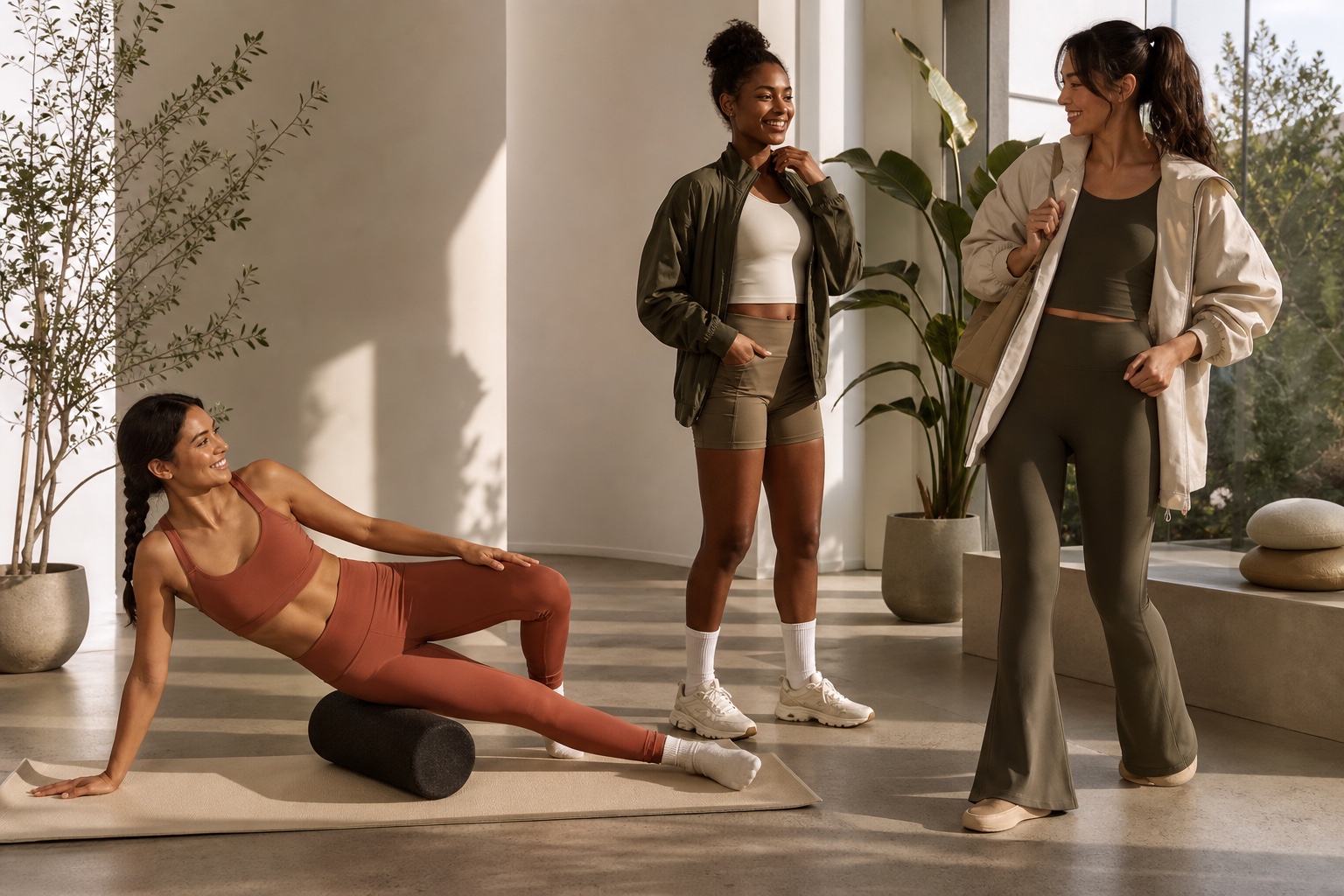
TALA’s product architecture gives that idea a visible form. Its current range includes families such as Dayflex, SkinLuxe, FormTech, 365, seamless pieces, leggings, flares, bras, outerwear, and everyday tailoring. The official leggings guide explains that the female-led product team initially persuaded the non-runner founder to launch a running collection, while FormTech was developed for performance beyond running. It positions Dayflex and SkinLuxe flares for Pilates, yoga, brunch, and office use.
This does not mean every family has the same technical standard or that one garment can genuinely perform every task. In fact, the boundaries are strategically useful. A flared legging can win the Pilates-to-brunch occasion precisely because it is not being sold as a universal high-impact running tight. A supportive running legging has a different construction brief from a soft, low-impact, studio-to-street style.
Product families therefore do three jobs at once:
- They translate materials into occasions. The customer understands why two recycled-polyamide garments might feel different and cost different amounts.
- They make assortment expansion legible. A new top can extend an existing fabric or activity family instead of appearing as a random launch.
- They create a development vocabulary. The team can discuss “Dayflex softness,” “FormTech support,” or “365 everyday use” as product requirements rather than vague moods.
That is more defensible than launching a large collection under one universal sustainability claim. It also has an inventory risk: every family can multiply colours, sizes, lengths, and fit blocks. A better customer experience can create a worse cash cycle if the business cannot replenish the important combinations.
Apply this: make a product-family matrix before adding a SKU.
| Product role | Customer occasion | Proof to show | Risk to control |
|---|---|---|---|
| High-support performance | Running, training, higher-impact movement | Support, recovery, sweat and movement tests | Overclaiming a soft fabric as universal performance |
| Studio / low-impact | Pilates, yoga, travel, errands | Softness, waistband stability, opacity, ease of movement | Being perceived as too delicate or too casual |
| Everyday layer | Commute, coffee, office, weekend | Heat, styling, pocket function, care and shape retention | Adding lifestyle pieces without a clear activewear connection |
| Repeatable core | The routine customers return to weekly | Consistent fit, colour, sizing and replenishment | SKU multiplication and silent fit changes |
Do not ask only, “What new style should we add?” Ask, “Which customer occasion is currently under-served, and which existing material, fit, or colour system can make that occasion easier?”
The body is where the sustainability claim earns trust
A responsible story is fragile if the garment is uncomfortable. Customers do not experience recycled polyamide as a sentence on a product page; they experience it as heat, stretch, compression, sweat, recovery, friction, and the need—or lack of need—to adjust the waistband.
Independent coverage gives a more balanced picture than campaign imagery. Who What Wear’s January 2026 try-on described Dayflex pieces as soft and versatile and noted useful details such as pockets, a deep waistband, and broad size or colour options. It also identified boundaries: flared trousers were less suitable for some higher-impact machines, some lengths were still long for petite wearers, a capri had a narrower size range, one top could feel hot, and a short’s waistband could twist.
Marie Claire’s testers were impressed across Reformer Pilates and running and reported no major issues with roll-down, digging, or sweat patches in the tested pieces. But even positive editorial testing is not a universal performance certification. Body shape, bust size, climate, activity intensity, laundering, and personal preference can change the result.
The lesson is not that TALA has solved fit. The lesson is that independent friction makes the brand more believable. A review that says “this is soft, but not ideal for high impact” helps a customer choose the right family. That can be more valuable than pretending every product is for every woman.
Build a fit evidence grid:
- Test the smallest and largest intended sizes, plus the middle size.
- Test at least two heights or inseam options where length is a meaningful purchase decision.
- Record compression, opacity, waistband movement, bust support, heat, sweat visibility, and pocket access.
- Test the garment in its promised activity and in the transition moment after it—walking home, sitting, commuting, or layering.
- Publish the boundary. “Best for low-to-medium impact” can improve conversion by reducing the wrong purchase.
The practical payoff is immediate: fit evidence becomes product copy, creator briefing material, customer-service guidance, and a quality-control checklist. One test can improve four parts of the business.
Creator distribution opened the loop; proof had to keep it open
Grace Beverley’s audience was a genuine strategic asset. TALA did not start from zero attention. Early reporting described a founder with a large following, and later coverage associated the brand with Gen Z women, social growth, and a strong online launch. In the latest business reporting, TALA’s social audience was also said to have increased by more than 115,000 across Instagram and TikTok during the reported period.
But reach and trust are different assets.
| Stage | Question | Metric or evidence |
|---|---|---|
| Discovery | Did the person notice the brand? | Reach, qualified views, profile visits, saves |
| Understanding | Did she understand the fabric, fit and use case? | Product-page depth, size-guide visits, material questions |
| First purchase | Did the product make the promise tangible? | Conversion, first-order return reasons, review content |
| Repeat | Did the experience earn another decision? | Restock requests, repeat purchase, colour or set attachment |
| Advocacy | Can customers explain the product to someone else? | Referrals, useful reviews, unprompted styling or care content |
This separation protects a founder from the most flattering but least useful dashboard. A creator video can produce high reach and low understanding. A fabric explainer can produce modest reach and lower returns. A try-on can create more size-guide visits but improve conversion. Without separating the stages, the brand cannot see what is actually working.
Run a two-track content test: show the same product in one set of posts as a desirable outfit and in another set as a fit-and-material decision. Compare not only clicks but also questions, returns, review language, and repeat behaviour. The goal is not to make every post educational. It is to learn which proof turns attention into confidence.
The uncomfortable test: can the model survive scale?
The strongest TALA analysis must include the part that weakens the neat success story.
FashionUnited and TheIndustry.fashion reported revenue of £19.8m for the year ended March 31, 2025, up from £16.8m. Retail Gazette reported a 58% gross margin and a wider operating loss, while other coverage cited a £1.9m loss before share-based payments rather than the £2.6m operating-loss figure. Those measures should not be treated as interchangeable. The important conclusion is narrower: TALA grew revenue, but the reported accounts do not show a simple story of growth automatically creating stronger operating profit.
At the same time, the company was expanding wholesale, moving to a new third-party logistics provider, opening a Carnaby Street store in May 2025 and a Westfield store later that year, and scaling back US operations in response to import-tariff pressure. Retail Gazette reported that wholesale operations were eight times higher year-on-year. These are signals of ambition and commercial progress, but they also add fixed costs, service expectations, inventory commitments, and geographic complexity.
Independent sustainability commentary introduces a related tension: TALA has been associated with small-batch manufacturing and transparent supply-chain ideals, but it remains an open question whether those ideals are equally easy to protect as the brand adds stores and wider distribution.
This is where a shallow article would fail. It would call TALA’s revenue growth proof that sustainable activewear is a winning formula. A better reading is more conditional:
- Creator distribution may have accelerated awareness faster than sustainability alone could.
- Product families may have improved repeat purchase while increasing assortment complexity.
- Wholesale and stores may improve fit confidence and discovery while increasing operating costs.
- Recycled fibres may support a better material story while leaving lifecycle and end-of-life questions unresolved.
- Revenue growth may be real while the economic model is still under pressure.
Use a scale gate before committing to more inventory: what is the minimum evidence required to move from sample to small batch, and from small batch to replenishment? Include target sell-through, return reasons, size availability, gross margin after freight and returns, defect rate, and the specific proof claim you can substantiate. A sustainable promise that cannot be measured operationally is a future reputation liability.

What an emerging activewear brand should copy
Test now
- Choose one customer occasion and write the exact garment behaviour required for it.
- Create a material proof card with composition, purpose, evidence, limitation, and care.
- Build one product family around a fabric or fit that customers can recognize.
- Wear-test the smallest, middle, and largest sizes; include length and activity boundaries.
- Publish content that answers one practical question before it asks for a purchase.
- Track returns and customer questions as product-development data, not only service problems.
Build after proof
- Extend a validated fabric into a matching top, layer, or adjacent occasion.
- Offer more colours and lengths only when the core combinations can stay available.
- Use creators for discovery, but brief them to demonstrate the product’s use and limits.
- Consider wholesale or a physical fitting experience when it solves a specific confidence problem.
- Invest in supply-chain and quality documentation before expanding the environmental claim.
Do not copy directly
- Do not copy the word “sustainable” without a product-level proof chain.
- Do not treat a large creator audience as evidence of product-market fit.
- Do not call one soft legging a universal performance garment.
- Do not multiply families, colours, lengths, and sizes before you understand replenishment economics.
- Do not claim that revenue growth proves a profitable or fully resolved operating model.
Where Battlerobe can help—and where it cannot
TALA raises a production question that is more useful than “Can you make this design?” The question is: Can the product promise be translated into a specification that a factory can sample, test, approve, reproduce, and inspect?
For an emerging activewear brand, that specification may include the target hand feel, stretch and recovery, opacity, compression, rise, inseam options, waistband behaviour, pocket construction, logo method, colour standard, wash-care instructions, tolerances, and inspection points. If sustainability matters, it should also name the exact fibre composition or certification requirement being requested—not rely on a broad adjective.
After the customer occasion and fit direction have been validated, Battlerobe’s bulk custom production service can support the next stage: fabric and colour coordination, sampling, branding, bulk production, quality control, and repeat orders for an approved activewear style. The relevant value is continuity. A clear product brief gives the production team something specific to preserve as the brand moves from an idea to an order.
The boundary is important. Battlerobe cannot certify a vague sustainability claim, prove demand, or replace independent wear testing. A production partner should not be presented as the reason a brand will succeed. The better promise is narrower and more credible: once the product direction is clear, a capable partner can help reduce the gap between the approved sample and the repeatable finished product.
Prepare this before requesting a sample: customer occasion, activity level, fabric composition, desired hand feel, fit block, size and length range, logo placement, target order quantity, acceptable tolerances, and the three tests that determine approval. That brief is far more useful than sending a reference image and asking for “something similar.”
The six-week test for a sustainability proof-to-product loop
If we were building a new activewear brand from this lesson, we would not begin with a full sustainable collection. We would run a constrained proof cycle:
- Week one: interview 10–15 target customers about one routine in which they want activewear to replace ordinary clothing. Record the words they use for comfort, confidence, care, and responsibility.
- Week two: choose one hero garment, one matching product, and one layer. Hold the core colour and fabric direction stable so the test does not become a test of ten variables.
- Weeks three and four: sample and wear-test the garments across the promised activity and the transition moment. Document fit, heat, opacity, recovery, support, and wash behaviour.
- Week five: publish two kinds of content: a visual styling story and a proof story. Use creator reach to attract attention, but make the product page answer material, fit, care, and limitation questions.
- Week six: launch a small batch or controlled preorder with clear delivery, care, and return information. Review sell-through, returns, questions, size demand, and the quality of customer language in reviews.
Scale only if the customer can explain the use occasion, the product survives the agreed tests, the material claim is supportable, and demand appears without depending entirely on discounts. Revise if people love the image but cannot explain when they would wear it, if returns cluster around length or support, if matching pieces do not attach, or if the range needs too many variants to remain available.
That is the TALA lesson worth carrying forward. A sustainable activewear brand does not earn trust by announcing a better intention once. It earns trust every time a material claim becomes a garment that works, a product page that tells the truth, a supplier process that can be documented, and an operating system that does not collapse when demand arrives.
Sources and further reading
This case study separates official brand claims, accounts-based reporting, independent product testing, and editorial interpretation. The public record does not prove the exact causal contribution of Grace Beverley’s audience, sustainability, product quality, wholesale, stores, or market timing. It also does not establish that TALA’s products are impact-free or that its current growth is already a profitable model.
- TALA: About Us and brand positioning
- TALA: Product, fibres and supplier information
- TALA: Leggings buying guide and product families
- TALA: Current product categories and 365 positioning
- TALA customer help: sizing, tariffs and availability notes
- FashionUnited: reported revenue growth and accounts context
- TheIndustry.fashion: revenue growth and store rollout
- Retail Gazette: margin, operating-loss, wholesale and tariff context
- Who What Wear: independent product try-on and limitations
- Marie Claire: independent workout-kit testing and founder context
- Marie Claire: sustainability and small-batch scaling tension
- Euronews: early founder and audience context