

Activewear production quality control is not something that should only happen at the end of production.
For yoga, Pilates, fitness, and activewear brands, product quality is not something that should only be checked at the end of production.
Real production quality comes from every step being confirmed before the next step begins.
A sports bra may look simple, but fabric stretch, color consistency, size measurements, strap position, stitching, logo placement, hang tags, and packaging can all affect the final product. A pair of leggings is not only about style. Waistband height, fabric recovery, opacity, inseam length, crotch comfort, and seam strength all influence how customers feel when they wear the product.
If these details are only checked before shipment, many problems may already be difficult or costly to fix.
That is why a clear quality control process should run through the whole production journey, from fabric approval to final packing.
1. Fabric and Color Verification: Quality Starts from the Source
Fabric is the foundation of activewear quality.
Before production starts, the fabric needs to be checked carefully to make sure it matches the product requirement. This includes fabric composition, hand feel, stretch, thickness, recovery, color, and overall stability.
For yoga and Pilates apparel, customers often care about softness, comfort, stretch, and how the fabric feels against the skin. For gym and training apparel, buyers may pay more attention to support, compression, durability, and performance.
At this stage, buyers and suppliers should confirm:
- Fabric composition
- Fabric weight and thickness
- Stretch and recovery
- Hand feel
- Color accuracy
- Color consistency
- Suitability for the product type
For leggings and shorts, opacity is especially important. A fabric may look good when flat, but it also needs to perform when stretched and worn.
For sports bras, fabric support and recovery can directly affect comfort and fit.
If fabric and color are not confirmed at the beginning, even a well-managed production process may still lead to unstable final products.
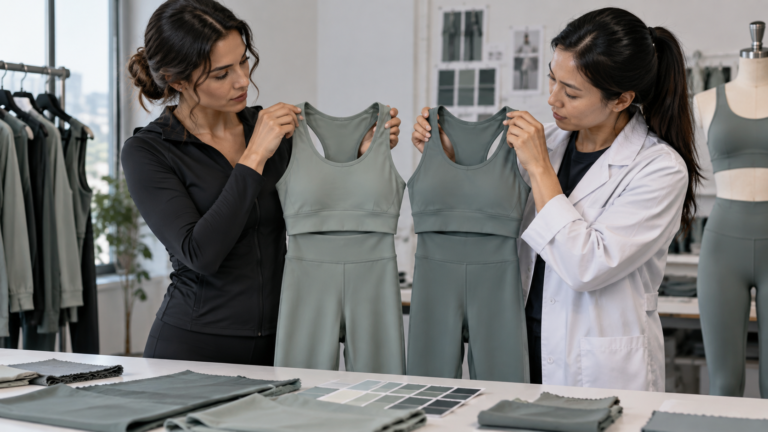
2. Pre-Production Sample Approval: Preventing the Wrong Direction
A pre-production sample is not only used to check whether the product looks good.
Its real purpose is to confirm whether the order is ready to move into production in the right direction.
Before production begins, the sample should be reviewed for:
- Style accuracy
- Fit and measurements
- Fabric use
- Color matching
- Logo placement
- Logo size
- Label and hang tag details
- Packaging requirements
For custom-developed products, sample approval helps buyers check pattern, fit, workmanship, and design details before bulk production.
For ready-to-custom products, this step helps confirm branding details such as logo placement, hang tags, logo packaging bags, and shipping bags.
When this step is done carefully, the risk of larger production mistakes can be reduced.
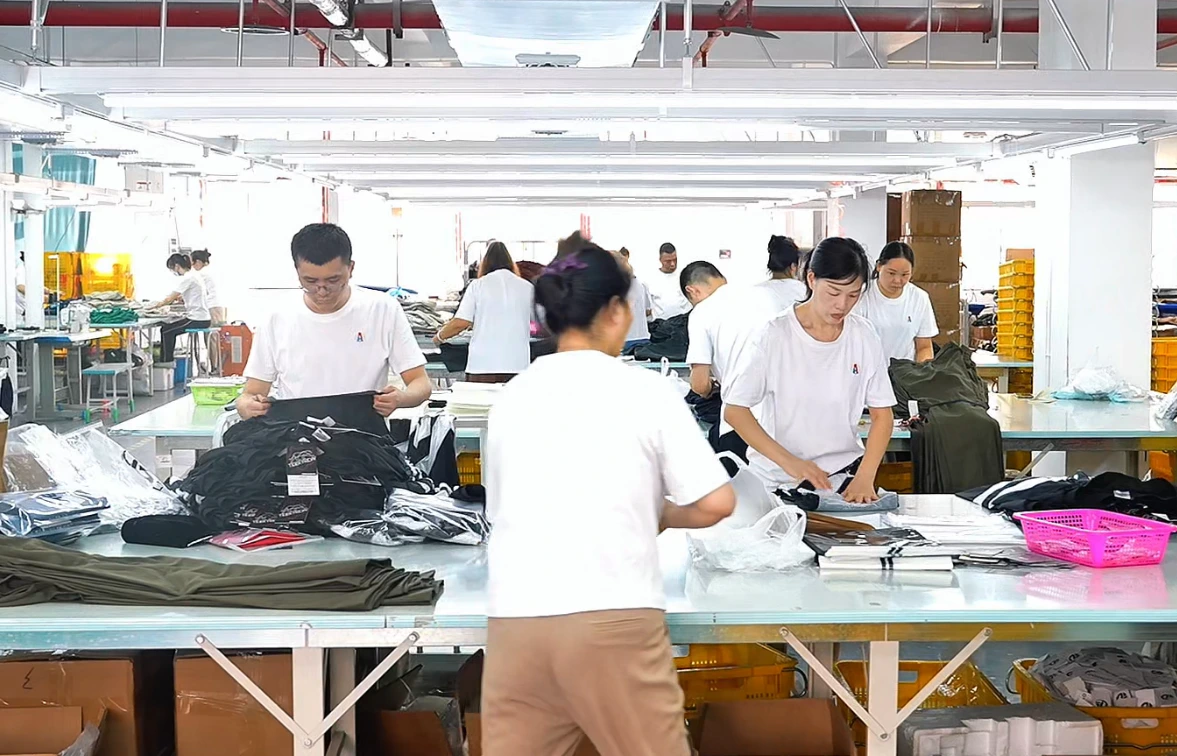
3. Inline Production Inspection: Finding Problems Early
Many quality problems do not appear suddenly at the end. They often develop during production.
If a problem is only found after all garments are finished, correction becomes more difficult. It can also affect cost, delivery time, and order confidence.
Inline inspection helps identify issues while production is still in progress.
This may include checking:
- Cutting accuracy
- Stitching quality
- Measurement consistency
- Logo position
- Fabric direction
- Size and color separation
- Semi-finished garment quality
- Workmanship consistency
For sports bras, inspection may focus on straps, underband, cup position, elastic comfort, and support structure.
For leggings and shorts, inspection may include waistband construction, crotch seam, inseam length, stretch recovery, and seam strength.
For jackets and jumpsuits, zipper quality, pocket position, sleeve length, and overall fit may need extra attention.
The value of inline inspection is simple: problems are easier to solve when they are found early.
4. Final Measurement and Workmanship Check
After garments are completed, a final inspection is needed before shipment.
This step confirms whether the finished products match the order requirement and are ready to be delivered.
Common final inspection points include:
- Finished garment measurements
- Stitching and seam quality
- Loose threads
- Stains or visible defects
- Symmetry
- Logo, label, and hang tag accuracy
- Color and style matching
- Quantity by size and color
- Overall appearance
Activewear is different from ordinary clothing because it needs to support movement, stretch, and body fit. So final inspection should not only focus on how the product looks, but also whether it is suitable for the intended use.
A stable final inspection process helps brands reduce complaints, returns, and after-sales problems.
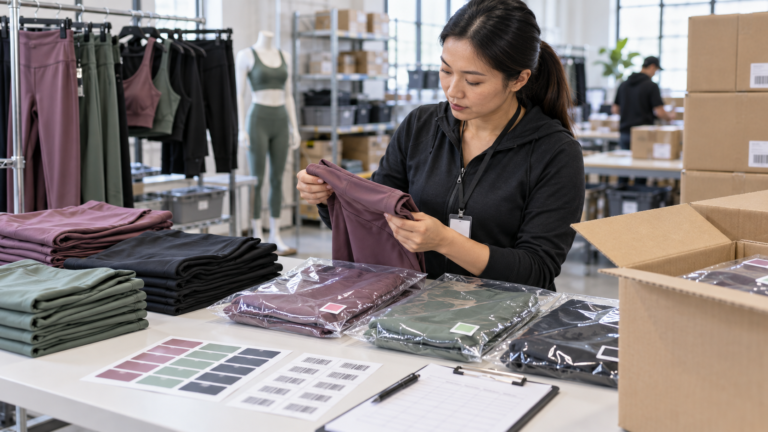
5. Packing and Shipment Verification
Quality control does not end when the garment is finished.
Packaging is also part of the delivery experience, especially for e-commerce brands, independent activewear brands, and social media-driven product launches.
Before shipment, buyers and suppliers should confirm:
- Individual packaging
- Logo packaging bags
- Hang tags
- Size stickers
- Shipping bags
- Carton labels
- Carton quantity
- Packing list
- Shipping information
If packing details are incorrect, even good products can create problems during warehousing, fulfillment, or final delivery.
Clear packing and shipment verification helps make sure the order is not only produced correctly, but also delivered in a way that supports the buyer’s business.
6. Why Full-Process Quality Control Reduces Delivery Risk
The real value of quality control is not only finding problems.
It is reducing the chance of problems happening in the first place.
If quality control only happens at the end, many risks have already entered the order. But when every stage is checked, from fabric and sample approval to inline inspection, final inspection, packing, and shipment, potential issues can be handled before they grow.
A full-process quality control system can help brands:
- Reduce production mistakes
- Lower the risk of rework
- Improve delivery stability
- Keep product quality more consistent
- Reduce after-sales issues
- Build stronger long-term supplier relationships
This is especially important for new and growing activewear brands.
The first production order often affects brand image, customer feedback, product reviews, and future reorder confidence.
7. How Battlerobe Approaches Quality and Execution
At Battlerobe, quality control is not treated as a final step before shipment.
It is part of the whole production process.
From fabric and color verification to pre-production sample approval, inline production inspection, final measurement check, workmanship review, packing confirmation, and shipment verification, we aim to identify possible issues before delivery.
Our goal is not to wait until customers receive the products to solve problems.
Our goal is to control important details before the order leaves the factory.
For ready-to-custom orders, we focus on confirming existing styles, available colors, logo placement, hang tags, logo packaging bags, shipping bags, and order quantity.
For small-batch custom development, we pay more attention to pattern, fit, sample approval, fabric selection, workmanship, and development details.
For bulk custom production, we focus more on production consistency, batch stability, quality control rhythm, and delivery planning.
Different production routes have different priorities, but the quality control goal is the same: to help buyers move from product idea to delivery with more clarity and lower risk.
Conclusion
Activewear production quality is not decided by one final inspection.
It is built through every stage of the production process.
From fabric selection and sample approval to inline inspection, final measurement, workmanship review, packing, and shipment confirmation, each step affects the final delivery result.
For yoga, Pilates, fitness, and lifestyle activewear brands, a clear quality control process can reduce communication problems, lower production risk, and support more stable product delivery.
If you are preparing an activewear order, Battlerobe can help you review your product type, target quantity, customization needs, quality requirements, and production route before moving forward.
Explore our production solutions or send your project details through Start Your Project.
For yoga, Pilates, fitness, and activewear brands, product quality is not something that should only be checked at the end of production.
Real production quality comes from every step being confirmed before the next step begins.
A sports bra may look simple, but fabric stretch, color consistency, size measurements, strap position, stitching, logo placement, hang tags, and packaging can all affect the final product. A pair of leggings is not only about style. Waistband height, fabric recovery, opacity, inseam length, crotch comfort, and seam strength all influence how customers feel when they wear the product.
If these details are only checked before shipment, many problems may already be difficult or costly to fix.
That is why a clear quality control process should run through the whole production journey, from fabric approval to final packing.
1. Fabric and Color Verification: Quality Starts from the Source
Fabric is the foundation of activewear quality.
Before production starts, the fabric needs to be checked carefully to make sure it matches the product requirement. This includes fabric composition, hand feel, stretch, thickness, recovery, color, and overall stability.
For yoga and Pilates apparel, customers often care about softness, comfort, stretch, and how the fabric feels against the skin. For gym and training apparel, buyers may pay more attention to support, compression, durability, and performance.
At this stage, buyers and suppliers should confirm:
- Fabric composition
- Fabric weight and thickness
- Stretch and recovery
- Hand feel
- Color accuracy
- Color consistency
- Suitability for the product type
For leggings and shorts, opacity is especially important. A fabric may look good when flat, but it also needs to perform when stretched and worn.
For sports bras, fabric support and recovery can directly affect comfort and fit.
If fabric and color are not confirmed at the beginning, even a well-managed production process may still lead to unstable final products.
2. Pre-Production Sample Approval: Preventing the Wrong Direction
A pre-production sample is not only used to check whether the product looks good.
Its real purpose is to confirm whether the order is ready to move into production in the right direction.
Before production begins, the sample should be reviewed for:
- Style accuracy
- Fit and measurements
- Fabric use
- Color matching
- Logo placement
- Logo size
- Label and hang tag details
- Packaging requirements
For custom-developed products, sample approval helps buyers check pattern, fit, workmanship, and design details before bulk production.
For ready-to-custom products, this step helps confirm branding details such as logo placement, hang tags, logo packaging bags, and shipping bags.
When this step is done carefully, the risk of larger production mistakes can be reduced.
3. Inline Production Inspection: Finding Problems Early
Many quality problems do not appear suddenly at the end. They often develop during production.
If a problem is only found after all garments are finished, correction becomes more difficult. It can also affect cost, delivery time, and order confidence.
Inline inspection helps identify issues while production is still in progress.
This may include checking:
- Cutting accuracy
- Stitching quality
- Measurement consistency
- Logo position
- Fabric direction
- Size and color separation
- Semi-finished garment quality
- Workmanship consistency
For sports bras, inspection may focus on straps, underband, cup position, elastic comfort, and support structure.
For leggings and shorts, inspection may include waistband construction, crotch seam, inseam length, stretch recovery, and seam strength.
For jackets and jumpsuits, zipper quality, pocket position, sleeve length, and overall fit may need extra attention.
The value of inline inspection is simple: problems are easier to solve when they are found early.
4. Final Measurement and Workmanship Check
After garments are completed, a final inspection is needed before shipment.
This step confirms whether the finished products match the order requirement and are ready to be delivered.
Common final inspection points include:
- Finished garment measurements
- Stitching and seam quality
- Loose threads
- Stains or visible defects
- Symmetry
- Logo, label, and hang tag accuracy
- Color and style matching
- Quantity by size and color
- Overall appearance
Activewear is different from ordinary clothing because it needs to support movement, stretch, and body fit. So final inspection should not only focus on how the product looks, but also whether it is suitable for the intended use.
A stable final inspection process helps brands reduce complaints, returns, and after-sales problems.
5. Packing and Shipment Verification
Quality control does not end when the garment is finished.
Packaging is also part of the delivery experience, especially for e-commerce brands, independent activewear brands, and social media-driven product launches.
Before shipment, buyers and suppliers should confirm:
- Individual packaging
- Logo packaging bags
- Hang tags
- Size stickers
- Shipping bags
- Carton labels
- Carton quantity
- Packing list
- Shipping information
If packing details are incorrect, even good products can create problems during warehousing, fulfillment, or final delivery.
Clear packing and shipment verification helps make sure the order is not only produced correctly, but also delivered in a way that supports the buyer’s business.
6. Why Full-Process Quality Control Reduces Delivery Risk
The real value of quality control is not only finding problems.
It is reducing the chance of problems happening in the first place.
If quality control only happens at the end, many risks have already entered the order. But when every stage is checked, from fabric and sample approval to inline inspection, final inspection, packing, and shipment, potential issues can be handled before they grow.
A full-process quality control system can help brands:
- Reduce production mistakes
- Lower the risk of rework
- Improve delivery stability
- Keep product quality more consistent
- Reduce after-sales issues
- Build stronger long-term supplier relationships
This is especially important for new and growing activewear brands.
The first production order often affects brand image, customer feedback, product reviews, and future reorder confidence.
7. How Battlerobe Approaches Quality and Execution
At Battlerobe, quality control is not treated as a final step before shipment.
It is part of the whole production process.
From fabric and color verification to pre-production sample approval, inline production inspection, final measurement check, workmanship review, packing confirmation, and shipment verification, we aim to identify possible issues before delivery.
Our goal is not to wait until customers receive the products to solve problems.
Our goal is to control important details before the order leaves the factory.
For ready-to-custom orders, we focus on confirming existing styles, available colors, logo placement, hang tags, logo packaging bags, shipping bags, and order quantity.
For small-batch custom development, we pay more attention to pattern, fit, sample approval, fabric selection, workmanship, and development details.
For bulk custom production, we focus more on production consistency, batch stability, quality control rhythm, and delivery planning.
Different production routes have different priorities, but the quality control goal is the same: to help buyers move from product idea to delivery with more clarity and lower risk.
Conclusion
Activewear production quality is not decided by one final inspection.
It is built through every stage of the production process.
From fabric selection and sample approval to inline inspection, final measurement, workmanship review, packing, and shipment confirmation, each step affects the final delivery result.
For yoga, Pilates, fitness, and lifestyle activewear brands, a clear quality control process can reduce communication problems, lower production risk, and support more stable product delivery.
If you are preparing an activewear order, Battlerobe can help you review your product type, target quantity, customization needs, quality requirements, and production route before moving forward.
Explore our production solutions or send your project details through Start Your Project.