

A fitness instructor activewear brand can begin with something most fashion startups spend heavily to acquire: repeated attention from people who already trust the founder in the product’s real use environment.
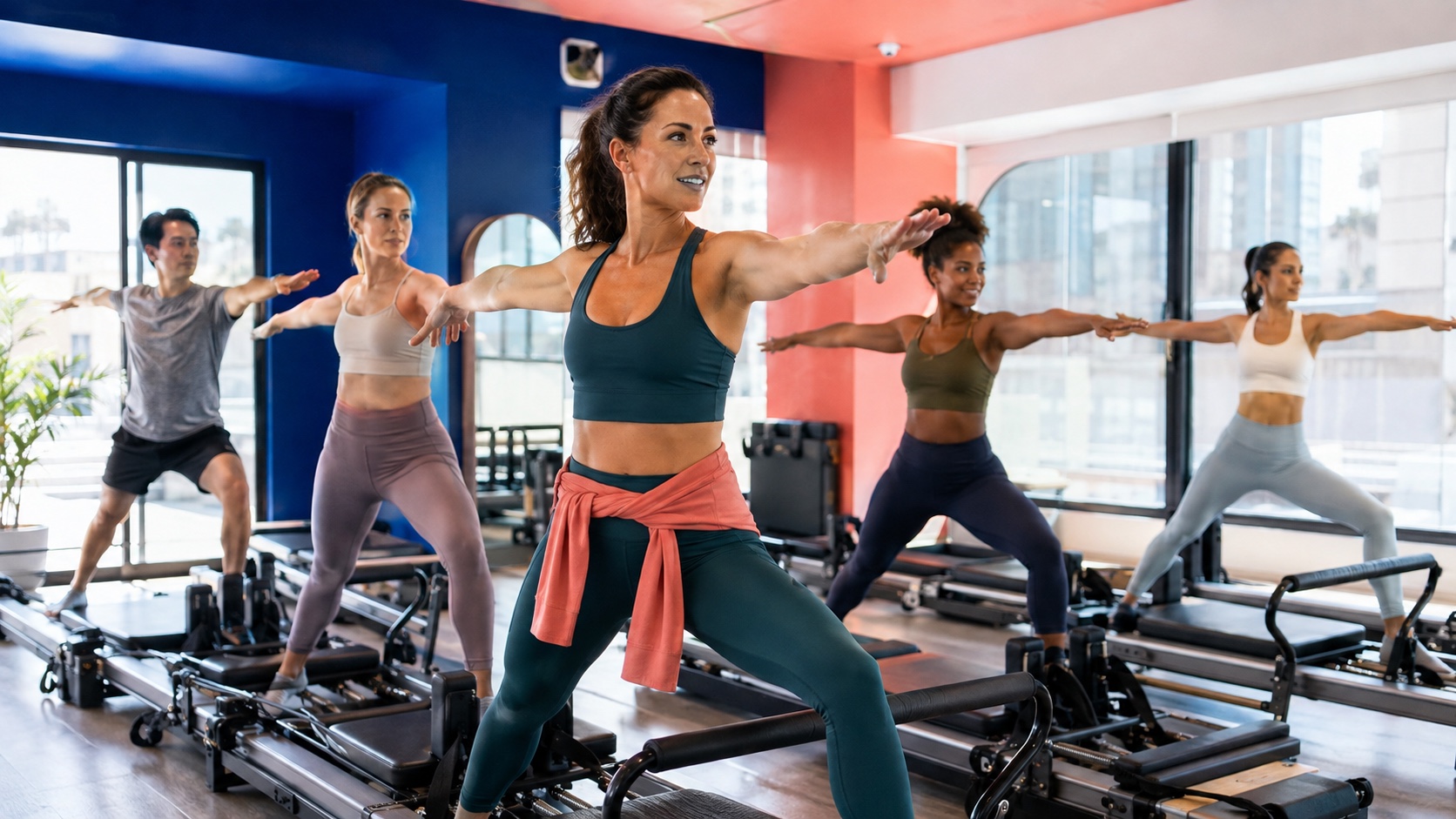
Every week, a Pilates instructor steps onto the same reformer floor. Her clients see whether a waistband rolls when she demonstrates teaser, whether a bra neckline feels too exposed when she leans over a carriage, whether a layer survives the walk from studio to coffee, and whether she chooses the same outfit again.
That is not yet demand. Trust in a coach does not automatically become willingness to buy her clothes. But it is a better starting signal than a mood board, a follower count, or a box of generic logo leggings.
The opportunity is narrow: an instructor with a recurring class community can test a class-uniform micro-capsule before trying to become a full activewear label. The first goal is not scale. It is to learn whether one useful uniform can turn repeated product demonstration and community belonging into paid reservations.
This requires separating three assets that founders often confuse: trust inventory, product inventory, and size inventory. A coach may already have the first. She has not yet earned the right to buy the other two.
Why instructors are a distribution node—but not automatic founders
The U.S. Bureau of Labor Statistics counted 370,100 fitness trainers and instructors in 2024 and projects employment to grow 12% through 2034. That is a labour-market statistic, not an apparel forecast. It matters because it identifies a broad population whose work combines demonstration, motivation, listening, and recurring client contact.
In-person fitness also continues to generate concentrated communities. ClassPass reported that Pilates was its most-booked workout for the third consecutive year in 2025, with bookings up 66% year over year and more than 27 million searches on its platform. Those figures describe ClassPass, not the entire market, but they show why a studio floor remains commercially interesting: people repeatedly gather around a method, place, and instructor.
Large activewear companies already recognise that node. lululemon’s Sweat Collective invites group instructors, personal trainers, studio owners, coaches, and team staff; it offers a 25% product discount and asks members to help improve designs. Its Strategic Sales program also works with fitness studios and wellness leaders.
The inference is not that every coach should compete with lululemon. It is that instructors sit where product trial, product explanation, feedback, and community overlap.
Useful first decision: count recurring face-to-face relationships, not followers. An instructor with 70,000 passive viewers may have a weaker first test than one who sees the same 45 clients every week and knows how they dress, move, hesitate, and complain.
The wrong first move is usually “launch my collection”
Mindbody’s 2025 State of the Industry report says one in three fitness and wellness businesses in its survey planned to add retail revenue through apparel, supplements, or equipment. Because Mindbody sells business software, the figure should be treated as an operator-intent signal, not proof that retail succeeds.
It also points to the risk. When many studios add merchandise, most products become interchangeable: a printed hoodie, a water bottle, a familiar seamless set, and a logo. The product says where the customer trains, but not why this instructor needed to make it.
Before choosing garments, a coach should choose among three business models:
- Affiliate: recommend an existing product and earn a disclosed commission. Best when the coach has trust but no original product insight.
- Curated resale: buy or consign products from other brands for the studio. Best when clients want convenience and selection.
- Owned micro-capsule: sell a tightly controlled uniform under the coach’s own identity. Best only when repeated use reveals a coherent product or belonging problem.
The second path is not theoretical. lululemon openly supplies fitness studios through wholesale. A coach who cannot explain why her own garment should exist may be better off curating a proven product and protecting her cash.
Decision rule: if clients mainly ask, “What brand are you wearing?”, start with affiliate or resale. If they repeatedly ask for a specific combination that does not exist—“I want your teaching tank, but longer, less low-cut, and in our studio colour”—an owned test becomes more credible.
The opportunity is a uniform, not merchandise
A uniform performs three jobs at once.
First, it solves the instructor’s repeated work occasion. Second, it helps clients recognise a shared class identity. Third, it produces natural product demonstration every time the instructor teaches.
Turn Up Tone Up offers a useful, if company-reported, example. The brand says its first hoodie was created in 2014 by the founder of Our Parks, then became the official uniform for coaches and participants across a community of more than 500,000 “Parkers.” Proceeds support free exercise and childcare programs. The garment is attached to showing up, belonging, and sustaining an activity—not merely to a graphic.
At a much larger creator scale, POPFLEX says founder Cassey Ho began as a Pilates instructor, noticed she could not find a bag that carried the equipment she needed, and started designing around that problem. Her outcome should not be treated as a template for a local coach. The transferable part is the order of operations: lived problem first, audience relationship second, product system later.
Ask this after the next ten classes: which garment does the instructor repeatedly adjust, remove, replace, or apologise for? Write down the movement and moment. “My top feels wrong” is not a product brief. “The neckline opens when I cue a client from above” can become one.
Three product roles are enough to test a system
The first concept should be visually complete but operationally small:
- one top the instructor can teach in;
- one bottom suited to the class method;
- one layer for arrival, departure, and temperature change;
- one core colour;
- one restrained logo placement.
Why three roles? A single T-shirt tests souvenir demand. A top, bottom, and layer show whether customers understand a repeatable uniform. That does not mean all three deserve production. Reservations may reveal that one teaching top carries the idea while the other pieces add inventory noise. Why only one colour? Because three styles across four colours and five sizes creates sixty SKU cells before the coach has learned what clients will actually reserve.
The product choices should follow the class, not the Instagram feed. A reformer instructor may value a smooth leg line, non-catching details, secure coverage, and a light arrival layer. A strength coach may need pocket access, higher neckline security, and fabric that tolerates repeated contact with benches and bars. The capsule should not pretend those occasions are identical.
Control one variable: for the first test, keep the colour and branding constant. Let clients choose among product and size. If everything varies, a weak order result will reveal nothing about whether the problem was price, colour, garment, fit, or trust.
Use reservations to separate kindness from demand
People are generous to instructors they like. “That is so cute” and “I would totally buy it” are socially easy responses after class. Inventory cannot be purchased with compliments.
A useful validation sequence is:
- Ten-session friction log: the instructor records what she wore, what she adjusted, and what clients noticed.
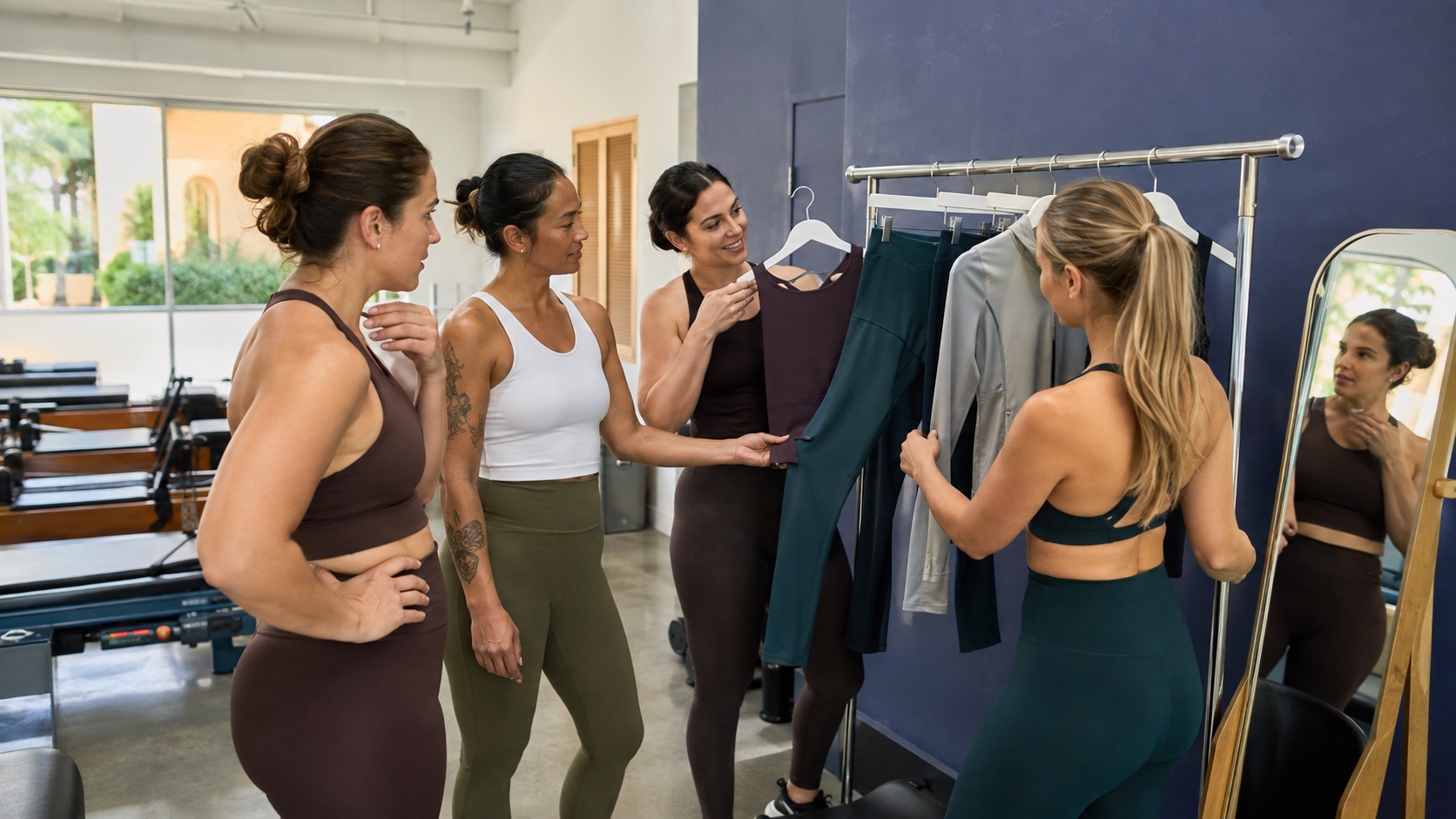
- Prototype table: after class, regular clients handle three existing silhouettes or early samples rather than reacting to a rendering.
- Structured reservation: each interested buyer chooses a specific product, size, and acceptable price.
- Deposit or explicit checkout intent: before inventory, ask for a reversible deposit or a real pre-order under clear delivery and refund terms.
The founder should track concentration, not vanity totals. If twenty people express interest but the requests scatter across seven garments and twelve colours, the signal is weak. If a smaller group repeatedly chooses the same top-and-layer combination at the real price, the capsule is becoming clearer.
Put four columns on the reservation sheet: product, size, real price accepted, deposit status. Add a fifth column for “would still buy without the studio logo.” That final answer helps distinguish a useful garment from a friendship purchase.
There is no universal pass rate. The coach’s cash, audience size, exchange burden, and production minimum determine what “enough” means. The important rule is set the required number of paid or deposit-backed reservations before presenting the product, then refuse to reinterpret compliments as orders afterward.
The class is also the fitting room—and that creates responsibility
A coach has an advantage online brands do not: she can see how garments behave on real people in motion. She also has a duty not to turn students into unpaid fit models or make them feel pressured to buy.
Invite a small opt-in test group. Include clients who differ in height, torso length, hip-to-waist relationship, and preferred coverage. Record:
- the size each person normally buys and the size that actually works;
- where the garment shifts during the class;
- where seams, straps, or waistbands create pressure;
- whether the client would wear it beyond the studio;
- whether she would exchange, keep, or repurchase it after a full session and wash.
Do not ask only, “Do you like it?” Ask, “At what exact movement did you stop thinking about the garment—or start thinking about it?” That question converts vague approval into design evidence.
Ready-to-Custom is useful only when the first question is commercial
If the instructor is still testing whether clients want her visual system, price, and three-piece idea, completely original patterns may be premature. Battlerobe’s Small-Batch Ready-to-Custom route uses existing silhouettes, available colours, standard sizing, and confirmed branding options. Its established minimums are 20 pieces per design and 60 pieces per order, subject to project confirmation.
That can support a disciplined micro-drop—but only after reservations. The production assortment should follow the concentration of demand rather than forcing all three concept pieces into stock. Ready-to-Custom does not create custom fabric, colour, cut, pattern, or fit. That limitation is valuable: it prevents the founder from pretending she is testing a proprietary fit when she is actually testing customer recognition and willingness to buy.
If class testing repeatedly uncovers a specific construction problem—an instructor neckline that opens during hands-on cueing, a waistband that rolls through flexion, or a layer length that interferes with equipment—the question changes. Battlerobe’s Small-Batch Custom Development can then evaluate a meaningful new fit, fabric, pattern, or construction. Feasibility, material, MOQ, sample cost, price, and lead time still need confirmation.
Stage rule: use existing silhouettes to prove the community will buy a uniform. Spend development money only when the community repeatedly identifies something worth owning.
This echoes a broader lesson in our SET Active strategy analysis: coordinated products become powerful when they create a repeatable participation loop. The coach version is smaller and more intimate. The class—not a national social audience—is the first loop.
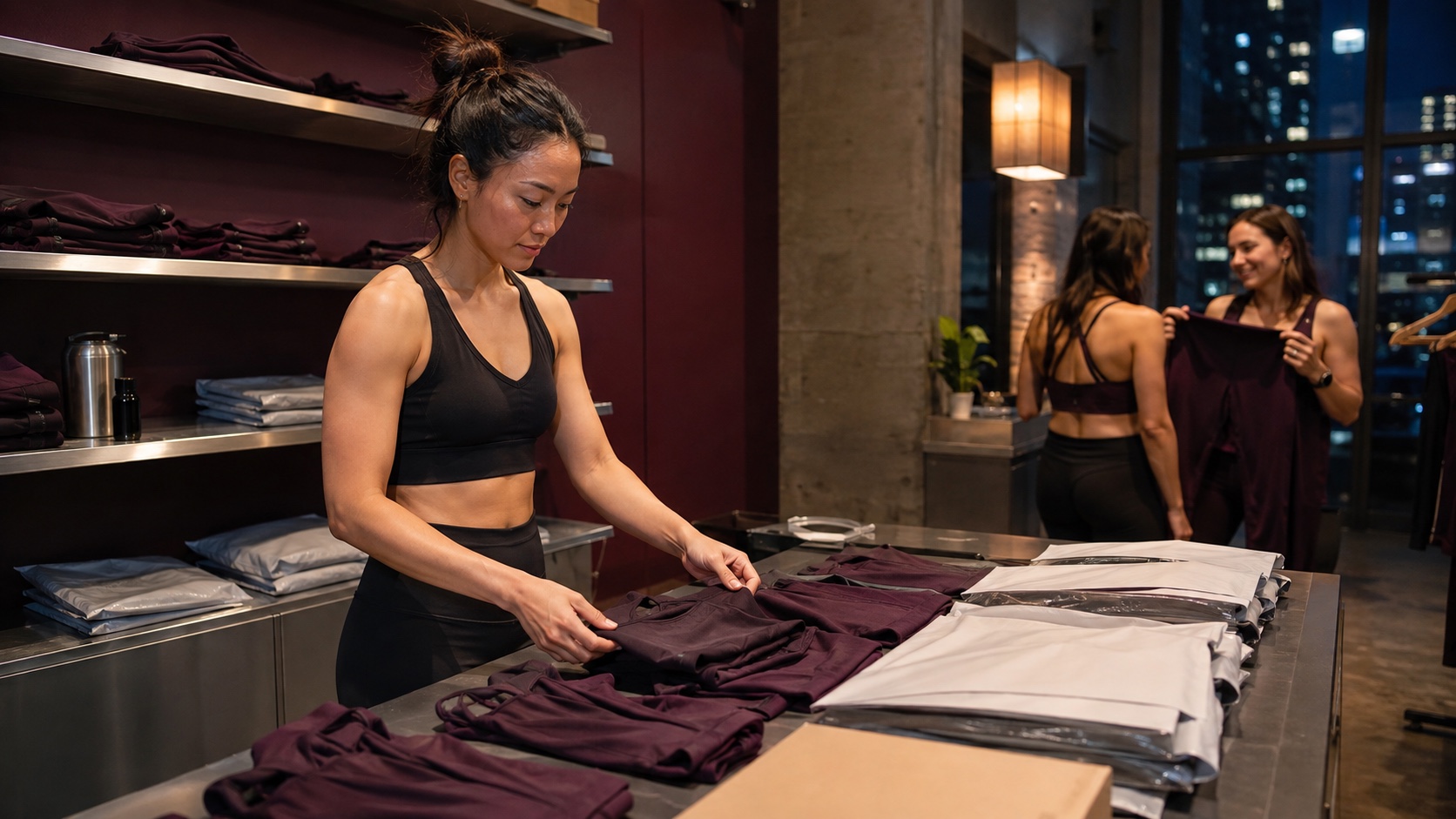
Teaching the product publicly can strengthen trust—if the selling stays honest
This opportunity is one of the few places where founder-as-proof is not an artificial marketing tactic. The instructor already performs the work. She can show the outfit friction, the first sample, the movement that failed, the change made, and the next class test.
The content sequence might be:
real teaching moment → garment problem → sample choice → class test → client feedback → correction → reservation.
That gives the audience small rewards before asking for a purchase. It also makes “quality” visible as decisions rather than adjectives.
But ownership and incentives must be clear. The U.S. Federal Trade Commission says material relationships in endorsements should be disclosed clearly and conspicuously; its guidance also notes that when it is not obvious an influencer is promoting her own brand, that relationship should be made clear. Founders outside the United States need to check local rules.
Transparency is not the enemy of strong advertising. In this case it is the source of credibility: “I made this because it failed here, and this is what we changed” is more persuasive than pretending a commercial product appeared spontaneously in class.
The hidden business is exchanges, not content
The instructor may be excellent at building trust and still be unprepared for retail operations. Before taking money, someone must own:
- size guidance;
- payment and tax handling;
- delivery timing;
- stock counts;
- exchanges and refunds;
- defect decisions;
- privacy for customer measurements;
- reorder communication.
A class community magnifies both good and bad service. A late order is not an anonymous support ticket when the customer sees the founder on Tuesday morning. That social proximity can produce accountability, but it can also damage the coaching relationship.
Stop condition: if the coach is unwilling to publish clear delivery, exchange, and refund rules—or cannot separate selling from participation in class—do not launch. Use affiliate or curated resale instead.
What would prove this can become more than a micro-drop?
The first drop does not prove a brand. Friends and regular clients may buy once to support the instructor. The second decision should depend on behaviour:
- Did buyers wear the pieces repeatedly in the intended class?
- Which sizes exchanged, and why?
- Did non-buyers ask after seeing the product in motion?
- Did one garment drive most orders?
- Did customers request a functional change or merely another colour?
- Would clients reorder without a founder-friendship effect?
If one product generates repeat wear and requests across more than one instructor or class cohort, it may deserve a custom block or construction improvement. If demand appears only during launch week and then disappears, the micro-drop did its job: it prevented a larger mistake.
Bulk production should follow stable reorders, clearer size curves, and evidence that the hero product sells beyond one room. It should not be the reward for a successful photoshoot.
Opportunity judgment: act now, but test the business model before the garment
The fitness instructor activewear brand opportunity is real for a narrow founder: someone with recurring in-person trust, a visible product problem, and the willingness to handle retail operations without compromising the coaching relationship.
The first move is not to ask a manufacturer for a 12-style collection. It is to choose among affiliate, curated resale, and owned capsule. If the owned route survives that decision, log ten classes, identify one repeated problem, show a one-colour three-role uniform, and collect size- and price-specific reservations before buying stock. Produce only the pieces around which demand actually concentrates.
A founder preparing that test can send Battlerobe a concise brief: the class type, the instructor’s repeated clothing friction, three reference silhouettes, intended product roles, target quantity, required launch date, and the one assumption the first drop must prove. Battlerobe can then help determine whether an existing-silhouette test or custom development is the stage-correct route.
Do not continue if clients like the idea but avoid the real price, if demand fragments across too many products, or if selling makes the class feel less safe and more transactional.
The strongest coach-to-brand businesses will not begin by acting like fashion companies. They will begin by treating the class as a place to observe, the uniform as a tool, the first drop as an experiment, and trust as an asset that must never be spent casually.