

Fuller bust activewear does not need another product that claims to support every workout.
That promise usually produces one of two compromises. A fashion-led tank looks like outerwear but offers only light support across a limited cup range. A technically serious full-bust sports bra controls movement, but it often looks and fits like specialist lingerie, then requires a second top for the gym floor.
The specific opportunity sits between those poles: a single, medium-support strength tank for a fuller-bust woman who lifts in a public gym and wants containment, comfortable breathing, secure coverage, and an outer silhouette she is willing to wear alone.
This is not a running bra disguised as a tank. Running, HIIT, and jumping should be excluded from the first claim. The product has one job: outperform the wearer’s current bra-plus-top combination during controlled strength training.
The market is not empty; it is split
Any honest fuller bust activewear analysis has to begin with the products that already work.
MAAREE’s current Solidarity sports bra is offered across many 28–38 underband and C–HH cup combinations. Its construction combines compression and encapsulation elements, a non-stretch front, stretch back, mesh, clasps, and an adjustable upper control panel. SHEFIT takes a different path: its Ultimate high-impact bra uses extensive adjustment and a proprietary measurement-based size system. Bravissimo’s sportswear category lists products into D–HH and DD–K cup ranges.
These products contradict the lazy claim that fuller-bust women have “no options.” They also reveal the engineering cost of high-impact support: separate underband and cup decisions, hardware, adjustability, multiple panels, and many fit combinations.
At the fashion-tank end, lululemon currently sells Align tanks described as light support for C/D cups and intended for yoga or low-impact activity. Those products integrate a shelf bra and outer silhouette cleanly—but the stated support and cup boundaries stop well before the needs of many fuller-bust lifters.
The opportunity is therefore not a blank category. It is a missing intersection:
- more support and fit intelligence than a standard shelf-bra tank;
- less visible hardware and maximum-control construction than a running bra;
- one outer garment for lifting, not a two-layer workaround;
- one clearly bounded fit population, not “for every body.”
Product decision: do not benchmark against a cheap crop top. Benchmark the outside against a fashion tank and the inside against a specialist bra. The product has to earn both comparisons.
Strength training is not simply “lower-impact running”
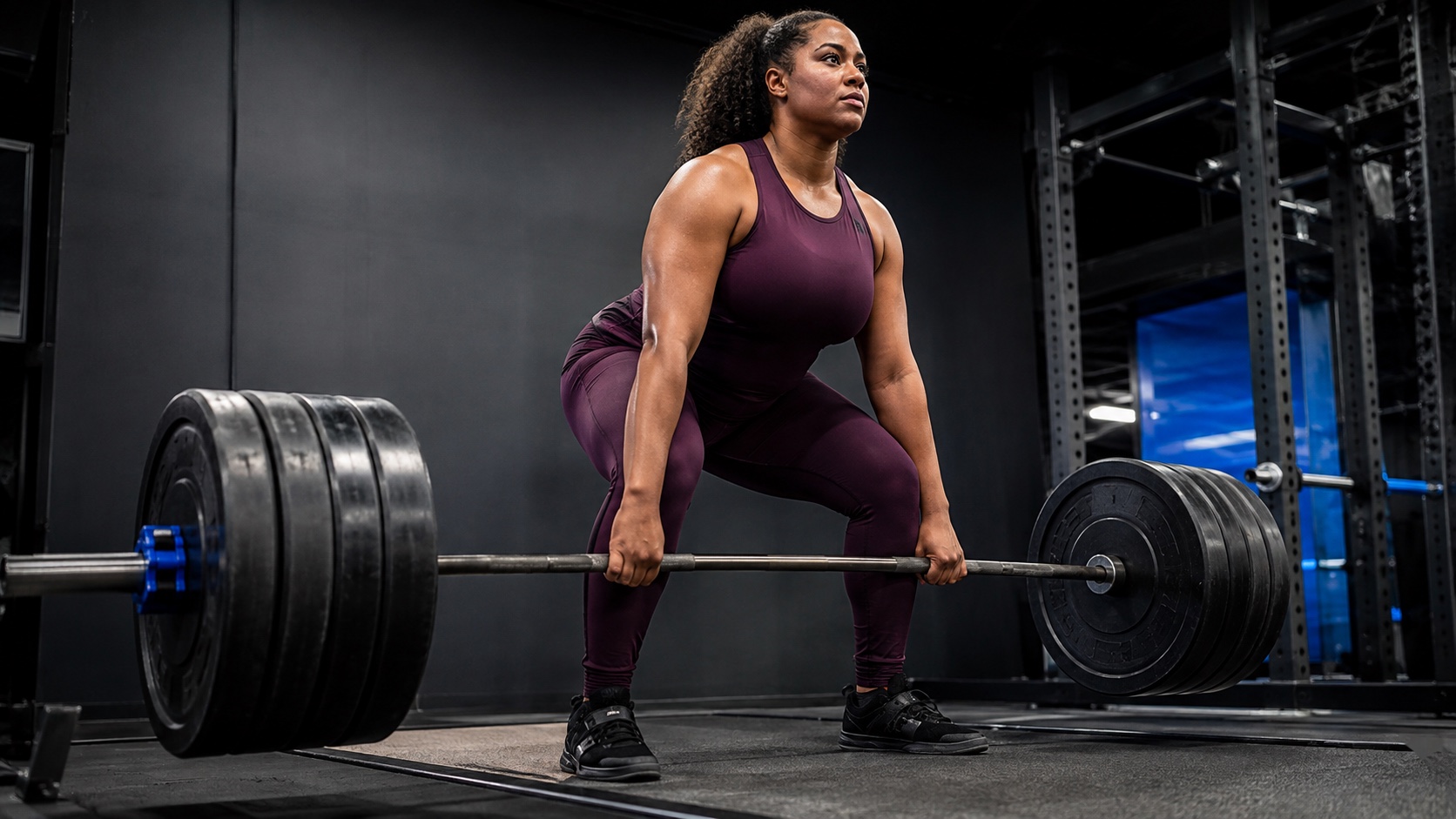
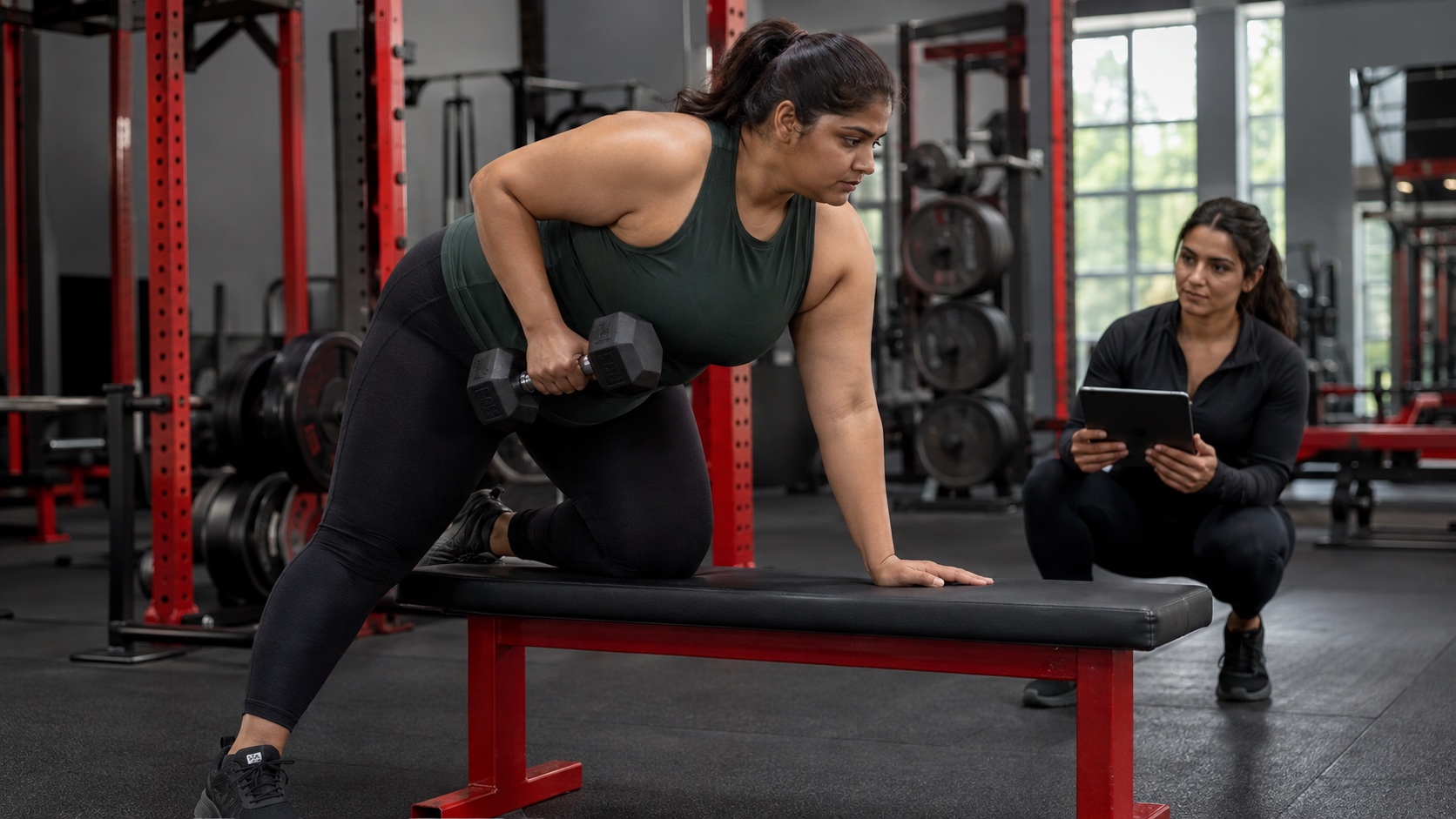
A fuller-bust lifter does not perform one repeated vertical motion. She hinges forward for rows and deadlifts, lies supine for bench work, raises her arms overhead, braces under load, and moves between machines in public.
That changes what “support” means. The first tank must be evaluated for:
- top-edge containment during a forward hinge;
- lateral stability while lying on a bench;
- underband migration during overhead reach;
- strap pressure during loaded pulling;
- comfortable rib-cage expansion while bracing;
- armhole and neckline coverage when viewed from different gym angles;
- removal after sweat without a painful wrestling match.
A systematic review and meta-analysis in the Journal of Women’s Sports Medicine found that women and girls with larger breasts reported more exercise-induced breast pain and showed greater motion measures than smaller-breasted participants. That supports the importance of support and fit. It does not tell a founder that maximum compression is always best.
A 2024 study on sports-bra underband pressure found that loosening the band reduced the work of breathing and changed breathing patterns in its participants. The study concerned exercise and should not be stretched into a strength-tank formula. Its useful warning is simpler: “tighter” is not a free upgrade. Support, breathing, and comfort must be tested together.
Interview question: ask, “Which lift makes you change, cover, or adjust your outfit?” Do not ask only, “Do you need more support?” The movement exposes the actual product requirement.
“Fuller bust” is not a size range
A founder may be tempted to write “D–G cup” into a brief and believe the customer has been defined. That is not enough.
Bra-size measurement research has documented a lack of standardisation and substantial breast-volume variation within reported sizes. A cup letter also changes meaning with the underband. Beyond volume, two people can differ in breast root width, projection, tissue distribution, shoulder geometry, torso length, and tolerance for pressure.
The University of Portsmouth’s Research Group in Breast Health tells consumers to search for their fit rather than assume a familiar size. Its testing work combines objective motion with participant perceptions of comfort, support, and appearance. That combination matters: a tank can reduce motion and still fail because it restricts breathing, creates an unwanted shape, or feels too exposed to wear alone.
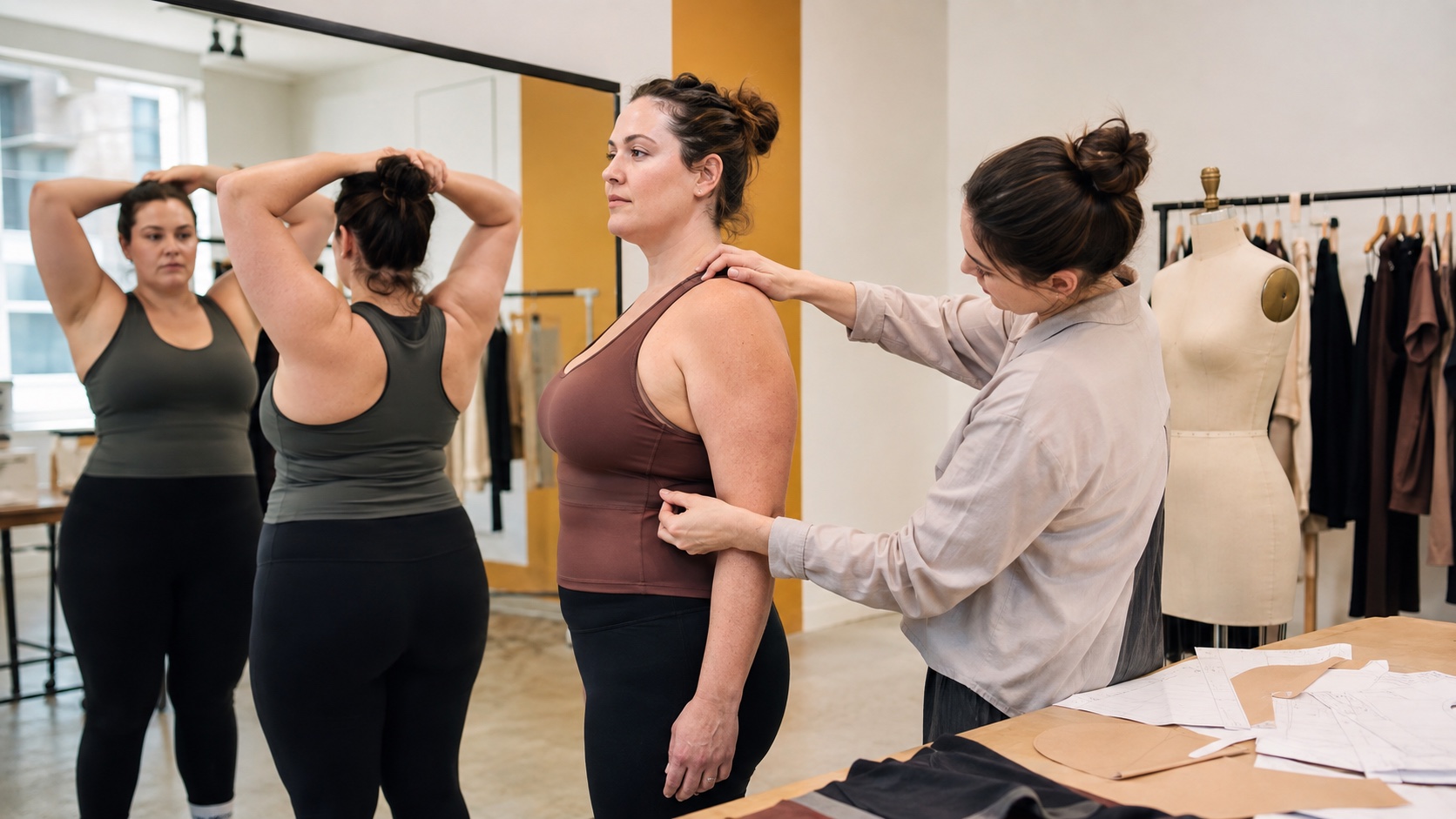
Build a one-page support passport for every tester: intended activity, underband and body measurements, usual bra references, breast-shape notes volunteered by the wearer, pressure tolerance, coverage preference, and the movement that causes failure. The passport is more actionable than one cup letter and easier to compare across fittings.
MVP rule: choose one bounded fit cluster from interviews. A founder might begin with two adjacent underband measurements and the cup-volume problems most repeated inside that group. That is an example of scope, not a universal range. Learn the geometry before promising alphabetic inclusivity.
The first product should be an outer shell with a testable inner machine
The consumer should see one clean tank. The development team should see two linked systems.
The outer shell
It controls fashion, coverage, torso ease, length, neckline appearance, armhole, and how the garment works with leggings or shorts. It should not become tighter everywhere merely because the bust needs control.
The inner support
It controls underband position, breast separation or compression, upper-edge containment, lining stability, strap load, and how force is distributed around the torso.
A generic shelf bra often treats those systems as one: the whole garment is tight, an elastic band circles the ribs, and removable pads attempt to cover multiple shapes. A useful fuller-bust strength tank may need the outer shell to remain visually calm while the inside becomes more specific.
For the first sample round, hold the outer fabric, silhouette, colour, and length constant. Compare two internal support architectures—perhaps one more compression-led and one with greater separation or zoned containment. The exact construction must follow technical feasibility and the fit cohort; it cannot be invented from a blog post.
Why this control matters: if both the neckline and inner support change between samples, testers cannot tell you which change improved confidence. A sample round should answer a question, not merely look newer.
Before paying for two prototypes, run a “fit archaeology” session. Ask each tester to bring her best sports bra and preferred outer tank. Photograph the garments off-body, record the features she relies on, and mark where the combined outfit succeeds or fails during the lifting circuit. Proceed to custom samples only if the same internal and outerwear conflict repeats across the chosen fit cluster.
A useful wear test compares against the “least-bad” current outfit
Do not test the prototype in isolation. Ask each participant to bring the bra-and-top combination she currently chooses for strength training—the outfit that has already survived her own wardrobe.
Use the same short movement circuit in both outfits:
- forward hinge and row;
- overhead press;
- bench setup and press;
- squat or split squat;
- loaded carry;
- normal changing-room removal after perspiration.
Record more than a 1–10 support score. Note top-edge escape, underband movement, strap pressure, rib restriction, range of motion, heat, visual shape, confidence to wear alone, and whether the tester voluntarily reaches for the garment in her next unsupervised session.
The last signal is especially useful. Participants may praise a prototype while the founder is present. Repeated voluntary wear reveals whether it actually displaced the old solution.
Set the non-claim before writing the marketing claim
A founder can earn trust unusually quickly by saying what the product is not.
For example:
This first tank is being developed for controlled strength sessions. It has not been validated for running, jumping, or high-impact classes.
That sentence may feel commercially timid. It actually makes the test legible. Customers know what evidence exists, testers know which movements matter, and the development team is not forced to solve incompatible requirements in one sample.
If later testing supports a higher-impact version, that should become a separate product architecture. British Army sports-bra work reported by the University of Portsmouth similarly notes that varied tasks can require a selection of bras rather than one universal design. Different occasions can deserve different support.
Stop rule: if buyers demand “one bra for lifting, running, HIIT, yoga, and daily wear” before the first occasion works, narrow the claim or stop. Universal language is not customer focus.
This opportunity cannot be validated with branding alone
A standard tank with a logo can test whether fuller-bust lifters like a visual identity. It cannot prove that a new support system works.
Once interviews repeatedly identify the same fit and movement problem, Battlerobe’s Small-Batch Custom Development route is the relevant starting point because the variables interact:
- cup volume and internal panel shape;
- underband elastic and recovery;
- neckline and armhole containment;
- strap geometry and adjustability;
- outer-shell ease and torso length;
- grading across the chosen fit cluster;
- lining, pad, seam, and closure decisions.
Feasibility, materials, MOQ, sample cost, price, and lead time still have to be confirmed for the actual brief. Ready-to-Custom may help a founder test visual positioning with an existing silhouette, but it should not be presented as evidence for a new fuller-bust support architecture.
The development brief should contain measurements, current bra and top references, movement videos with consent, failure notes by exercise, pressure and coverage preferences, and the exact first non-claim. That gives a manufacturer a problem to solve rather than the vague instruction “make it more supportive.”
The hardest problem may be grading, not the hero sample
A beautiful sample on one fit model can hide the business risk. The outer garment and the inner support system may not grade at the same rate. As underband, torso, and breast volume change, the neckline, armhole, straps, elastic tension, and internal panels may need different rules.
This creates an uncomfortable strategic choice:
- offer a narrow fit cluster honestly and fit it well;
- create separate internal blocks while maintaining one outer look;
- or offer broad S–XL sizing and accept that the support promise becomes weaker.
For a young brand, the first option is often the most credible. Inclusivity should be a development path, not an unsupported launch sentence. Publish the current fit boundary, invite the next cohort, and expand only when fit evidence supports it.
Quality control also needs to follow the support function. Battlerobe’s guide to activewear production quality control explains why approved measurements and specifications matter across production. For this product, checks should include underband and strap measurements, seam placement, internal-panel symmetry, elastic recovery, and comparison to the approved sample after laundering.
Scale trigger: do not place bulk production because the centre fit looks good. Wait until adjacent sizes preserve the intended support, testers repeatedly choose the tank, wash testing protects recovery, and exchange reasons are understood.
The strongest content is the problem being solved in public
A founder or strength coach who authentically lives this problem can make development visible without manufacturing a transformation story.
Useful content is not “big-bust girls, this is for you” repeated over campaign footage. It is:
- why a shelf bra failed during a hinge;
- why simply tightening the band made breathing worse;
- how two internal prototypes differ;
- why the first size range is deliberately narrow;
- what testers disliked;
- which change earned the next sample.
That approach turns the customer into a participant in the product question, not a stereotype. It also creates evidence that a glossy shoot cannot provide.
Our DFYNE strategy analysis shows how a focused training identity can create a strong growth system. The opportunity here is different: rather than borrowing a general gym aesthetic, a new brand can own one underdeveloped intersection of body geometry, lifting movement, and outerwear confidence.
Opportunity judgment: act now on fit discovery, not inventory
Fuller bust activewear is not an empty market, and a startup should not compete with established high-impact bra specialists on their strongest ground.
The actionable opening is narrower: one medium-support strength tank, one public-gym occasion, one bounded fit cluster, one outer shell, and two testable internal support approaches.
Start with a small opt-in interview group—often 10–15 people is enough to expose repeated language without pretending to estimate a market—and ask for the exact lift, adjustment, pressure point, and two-layer compromise. Build a support passport for each participant, then select the first fit cohort from repeated evidence. Compare prototypes against each woman’s current least-bad outfit through the same movement circuit. Continue only if the integrated tank wins on repeated wear and outerwear confidence without unacceptable breathing, movement, or fit trade-offs.
A founder ready for that step can send Battlerobe the target activity, fit-cluster measurements, current garment references, movement failures, desired outer silhouette, test quantity, launch window, and first non-claim. Battlerobe can then assess whether the support concept is technically feasible and what the sampling path would require.
Stop if testers still prefer a specialist bra under a separate top, if acceptable support requires running-bra levels of hardware, or if adjacent sizes cannot preserve the result without a fit matrix the business cannot support.
The opportunity is not “serve bigger bodies.” It is more demanding and more useful: build one garment around a real lifting moment, admit who it does not yet fit, and let evidence—not inclusive language—earn the next size.