

Hot climate modest activewear is often designed as if coverage were simply a request for more fabric.
Add sleeve length. Extend the hem. Raise the neckline. Make the fit larger. If the customer still feels exposed, add an undershirt, arm layer, oversized hoodie, or longer outer garment.
Every addition may increase coverage. It can also increase weight, trapped moisture, garment contact, and the number of pieces a woman must manage while moving. In a hot or humid environment, the product solves one problem by intensifying another.
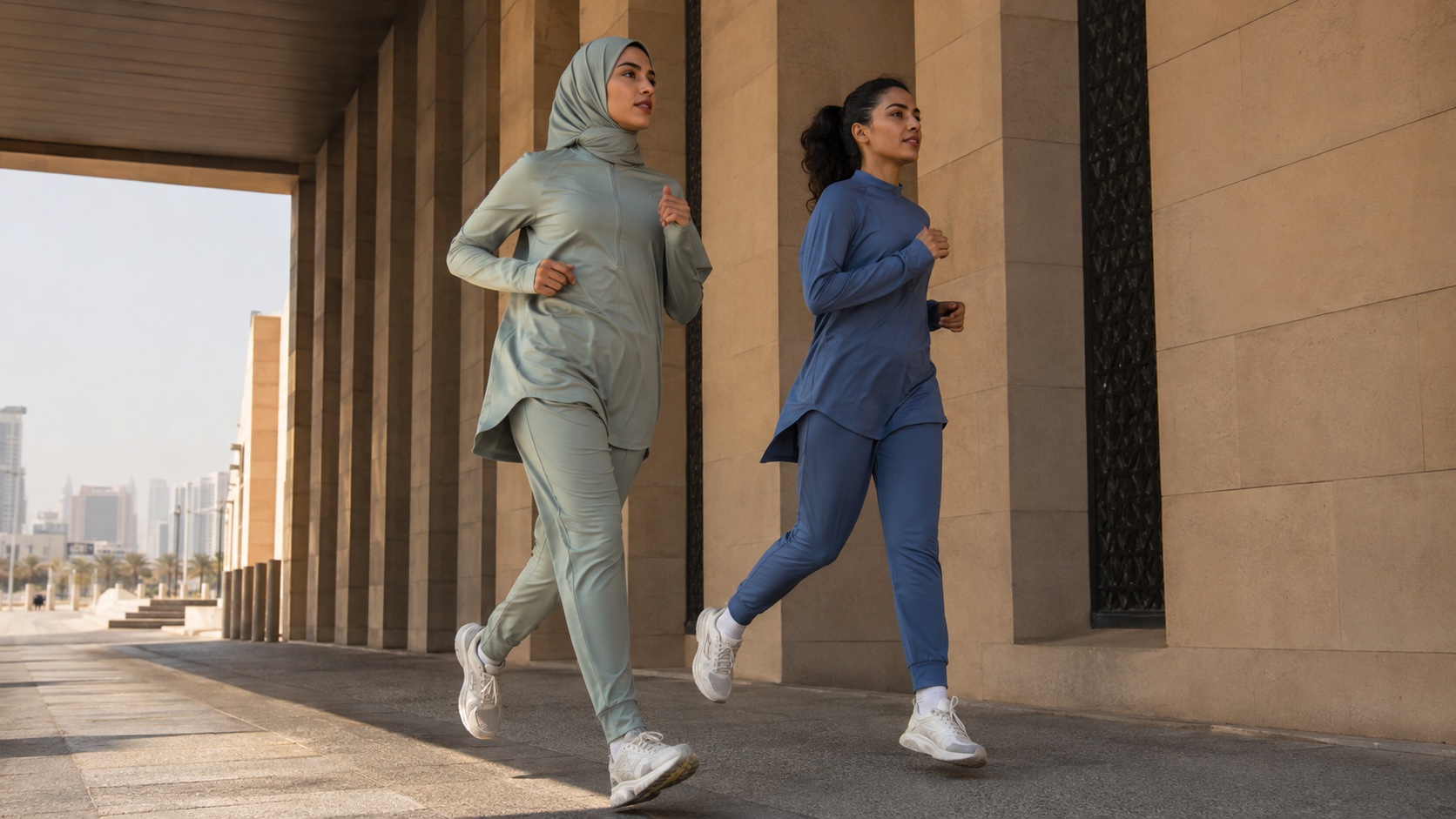
The opening is not “modest activewear for everyone.” It is narrower: one single-layer longline training top for modest-dressing women who exercise in mixed-gender public space in a specific hot climate. The garment should create coverage through pattern, opacity, drape, anchoring, and screened ventilation—not through automatic layering.
Our judgment is act now at discovery and prototype stage. The signal is meaningful enough for a controlled test, but neither current products nor academic research justifies a broad collection order.
Why hot climate modest activewear still has a system problem
Dedicated brands already show that modest activewear is not an empty niche. HAYA’s Essential Training Top currently combines glute-covering length, long side slits, a zip neck, thumbholes and pockets in an 87% polyester/13% spandex fabric. It is offered from XS through 5XL.
Dignitii’s Performance Top takes another approach: a turtleneck, a tulip-shaped skirt and an internal tuck-in panel intended to prevent the back and abdomen from becoming exposed during movement. Its listed fabric is 100% OEKO-TEX-certified polyester.
Qatar-founded oola positions an assortment of long-sleeve tops, full-coverage bottoms, running sets and sports hijabs around GCC exercise. Saudi-based A&B Label explicitly describes lightweight garments for warm climates. HAYA, Dignitii, oola and A&B all make company claims about breathability or hot-climate suitability; their public pages do not independently establish comparative cooling performance or sales.
The useful signal is the range of constructions brands have already needed: side slits, high necks, long backs, tuck-in panels, tulip skirts, oversized fits, sports hijabs and wide-leg bottoms. Coverage is not one measurement. It changes when a wearer raises her arms, bends, runs, catches wind, sweats, sits, or uses equipment.
The reviews are equally instructive, though they remain brand-hosted and non-representative. HAYA customers have asked for more length or described differences in chest fit. Some Dignitii reviewers report that a recommended size or even sizing up still left the waist and abdomen more fitted than they wanted.
Competitive audit: do not score products simply as “modest” or “not modest.” Record front length, back length, chest and hip ease, neckline, sleeve behavior, slit height, wet and dry opacity, cling after sweat, lift during overhead reach, obstruction near equipment, and how many layers are still required.
The hidden competitor is the improvised outfit
The customer may not be choosing between two modest-activewear brands. She may be choosing between a purpose-built product and an outfit assembled from unrelated categories:
- a men’s running top for extra width;
- a fitted base layer under a loose T-shirt;
- arm sleeves plus a short-sleeve top;
- a hoodie despite the temperature;
- a long lifestyle tunic that was never designed for running or strength work;
- an indoor or women-only activity because the public outfit feels unworkable.
Recent Reddit discussions cannot quantify a market, but they repeatedly reveal this improvisation. Women describe shopping in men’s sections, combining layers, searching for tops that cover the glutes without looking shapeless, and balancing a secure head covering against heat. One discussion about training for a summer 10K focused not only on fabric but on side openings, movement and whether a garment remained loose when wet.
This changes the product question. The new top does not have to beat every activewear garment. It has to replace one specific compromised outfit.
Interview question: “Show me exactly what you wore the last time you exercised outdoors, including every layer. At what movement or moment did the outfit stop working?” That will produce better evidence than asking whether someone likes the idea of breathable modest sportswear.
Coverage must be mapped in motion
A static mirror check misses the moments that define modesty for the wearer. A hem that covers the glutes while standing may rise during a lunge. A loose torso can collapse against the chest in wind. A side slit can improve stride and expose more than intended. A high neckline may remove the need for an undershirt but add heat at the neck.
The founder should create a coverage map with the test group. It should identify:
- which body areas each wearer wants covered;
- whether “covered” means skin hidden, body outline softened, fabric opaque, or all three;
- which requirements change between women-only and mixed-gender environments;
- which movements create exposure, outline or garment-lift events;
- where loose fabric becomes distracting or unsafe.
There is no single religious or cultural specification that every Muslim woman follows. Some customers wear hijab; others do not. Some require glute and chest coverage; others prioritise arms, neckline, or reduced body outline. A global “modest fit” drafted from one founder’s preferences will turn disagreement into returns.
Fit-panel rule: recruit around one shared coverage standard and one activity for the first product. Record other requirements as future segments rather than averaging incompatible expectations into a shapeless garment.
Turn that standard into a dynamic coverage matrix before drawing the final pattern:
| Garment zone | Movement test | Coverage failure to observe | Heat or movement conflict |
|---|---|---|---|
| Neckline and upper chest | Reach, bend, turn head | Gaping, skin exposure, outline under wind | High collar or hijab overlap traps warmth |
| Upper back and underarm | Arm swing, overhead reach | Transparent vent, bra line or skin visible | High-sweat zone needs an indirect airflow path |
| Chest and abdomen | Forward bend, crosswind, damp wear | Fabric collapses onto body outline | More ease may flap; more weight may cling |
| Hip and glute coverage | Squat, lunge, stairs, seated position | Hem lifts above the agreed line or sticks to bottoms | Extra length increases contact and wet drag |
| Side opening and hem | Long stride, rotation, fan or breeze | Slit exposes the side body or underlayer | Closed hem restricts stride and ventilation |
The table should be rewritten with the actual co-design group. Its purpose is to turn “I feel covered” into observable garment behavior without pretending modesty can be reduced to one universal centimetre measurement.
The heat map is a different drawing
Coverage requirements do not identify where the garment must release heat and moisture. That requires a second map.
The heat-and-cling map records where testers feel heat accumulating, where sweat becomes visible, where fabric sticks to the body, where a head covering overlaps the top, and where airflow is blocked by a sports bra, waistband, bag strap or another layer.
Scientific evidence supports caution rather than a miracle-fabric answer. In a randomized crossover study of only eight women exercising at a 30°C Wet Bulb Globe Temperature, Islamic athletic clothing produced higher clothing microclimate temperature and humidity, greater session perceived exertion, sweat loss and discomfort than a traditional soccer uniform. Core temperature and heart rate did not differ significantly.
The study is small and tested one clothing system; it cannot define all modest activewear. It shows why a founder should measure both physical and perceived outcomes instead of declaring a covered garment “cooling.”
A 2022 review of sports clothing in heat found mixed results across fabrics and designs and noted how few studies directly compare loose and tight garments. A 2024 study involving 12 women found that ease allowance altered clothing air gaps and airflow—but in a 20°C office-like environment, not a hot outdoor workout.
The design implication is not “make it loose.” Excess ease can collapse, flap, snag, or create stagnant pockets. The garment needs managed air space plus an exit path.
Product-development reward: place the coverage map and heat map on top of each other. The opportunity lives where coverage is non-negotiable but direct fabric contact, overlapping layers or closed openings create the greatest discomfort.
Coverage without heat trap is a construction problem
Fabric matters, but fabric alone cannot solve a closed garment system. A thermal-manikin study of athletic T-shirts found that extending the air gap improved ventilation when vented panels were also present, and that vent placement affected heat and moisture transfer. Because it was a manikin test, it should inspire prototypes—not marketing claims.
A credible longline top could explore four construction ideas:
- Single-layer opacity: use one fabric system that remains acceptably opaque and does not reveal the body outline when damp, instead of relying on an undershirt.
- Managed ease: add room where the chest, abdomen and hips need shape separation, while controlling excess fabric around arms and equipment.
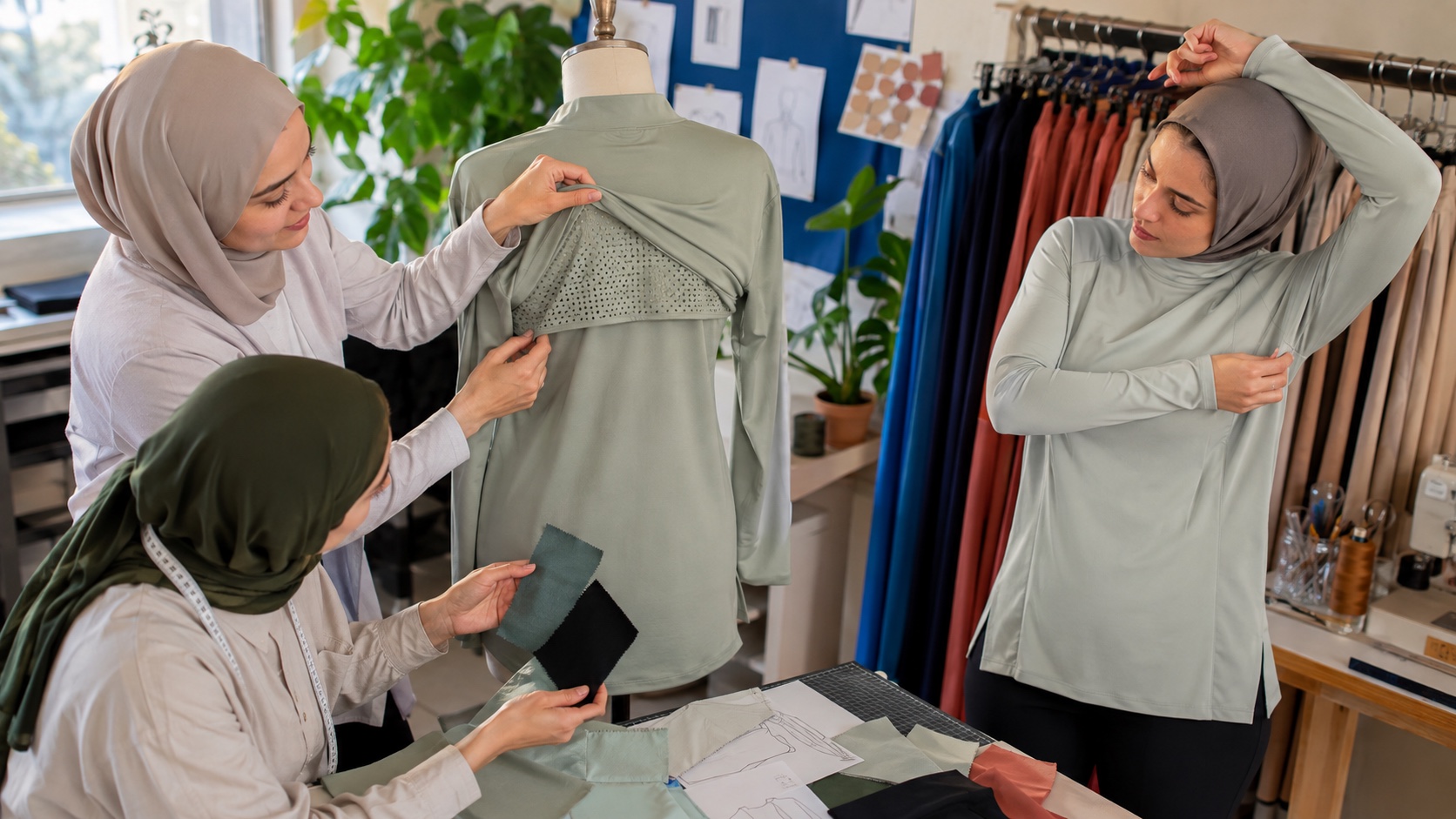
- Screened ventilation: place breathable or perforated zones at underarms or upper back behind overlapping yokes or indirect sight lines, rather than using transparent mesh across a coverage-critical area.
- Anti-lift architecture: use hem shape, movement gussets, or a discreet internal anchor so the garment can open for stride without exposing the abdomen or riding above the intended back coverage.
Each idea contains a trade-off. An opaque fabric may become heavier. A vent may show skin under stretch. An anchor may feel restrictive. A long back may cling to damp leggings. A side opening can improve movement while undermining coverage. The job of sampling is to reveal those conflicts early.
Hot weather does not make one fibre category the automatic answer. A natural-forward fabric may feel pleasant but hold more water, dry differently, lose shape, or require a heavier construction for opacity. A synthetic fabric may manage moisture well but still feel clammy when it closes the air space or clings to the body. Our related analysis of the natural fiber activewear opportunity reaches the same underlying conclusion: the material must earn one use occasion through the finished garment, not through its label.
Claims rule: “lightweight,” “breathable,” “quick-dry,” “sweat-wicking,” “UPF,” and “cooling” are different claims. Define which one matters, how it will be tested, and what the product will not promise. Coverage from the sun does not automatically establish a UPF rating.
The first MVP should be one top—not a complete modest collection
A founder may want to launch a long top, loose trousers, sports hijab, swim option and layering jacket together. That makes the imagery coherent and the learning useless.
Head coverings involve face opening, head size, hair volume, glasses, hearing, helmet compatibility, slip, neck overlap and personal styling. Bottoms introduce stride, crotch fit, opacity, thigh contact, waistband security and wide-leg equipment risk. If all three categories launch together, the team will not know which failure prevented adoption.
The first MVP should be one single-layer longline airflow training top. Ask testers to keep using their existing sports bra, bottom and head covering. The product tests one proposition: can a purpose-built top remove one layer while preserving the wearer’s required coverage through her selected run-walk movements?
One possible prototype direction is:
- high but non-compressive neckline;
- raglan or movement-oriented sleeve architecture;
- controlled chest, waist and hip ease based on garment—not body—measurements;
- longer back with a front length that does not bunch at the thighs;
- overlapping upper-back or underarm ventilation that preserves the agreed sight line;
- curved or tulip movement opening plus a hidden anti-lift solution;
- no exposed drawcord or loose trim near gym equipment.
This is a development hypothesis, not a finished specification. The target women should decide whether each detail actually meets their definition of modesty.
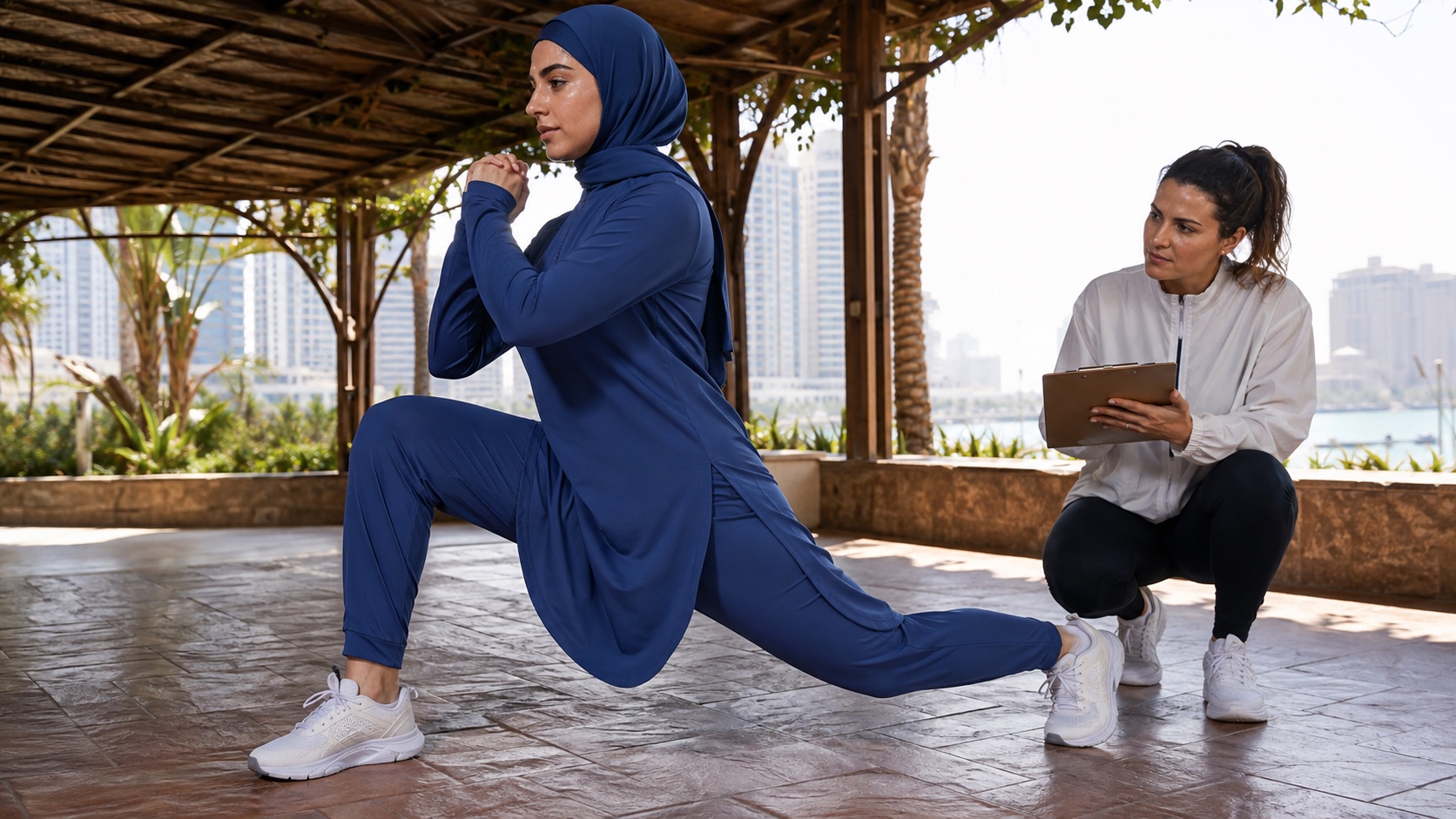
A seven-day diary should come before the first sample
Recruit eight to twelve women in one city who already use long sleeves and longline coverage for the chosen public activity. Do not recruit “the modest market.” Choose one shared use case—for example, early-morning or evening outdoor run-walk sessions.
For seven days, ask participants to record:
- temperature, humidity or heat index available for the time and location;
- activity, duration and whether the space was mixed-gender;
- every garment layer worn;
- the first place heat or sweat became distracting;
- where fabric clung, lifted, opened, became transparent, or obstructed movement;
- any adjustment made during the session;
- whether clothing changed the route, intensity, timing or decision to exercise.
The sample gate is a repeated sequence: the same occasion requires coverage; the current outfit needs multiple or unsuitable pieces; the same heat, cling or movement failure occurs; and the participant actively wants to replace that outfit.
If the group is satisfied with an existing top or the dominant barrier is facility access, safety, schedule or family responsibility, a new garment may not be the best business. A survey of 447 Arab Muslim mothers in the United States identified dress code among several barriers, alongside stress, motivation and responsibilities. A recent Saudi qualitative study also describes facility, safety, social and climate constraints.
Stop before sampling if clothing is not the repeated bottleneck. Product empathy does not require pretending every participation problem is solvable by apparel.
Test replacement, not compliments
Once the diary earns a sample, compare the candidate against each tester’s real improvised outfit. Keep the route, time window, activity sequence, base layer, bottom and head covering as consistent as safety and real life allow.
Use a short movement sequence before the outdoor session:
- overhead reach;
- deep squat and forward bend;
- walking lunge;
- short jog or stair climb;
- turn into a fan or natural breeze;
- sit, stand and use any relevant equipment.
Record layer count, thermal sensation, damp cling, wet and dry opacity, hem movement, exposure events, fabric obstruction, drying experience, and which outfit the tester would choose for the next session. Weighing the dry and post-session garment can provide a simple comparative signal of moisture held, but it is not a laboratory moisture-management claim.
A practical continuation gate for this small directional panel is that a clear majority chooses the candidate for the named occasion, the top removes at least one current layer, and no coverage, cling or safety failure repeats across the group. This is a founder decision rule, not statistical market proof.
Revise if the candidate feels cooler but clings or lifts. Stop if it does not replace a layer, existing products perform equally well, or achieving coverage creates unacceptable weight, transparency, obstruction or cost.
Hot-climate testing has a non-negotiable safety boundary
No activewear product makes extreme heat safe. CDC/NIOSH describes heat stress as the combined effect of environmental heat, physical activity, clothing and personal factors. Its guidance explains that thicker or less permeable clothing can inhibit sweat evaporation and convective cooling.
A founder should not deliberately expose testers to unsafe conditions to prove a garment. Use familiar routes, appropriate times, hydration and stop rules. Do not tell wearers that “cooling fabric” prevents heat illness. If a participant feels unwell, the test ends; the clothing result is irrelevant.
This boundary can improve brand trust. The product promise is not “train safely in any temperature.” It is “reduce an avoidable clothing compromise during an activity the wearer has already decided is appropriate.”
The founder should make the fit disagreement visible
Founder-led content can work especially well here when the founder or co-designers genuinely live the problem. The useful story is not a generic declaration that modest women deserve better. It is the product disagreement:
- one tester wants a longer back while another finds it sticky;
- the first vent improves airflow but reveals skin during reach;
- sizing up fixes outline at the torso and ruins the sleeve;
- a side slit improves stride but opens in crosswind;
- a darker fabric feels secure when damp but changes the heat experience.
Showing these choices can recruit the right testers and teach customers what the brand means by coverage. It also protects the founder from presenting her personal standard as universal.
If the founder does not wear modest activewear, build a paid or fairly compensated co-design group with decision power. Do not use Muslim women as visual legitimacy while outsiders define the product.
Content reward: publish one “coverage in motion” clip for each sample—not a polished transformation montage. Show the six movements, the failure found, and the single change made next.
When Battlerobe becomes relevant
The diary, coverage map, competitor audit and first positioning test should happen before factory development. A manufacturer cannot decide which modesty standard the customer follows or whether clothing is the real participation barrier.
Once the problem repeats, the product becomes highly interconnected. Fabric air permeability and opacity, garment ease, back length, slit position, vent geometry, seam placement, wet cling, anchoring, sleeve movement and size grading all affect the same promise. Enlarging a standard top cannot solve that system reliably.
Small-Batch Ready-to-Custom is unsuitable when the hypothesis requires a new pattern, custom vent placement, controlled ease or different fabric behavior. After customer evidence, Battlerobe’s Small-Batch Custom Development is the stage-correct route for turning the coverage and heat maps into controlled samples.
Battlerobe can help develop the pattern, evaluate feasible stock-ready fabrics, tune fit and construction, and maintain clear sample variables. Small-batch fabric and colour choices depend on stock availability; high-MOQ mill-run fabrics, custom dyeing, exact price, development cost and lead time must be confirmed for the project. Battlerobe should not promise a “cooling” result before wear and material testing.
Bring this preparation brief:
- one city, safe test window, activity and public-space context;
- one shared coverage standard plus documented variations;
- three improvised or competitor outfits and their exact failures;
- the coverage map and heat-and-cling map;
- required dry/wet opacity, handfeel, ease, weight and care behavior;
- movement sequence and outdoor comparison protocol;
- features to hold constant between samples;
- continue, revise and stop conditions.
The Battlerobe product-development guide explains why fabric, pattern, fit and sampling must be resolved together. If the top later proves repeat demand, production quality control becomes important because small changes in fabric weight, opacity, measurement, slit height or vent construction can change both coverage and thermal experience.
Expansion should follow the next unresolved layer
If the top removes one layer and earns repeat use, the next product should address the adjacent compromise reported by the same cohort.
That may be a warmer-climate tank-and-sleeve modular system for a different modesty standard, a loose tapered running trouser that avoids equipment risk, or a sports hijab designed around the neck overlap of the proven top. It should not automatically be all three.
The expansion sequence is:
- prove coverage in motion;
- prove the removal of one improvised layer;
- prove climate-specific wear and care;
- prove size and length logic across the selected cohort;
- then solve the next layer that customers still have to improvise.
Only after commercial proof should a brand consider custom fabric development, larger colour architecture and a complete system. The moat is not simply “we cover more.” It is accumulated knowledge of how this customer moves, sweats, layers, adjusts and defines confidence.
The opportunity is fewer compromises, not more fabric
Hot climate modest activewear is ready for a bounded test because product activity, customer improvisation and participation research point to a real friction. It is not ready for certainty because modesty standards differ, thermal evidence is limited, existing specialists are active, and clothing is only one of several barriers to movement.
The unusually well-suited founder is someone who lives the outfit problem or is prepared to give a local co-design group real authority. She should begin in one climate and one public exercise occasion, not with a global cultural category.
The first action is simple: ask ten women to bring the exact layered or borrowed outfit they currently use. Map every place it covers, every place it traps heat or clings, and every movement that forces an adjustment. If one repeated problem appears, sample one top.
Continue only if the candidate replaces a layer and preserves coverage through movement. Revise if cooling and modesty trade places. Stop if the dominant barrier is not clothing or an existing product already solves the job.
A strong modest-activewear brand will not tell women to accept heat in exchange for coverage—or exposure in exchange for performance. It will show, one tested construction at a time, where that compromise can genuinely be reduced.
Sources and further reading
- HAYA Essential Training Top
- Dignitii Performance Top
- oola brand and product positioning
- European Journal of Applied Physiology: Islamic athletic clothing and heat response
- Sports Medicine – Open: sports clothing, thermoregulation and exercise in heat
- Research Journal of Textile and Apparel: athletic T-shirt ventilation design
- Case Studies in Thermal Engineering: ease allowance and clothing microclimate
- Ethnicity & Disease: physical-activity barriers among Arab Muslim mothers
- BMC Public Health: barriers and facilitators among Saudi adults
- CDC/NIOSH: heat stress and clothing