

Leelo Active is a useful brand to study for a very different reason from Lululemon.
It did not create a new product category. It did not enter an empty market. And it did not begin with a famous founder, a huge audience, or a large retail network.
When Leelo launched in Perth in 2019, activewear was already crowded.
Lululemon was established. Gymshark was growing globally. Australia already had strong activewear brands. Thousands of leggings, sports bras and crop tops were already available.
Yet within roughly five years, Leelo went from a spare bedroom and a first bulk order of AUD 26,000 to a business its co-founder said was on track to exceed AUD 10 million in annual revenue. By 2025, a retention agency working with the company described Leelo as an eight-figure Australian activewear brand. Because Leelo is privately held, these figures are founder- and partner-reported rather than audited public-company revenue. (founder interview) LinkedIn
That makes Leelo particularly useful for emerging brands.
The question is not:
How do you become the next Lululemon?
A much more realistic question is:
How does a small brand find enough space inside an already crowded market to become meaningful?
Leelo’s story suggests that the answer is not one brilliant product or one viral campaign. Its real strength was the sequence in which positioning, product, content, distribution and retention developed.
1. Leelo Chose a Cultural Position Before It Built a Large Product Range
Beth Walker and Sean Meyer started Leelo in 2019 after returning to Perth from London. According to their own account, they launched from a spare bedroom in Sean’s parents’ house and put approximately AUD 26,000 into their first bulk order, delaying other personal spending such as moving out and buying a car. (Beth Walker and Sean Meyer interview) LinkedIn
But the more important part of that interview is not the AUD 26,000.
It is why they chose the market they chose.
The founders said they could see Pilates becoming increasingly popular and deliberately decided to “lean into the Pilates niche”, with the intention of becoming a brand closely associated with that movement. RetailOasis later described the same strategy as Leelo finding its niche in the growing Pilates market and differentiating through product design and quality. (RetailOasis interview with Sean Meyer) Apple Podcasts
This distinction matters.
Leelo did not ask:
“Which leggings are selling well?”
It effectively asked:
“Which kind of woman, activity and lifestyle do we want this brand to become associated with?”
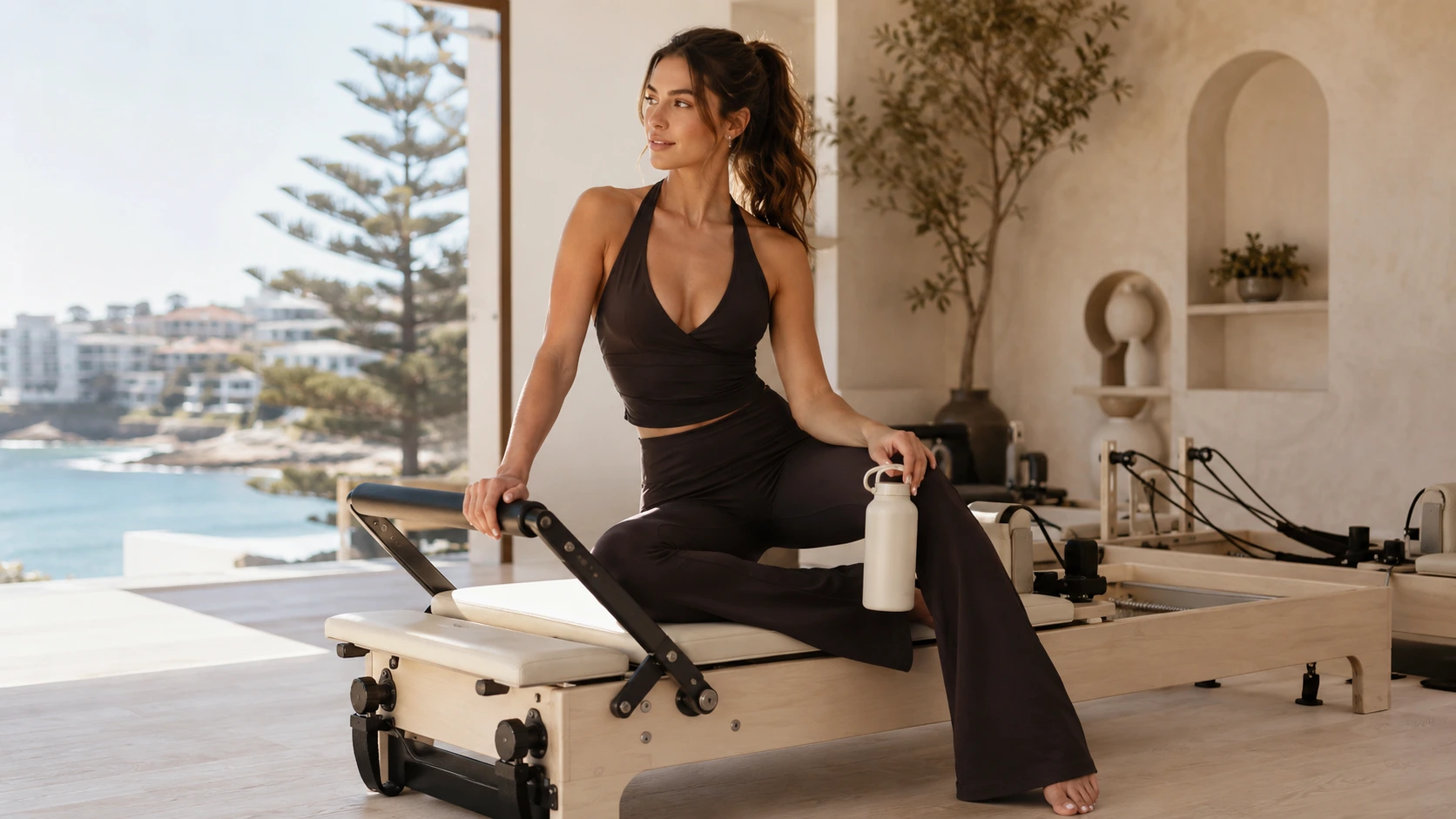
Pilates became more than an exercise category. It developed a visual and social world around studio culture, feminine activewear, wellness, coffee, low-impact movement and clothes that could move beyond the workout itself.
That gave Leelo a much clearer territory than simply saying it sold women’s activewear.
What I would do if I were starting a brand today
Before selecting the first styles, I would force the positioning into one sentence containing four elements:
Activity + Customer + Lifestyle + Aesthetic.
For example, “women’s activewear” is too broad.
So is “Pilates clothing.”
Something closer to:
Reformer Pilates + urban professional women + studio-to-street + feminine minimalism
is already useful enough to make decisions.
It tells you what products belong in the first collection, what probably does not belong, what creators make sense, what photography should look like, and even which colors are likely to feel consistent.
The lesson from Leelo is therefore not to choose Pilates.
It is to occupy a narrower cultural position than the large brands need to occupy.
A small brand does not need millions of people to care about it.
It needs a particular group of people to feel:
“This brand looks like it was made for us.”
2. The First Money Went Into Product Before the Brand Had Proof of Scale
The founders say they tested seven supplier options before choosing their first supplier, and that they were still working with the same supplier five years later. They specifically connected their early insistence on product quality with the premium reputation the brand later developed. (founder interview) LinkedIn
That matters because an early activewear brand has limited capital and an uncomfortable choice.
You can spend heavily making the brand look established.
Or you can spend more of that limited capital making sure the customer who finally buys the product does not regret it.
Leelo’s current positioning still reflects that early choice. The company describes itself as a luxury athleisure label built around fitness, fashion, comfort, style and quality. Its current Sculpt products emphasize details such as nylon-spandex fabrics, squat-proof coverage, no-front-seam construction, support, moisture management and fit. (Leelo About Us) (Sculpt Wide Leg Pants) LEELO ACTIVE
What I would recommend to a new brand
If your first meaningful product budget is somewhere in the USD 10,000–30,000 range, I would not use it to create a large collection.
I would rather launch three to five products that share one or two core fabric systems than ten unrelated products sourced from multiple constructions and fabrics.
That makes it much easier to learn.
If customers love the fabric but dislike one neckline, you know what to change.
If every style uses a different fabric, fit and construction, you have too many variables to understand why something succeeded or failed.
This is also where production strategy should depend on what you are trying to learn.
If the biggest uncertainty is still:
Will this customer buy this silhouette, color direction and positioning at all?
then developing every pattern from scratch may be an unnecessarily expensive way to answer that question. A route such as Battlerobe’s Small-Batch Ready-to-Custom can be useful because existing silhouettes let a founder test the brand, assortment and customer response with less development commitment. Battlerobe’s current Ready-to-Custom model is specifically structured around existing silhouettes with brand customization rather than original pattern development. Battlerobe
But if the reason the brand deserves to exist is a specific fit, neckline, waistband, construction or product concept that existing styles cannot deliver, then testing generic products defeats the purpose. That is the point at which Small-Batch Custom Development becomes more logical.
The production route should answer the uncertainty.
Use existing products to test the market.
Use development to test a real product idea.
3. Leelo Found Products That Could Perform and Communicate at the Same Time
Leelo’s black flares became one of the products most strongly associated with the brand. Perth Is OK described the black flares as one of Leelo’s standout products, while the brand’s current range continues to feature flare leggings prominently alongside wide-leg pants, leggings, tanks and shorts. (Perth Is OK brand profile) (Leelo leggings collection) LinkedIn
This is a particularly useful product lesson.
A black flare is not a revolutionary piece of textile engineering.
Its advantage is that it works at two levels simultaneously.
It can function as activewear.
But visually, it is immediately different from a conventional ankle-length legging.
That distinction matters much more in a social-media-led environment than many product developers realize.
Consumers do not initially experience your moisture-wicking percentage or seam durability in an Instagram Reel.
They experience the silhouette.
The neckline.
The waist.
The back.
The color.
The way the product changes the body visually.
Leelo later repeated the same logic with products such as its Sculpt Halter Neck Tank, which the company positions for Pilates, gym, yoga and even “going for a coffee.” LEELO ACTIVE
That last phrase says a lot about the brand.
The product is not being asked to live only inside the workout.
How I would build a first collection around this idea
For a first collection of four to six styles, I would not make every item visually unusual.
That creates a collection that is difficult to wear and difficult to replenish.
Instead, I would build approximately three or four commercial core products and one or two visible signature products.
The commercial core could be a dependable legging, short, bra or fitted tank.
The visual hook might come from a halter neckline, a different waist construction, a flare proportion, a distinctive back, layering detail or unusually strong silhouette.
The important test is simple:
Put your product beside 15–20 competitor products and remove the logos. Can a customer still notice yours?
If the answer is no, you may have a perfectly sellable product.
But you probably do not yet have a product doing much work for brand recognition.
This is where original development earns its cost. Customization is most valuable when the design difference is visible or functionally meaningful—not simply because a founder wants to say the product is “custom.”
4. Leelo Did Not Abandon a Winner; It Turned the Winner Into a Product Language
This is one of the strongest parts of the Leelo case.
Look at its current Sculpt collection and the pattern becomes obvious.
Sculpt is no longer one legging.
The same product language extends across full-length leggings, flares, wide-leg pants, bike shorts, tanks, halter tops, long sleeves and other silhouettes. It also extends through different lengths and fit options, including tall and petite versions of certain bottoms. LEELO ACTIVE
Color is layered onto the same system. Dark Chocolate, Cherry Cola, Black, Navy, French Vanilla and other colors reappear across multiple related products rather than every color belonging to one isolated style. (Leelo Dark Chocolate collection) LEELO ACTIVE
That is very different from the way many new brands source products.
A weak collection often looks like this:
Find one popular bra.
Find a completely unrelated legging.
Find a trending jacket.
Add six colors.
Call it a collection.
Leelo’s current assortment behaves more like a product family.
The customer who likes Sculpt does not need to relearn the brand every time a new product appears.
What new brands should do after finding a winner
Do not immediately ask:
“What is the next trend?”
First ask:
“How far can this winning idea travel?”
If a tank is working because of a specific neckline, could that language extend into a crop, dress or one-piece?
If a particular fabric becomes associated with the brand, can it support leggings, shorts, flare pants and fitted tops?
If one waistband consistently receives good feedback, should it become part of the brand’s bottom architecture rather than remain attached to a single SKU?
This matters operationally too.
Reusing proven product logic reduces the amount of uncertainty introduced with each new launch.
You are not starting from zero every season.
A strong growing brand gradually accumulates product memory.
That is one of the reasons repeat production becomes more valuable as a brand matures. Once several products have proven demand, the production question shifts from “What should we test?” toward consistency, color matching, repeat fit, cost and reliable replenishment.
That is the natural point where larger-volume custom production starts becoming economically more useful than keeping every order tiny.
5. Leelo Sold an Identity, Not Just Exercise Clothing
Leelo describes itself as a label for women with “a passion for fitness and fashion” and positions its products for life both inside and outside the gym. (Leelo About Us) LEELO ACTIVE
A Perth ecommerce agency that has observed the brand described its aesthetic as a form of “attainable luxury”: clean, elevated, apparently effortless imagery that sells the feeling of being the woman in the image rather than simply selling leggings. That is an outside interpretation, not Leelo’s own formal positioning, but it captures something visible in the way the brand has marketed itself. (Lethal Digital analysis) Lethal
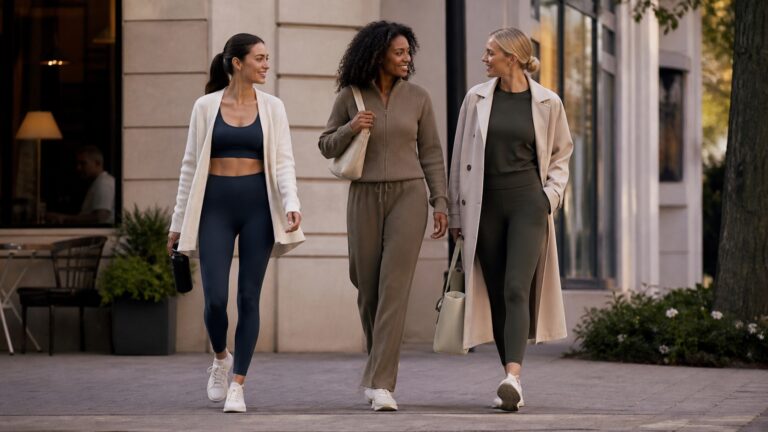
This is why activewear branding is increasingly difficult to separate from lifestyle branding.
Function gets the customer through the workout.
Identity gives her a reason to choose one functioning product over twenty alternatives.
A practical exercise I would use before creating brand content
I would finish this sentence:
Our customer wears us because she wants to feel ________.
Not:
because the leggings are 75% nylon.
And not:
because we make high-quality activewear.
Those are product attributes.
The missing word might be:
polished.
feminine.
strong.
effortless.
technical.
bold.
understated.
Then I would audit the entire brand against that answer.
If the desired identity is “effortlessly polished,” but the homepage uses aggressive bodybuilding photography, neon color palettes and technical-performance language, the brand is fighting itself.
If the desired identity is “serious hybrid athlete,” but every piece of content is coffee, mirrors and soft studio poses, the problem is the same.
The strongest lifestyle brands repeat one identity through products, people, environments, language and styling until the customer no longer needs the logo to understand the world.
6. Leelo Used Paid Media to Amplify Content That Already Felt Native
Leelo launched its TikTok channel in early 2023 and then worked with Megaphone on Spark Ads, In-feed Ads and lookalike audiences. TikTok’s own case study reports that between February 2023 and February 2024 the campaigns achieved an average 4.5× ROAS, a 4.2% Complete Payment conversion rate on dark ads and more than 870 tracked purchases. These are platform case-study results, not audited company-wide marketing figures, so they should be read as evidence of that campaign rather than Leelo’s entire acquisition performance. (TikTok for Business case study) TikTok For Business
The more useful detail is how the advertising worked.
Spark Ads allowed Leelo to amplify organic videos and creator content while retaining the native TikTok format. In-feed dark ads were used to test creative styles, while customer signals and lookalike audiences helped the campaign find more likely buyers. TikTok For Business
The sequence is important:
content → response → amplification
rather than:
advertising budget → expensive campaign creative → hope
How I would run the first content test today
Before spending heavily on paid ads, I would make 20–30 relatively low-cost pieces of content around the same small product collection.
Not 30 versions of a polished campaign.
I would deliberately vary the job the content performs: some should show fit, some styling, some movement, some product details, some founder context, some real customer or creator use, and some pure lifestyle.
Then I would look for creative that repeatedly earns attention and buying signals.
Only after that would I put meaningful paid budget behind it.
A startup does not need to use advertising to discover whether a boring creative is boring.
Organic response can do some of that work for free.
Paid media should accelerate learning that has already started, not replace it.
7. Creator Marketing Works Better When Creators Have Different Jobs
Leelo’s growth has included TikTok, Instagram, creator-generated content and community activity around Pilates. Its TikTok case study specifically says the company intended to expand creator collaboration and user-generated content, while the founders themselves describe Pilates as the niche around which they deliberately built the brand. TikTok For Business
This is where many small brands waste product and budget.
They send the same package to 100 creators and evaluate everyone using the same question:
How many views did we get?
But creators can create value in different ways.
The first 20 creators I would recruit
I would deliberately give them three different jobs.
A small group would be product testers. Their value is not public reach. I want detailed criticism about fit, support, fabric, movement and styling.
The second and largest group would be content creators. Their job is to make the product look desirable and understandable in a format I can potentially reuse.
The final group would be sales creators or affiliates. Their job is measurable conversion.
One person may perform more than one role, but the distinction matters.
A Pilates instructor with 6,000 highly local followers may be an exceptional product tester and trust source without generating huge online sales.
A creator with 60,000 followers may make outstanding reusable video but convert poorly.
Another creator may produce unimpressive-looking content that somehow sells repeatedly.
Those are three different assets.
For the second round, I would not send more products to everybody.
I would concentrate product and money around whichever people proved useful at the job they were selected to do.
That turns creator marketing from gifting into a learning system.
8. Leelo Used Wholesale as a Brand Signal, Not Only a Sales Channel
Leelo currently says it is stocked in more than 35 Australian stores, including StyleRunner, Hyperluxe, The Iconic and Motion Lifestyle. (Leelo About Us) LEELO ACTIVE
More interestingly, Beth and Sean said in their founder interview that they were intentional about who stocked the brand, deliberately wanting Leelo positioned alongside other premium labels. (founder interview) LinkedIn
That turns wholesale into more than distribution.
Imagine a customer who has never heard of a small brand.
If she first discovers it in a retailer she already trusts, sitting beside New Balance, P.E Nation, Nagnata or other premium labels, the retailer has already done part of the credibility work.
The shelf itself communicates positioning.
When I would start wholesale—and when I would not
I would not pursue wholesale simply because a boutique sends an email.
Before pushing seriously into wholesale, a brand should already know at least one or two products that sell consistently, understand its size curve, have enough margin to support wholesale pricing, and have a production system that can reproduce the same garment reliably.
Then I would evaluate retailers by adjacency, not simply number of doors.
Ask:
What other brands will we sit beside?
What price environment does this retailer create?
Does its customer resemble ours?
Will it strengthen or confuse our positioning?
Ten highly aligned doors can be strategically more valuable than fifty random doors.
And once wholesale starts creating larger, more predictable repeat orders, production priorities change again. Unit economics, consistency and replenishment become more important. That is where a larger-scale production model starts making sense—not because “bulk is better,” but because the business has finally created enough certainty to justify the commitment.
9. At Scale, Leelo Shifted From Finding Customers to Making Existing Traffic and Customers More Valuable
A young ecommerce brand naturally spends enormous attention on acquisition.
Leelo eventually reached the point where retention became large enough to deserve its own growth system.
A 2025 case study from MKTG Emails, which works with Leelo, describes the company as an eight-figure activewear brand. The agency says email was already generating roughly 30–35% of Leelo’s total revenue before its retention work was rebuilt. During the first six months of the engagement, the agency reports email-driven revenue rising 89% year over year, approximately 7,000 new subscribers per month, more than AUD 1 million in additional annualized retention revenue, and overall company revenue growing 56% year over year. These are agency-reported client results and should not be treated as independently audited company accounts. (MKTG Emails Leelo case study) MKTG Emails
Sean Meyer also described using visitor re-engagement technology to recover traffic that had not purchased; an Add To Cart case study reports Leelo seeing an extra AUD 66,000 and a claimed 25× ROI during the first 30 days of one such implementation. Again, this is a vendor/podcast case study rather than audited company reporting. (Add To Cart interview) Add To Cart
The strategic change is more important than the exact numbers.
At the beginning, the question is:
How do we get a customer?
Later it becomes:
Why are we paying repeatedly to reacquire people who already know us?
What an early brand actually needs
A startup does not need 40 complex automations on launch day.
But once there is steady traffic and regular orders, I would at minimum build a useful welcome sequence, abandoned-cart recovery, post-purchase communication and a win-back system.
More importantly, product strategy should support retention.
If a customer loves one Sculpt-style bottom, a related top or new color gives her a logical reason to return.
This is another reason product families matter.
Retention is not only an email problem.
It is also a merchandising problem.
10. Leelo Grew Without Pretending It Needed a Huge Organization
In the founders’ 2024 interview, they said the Leelo team had grown to around 13 full-time and casual staff and emphasized keeping the company lean even as revenue grew. Sean Meyer separately wrote at the five-year mark that the company had grown from a spare bedroom with “zero business knowledge or experience” to being on track for more than AUD 10 million in annual revenue and achieving six-figure sales days. (founder interview) (Sean Meyer five-year post) LinkedIn
That is a useful counterweight to the way many founders imagine growth.
A brand does not become legitimate because it has:
a large office,
a huge catalogue,
a large internal team,
or complicated systems.
Those things become useful only when the business needs them.
The early brand’s scarce resource is not organizational complexity.
It is attention.
Every new SKU, supplier, market, channel and employee creates something else that must be managed.
Leelo’s trajectory suggests a more disciplined sequence:
prove something, then add the capability required to support what has been proven.
11. Leelo’s Next Challenge May Be Harder Than Its First
Successful case studies become useless when they end with:
“And then the brand succeeded.”
Leelo’s future is not guaranteed.
Its own website now contains a much broader product assortment than the early brand, including multiple Sculpt silhouettes, lengths, colors, tanks, flares, wide-leg pants, leggings, shorts, layers and accessories. The site currently also promotes offers such as three tanks or crops for AUD 150 and two leggings or flares for AUD 150, while some products are sold at markdowns. (Leelo current website) LEELO ACTIVE
Discounts and bundles are normal retail tools. Their presence does not prove Leelo has an inventory or margin problem.
But they point toward the strategic problem every scaling fashion-activewear brand eventually faces.
The more products and colors you introduce, the more inventory positions you create.
The more competitors copy halters, flares, wide-leg pants and Pilates styling, the less those elements alone can protect the brand.
The question shifts from:
Can Leelo become known for this aesthetic?
to:
Can Leelo keep customers choosing Leelo after the aesthetic becomes common?
That may require deeper fit advantages, better product systems, faster trend interpretation, stronger community, international expansion, more distinctive product development—or some combination of all of them.
This is also the warning for a new brand
A trend can help you enter the market.
It cannot be your entire moat.
If your only advantage is:
“We sell the currently fashionable halter top,”
then a faster factory, larger retailer or better-funded brand can take that advantage away quickly.
The purpose of an early trend is to acquire attention.
The next job is to turn that attention into something harder to replace:
fit, product language, trust, customer data, community, repeat purchase or brand identity.
So What Actually Made Leelo Work?
The most interesting thing about Leelo is not one tactic.
It is the order.
The founders picked an emerging cultural position before building a giant assortment. They put meaningful early capital into product quality. They found products that were visually recognizable enough to travel through social media. Instead of constantly replacing the successful idea, they expanded it into a product family. They wrapped that product system inside a clear fitness-and-fashion lifestyle. They used platform-native content and creators, then amplified what worked with paid media. They chose retailers that strengthened the brand’s positioning. And when the business became large enough, they invested much more heavily in retention rather than treating every order as a one-time transaction. LinkedIn
That sequence is much more useful than copying the visible surface of the brand.
A founder copying Leelo’s flare leggings is copying the easiest part.
A founder learning from Leelo would instead ask:
What do I need to prove at my current stage, and what is the least wasteful way to prove it?
That is also how we think about production at Battlerobe.
A brand that is still proving which products customers want needs flexibility more than the lowest theoretical unit cost. A brand with a differentiated product concept needs enough development freedom to turn that idea into a real garment. A brand with repeat demand needs consistency, economics and production capacity.
Those are different problems, so they should not be forced into one manufacturing model.
Battlerobe structures its production solutions around those different stages: ready-to-custom testing, small-batch original development, and larger-volume custom production once the brand has stronger product and demand certainty. Battlerobe
Leelo’s story is ultimately encouraging for a simple reason.
It entered a market that was already crowded.
It did not need to defeat every activewear brand.
It needed to understand one emerging customer identity well enough to earn a place in her wardrobe—and then become better at serving that customer as the company grew.
For most emerging brands, that is a much more useful definition of success.