

Bo+Tee is easy to study badly.
Look at the surface and the lesson appears obvious: launch attractive matching sets, work with creators, release new colours and keep the product feed moving.
Those tactics are visible. They are also widely copied.
The more useful explanation is deeper:
Bo+Tee transferred Oh Polly’s fashion-commerce capabilities into a category with more frequent wearing occasions, then connected product platforms, occasion-led merchandising, content distribution and production decisions into one learning system.
That is a much better lesson for an emerging activewear founder than “post more on social media.” Most small brands cannot copy Oh Polly’s audience, team or infrastructure. They can, however, copy the order in which the decisions were made:
Move into an adjacent, higher-frequency customer occasion. Build a small product language that can travel across garments. Make the product easy to understand in content and on-site. Use launches and creators to expose real demand. Let manufacturing respond to evidence rather than optimism.
This article treats Bo+Tee as a brand case study, not as a perfect success story. Bo+Tee is privately held, so public revenue, margin, unit-sales and repeat-purchase data are limited. Where a brand or service provider reports a number, it is labelled as such. Where this article explains why a mechanism may work, that is an interpretation based on public evidence.
1. Bo+Tee was not a cold-start activewear brand
Bo+Tee entered the market in 2020. The Shopify Plus case study from By Association Only describes it as an Oh Polly sub-brand founded by Claire Henderson and Mike Branney.
That starting point matters more than the launch date.
Bo+Tee did not have to build every growth capability from zero. It could draw on a business that already understood direct-to-consumer fashion, social content, online conversion, creator relationships, product launches and a style-conscious young female customer.
The transferable lesson is not “start with a parent brand.” Most founders cannot do that. The lesson is to identify which customer problem and commercial capabilities can move into a new category before investing in a completely new business system.
Oh Polly already understood trend-led womenswear, social discovery and the emotional value of looking good in public. Bo+Tee placed those capabilities into gym, studio, leisure, travel and everyday movement occasions.
That is a more specific expansion thesis than “the activewear market is growing”:
Keep a similar customer identity, but give that customer more reasons to wear the brand during the week.
For a new brand considering a category move, four questions are more useful than a trend report:
- Does the existing customer genuinely have this new occasion?
- Does the new category solve the same emotional or functional problem?
- Will it increase the frequency with which she can wear the brand?
- Can an existing capability—fit, fabric, design language, community or distribution—transfer into it?
If the answer is unclear, the brand may be expanding inventory rather than expanding customer value.
2. Bo+Tee sells an extendable wardrobe language, not only activewear
The most revealing change on the current Bo+Tee website is not simply that the catalogue is large. It is the way the catalogue is organised.
The site separates active and lifestyle products, then adds movement and occasion-led entry points such as gym, yoga and Pilates, racket sports, lounge, ski, airport outfits, tennis club and on-campus essentials. Its product architecture includes sports bras, leggings, active sets, active dresses, skorts, jumpsuits, hoodies, jackets, knitwear and accessories.
This changes the competitive unit.
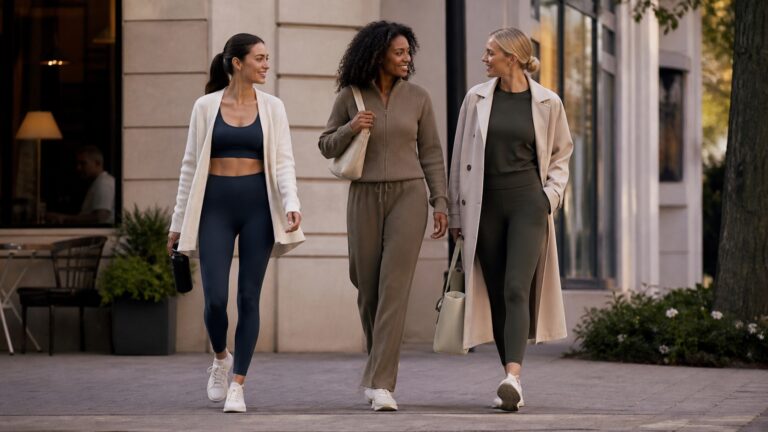
Bo+Tee is no longer asking the customer to choose only between a legging and another legging. It is trying to become a wardrobe system that can move with the same customer from training to Pilates, from tennis to travel, and from close-to-body activewear to lounge or lifestyle dressing.
That expansion would become generic if it were just a long list of categories. The more defensible move is to use a repeatable product platform to connect them.
ButterCloud™ as a product platform
The ButterCloud™ collection is a useful public example. The same named product concept extends into built-in-bra tanks, long-sleeve tops, T-shirts, 7/8 leggings, capri leggings, wide-leg trousers, dresses and jumpsuits. The ButterCloud™ T-shirt page describes a soft, lightweight, close-to-body and high-stretch product, while the brand’s planet page presents ButterCloud™ as a signature modal fabric made with TENCEL™ Modal fibres.
Whether a customer buys because of the fibre story, the handfeel or the styling is not the main point. The strategic point is that a named fabric and design language can reduce the distance between products. The customer does not have to learn an entirely new promise with every launch.
A product platform can accumulate trust across styles:
- a recognisable handfeel or performance range;
- a stable waistband, support, shoulder or length logic;
- a silhouette that reads quickly in an image or video;
- a small group of garments that can be styled together;
- one hero detail that can travel into adjacent occasions.
This is more durable than changing the visual identity every season.
Customisation is not automatically differentiation
There is an important production decision hidden inside this lesson. Customisation is not the same as meaningful differentiation.
If a founder still does not know whether customers value a V-waist, a straight waistband, a short, a flare, light support or high support, investing heavily in an original pattern may be an expensive way to answer an undefined question.
A more disciplined sequence is to test a smaller range of silhouettes, colours and materials first. When one detail is repeatedly purchased, requested or extended into another product, it has earned a deeper development investment.
This is where Battlerobe can support the decision rather than simply receive a final tech pack. During validation, a founder can discuss a brand-ready small-batch route using existing styles with branded logos, labels and packaging. Once customer response repeatedly points to a particular silhouette, waistband, support structure or functional detail, the project can be reviewed for small-batch custom development from a photo, sketch, tech pack or physical sample. The exact style, fabric, quantity and feasibility still need to be confirmed case by case.
The goal is not to lower the product standard. It is to spend development money on the difference customers have shown they value.
3. The important question is not how quickly Bo+Tee launches, but how it sells more occasions
Bo+Tee’s website also shows why merchandising deserves to be studied alongside product design.
The site does not only sell products by garment type. It helps customers enter through activities and situations. It also includes “Spotted: IRL Looks You Love,” where user or creator looks are connected to specific products through “Shop The Look.” Selected styles appear in Build Your Bundle – 3 for 2, allowing customers to mix eligible items and receive the lowest-priced item free.
These look like e-commerce features. They also influence product strategy.
A product-only navigation tells a customer what the brand has. Occasion-led navigation tells her when the product belongs in her life. That makes it easier for one item to acquire a second and third use case, and easier for an individual purchase to become an outfit purchase.
The By Association Only Bo+Tee case study reports work involving Algolia search, product recommendations and bundles, customer reviews and Shopify Markets. The agency reports a 69% increase in purchase rate among users who engage with search and a 25% uplift in AOV. These are service-provider-reported project results, not audited Bo+Tee financial statements. They still point to an important mechanism:
Growth does not happen only before the customer reaches the website. It also happens in the way an existing visitor finds, understands and combines products.
For a smaller brand, that leads to three practical decisions.
First, do not photograph only the garment. Show how it is worn: front, side, movement, layering and multiple outfit combinations.
Second, do not treat a matching set as merely two products in the same colour. Use it to answer a situation: training, studio work, travel, rest day or everyday styling.
Third, send on-site evidence back to product development. Reviews, search terms, size questions, returns, product pairings and bundle clicks are not just e-commerce metrics. They are low-cost product research.
4. Creators were more than media inventory
Bo+Tee’s public marketing content shows a more structured creator model than simple gifting. In a marketing team profile, the team described the early-access launch of a Meggan Grubb collaboration. The work included sign-ups, launch scheduling, email campaigns, website banners, advertising and swipe-up links, and the team described it as one of the brand’s most successful launches at the time.
That is not just “a creator wore the product.” It is a launch system built around a creator.
For activewear, a creator can serve three different roles:
- Product tester: checking fit, support, opacity, sweat behaviour, movement and comfort.
- Content translator: showing whether the product belongs in a gym, studio, street, airport or travel context.
- Sales channel: generating measurable traffic, early-access sign-ups, affiliate sales or waitlist demand.
These roles overlap, but they are not interchangeable. A creator with reach is not automatically a good fit tester. A technically useful tester may not be the person who makes the strongest launch content.
A better creator test for a young brand
Instead of sending samples with a vague request to post, a founder can define the test:
- send two sizes when fit uncertainty is high;
- request front, side and back movement footage;
- ask which activity the product genuinely feels designed for;
- collect feedback on waistband, rise, compression, length, support and handfeel;
- record whether the response is about appearance, fit, performance, price or occasion;
- track saves, replies, sign-ups, product-page clicks and purchases—not only likes.
This turns creator marketing into product development as well as distribution.
The boundary matters. Creators cannot replace quality control. If a light colour is sheer, a waistband rolls or a bra fails under movement, creator content may accelerate the problem. Creator feedback and sample refinement should therefore happen before the brand commits to a larger production run.
5. Drops, pre-orders and the app turn attention into measurable demand
Bo+Tee’s runway recap featured unreleased products and directed customers toward app notifications, rewards and student ambassador participation. The current site still uses new, back-in-stock, pre-order and core-collection states, while the app is positioned as a route to exclusive collection access.
The useful interpretation is not simply that Bo+Tee creates scarcity. It is that a drop can concentrate attention around a product question.
Instead of launching a large collection quietly and waiting months to understand the result, a focused release makes certain signals easier to observe:
- which product is saved or requested first;
- which colour receives attention but not conversion;
- which size moves fastest;
- which creator produces qualified sign-ups;
- whether customers request another length, more support or a softer fabric;
- whether pre-orders and restock requests justify the next production decision.
A small brand does not need an app, runway show or large ambassador programme to use the same logic. It can run:
- a capsule of four to eight connected SKUs;
- an early-access list before production is too deep;
- a small group of testers with defined roles;
- movement content before the product page goes live;
- a clear reorder or correction threshold;
- a formal review within two weeks of launch.
The purpose is not to manufacture anxiety. It is to make the market answer a specific product question. Is the customer buying the black set, the seasonal colour, the waistband, the handfeel or the identity of the occasion? If the question is not defined, “speed” only produces uncertain inventory faster.
6. The category expansion works when one occasion creates several buying entrances
Bo+Tee’s current assortment reaches beyond leggings and sports bras into yoga, Pilates, racket-inspired products, lounge, outer layers, dresses, skorts, jumpsuits, knitwear, jackets and ski-related products. The website also presents collections and edits associated with collaborators such as Holly Jai, Barbara Kristoffersen and Anna Astrup.
This does not prove that every extension is successful, or that all expansion decisions came from one clean strategy. But the visible site architecture suggests a coherent direction: customers can enter through what they are doing, where they are going or how they want to dress—not only through a garment category.
That creates a useful filter for a smaller brand:
A new category should increase the frequency of an existing customer’s relationship with the brand, or make the existing product language useful in a new occasion.
A disciplined sequence might be:
Core training product → studio or movement layer → rest-day and travel layer → adjacent seasonal or sport-specific capsule.
Before adding a category, ask:
- Does the current customer already have this occasion?
- Can the current fit, fabric or design code transfer?
- Does the new product make existing pieces more wearable?
- Can it be styled with the core collection?
- Does it create a clearer identity, or only more inventory?
- Can the manufacturing partner execute it without introducing quality inconsistency?
If the answer is weak, the category is probably a distraction.
7. Manufacturing is where the brand promise either becomes real or breaks
Bo+Tee’s Our People page says that products are designed in-house at its London studio and that the founders established and continue to oversee two main factories. It also says approved suppliers sign a Code of Conduct and that both factories undergo regular SMETA audits. These are company-stated claims, not independent proof of every production condition. They do, however, show how Bo+Tee wants its operating model to be understood: design, manufacturing and responsibility are connected.
The lesson for a smaller brand is not that it must own factories. The lesson is that manufacturing should enter the decision before the final product is treated as inevitable.
A production partner should help the brand think through:
- what fabric weight, stretch, recovery and support match the intended activity;
- how a silhouette affects the size chart and grading;
- whether a feature is a repeatable brand asset or a one-season decoration;
- which custom materials, colours, trims or packaging create additional minimums;
- when to test in a smaller run and when volume production is justified.
This is where Battlerobe’s bulk custom production route becomes relevant for brands with confirmed products and larger volume requirements. Its public process describes tech-pack review, sampling, sample approval, bulk production, quality inspection and production follow-up. For a growing brand, the useful question is not “Can the factory make my idea?” It is “Which production route matches the certainty I have today?”
The practical progression is:
- Validation: discuss a brand-ready small-batch route using existing styles, branding and approved options to test the customer, assortment and presentation.
- Differentiation: when the market repeatedly confirms a particular fit, fabric or functional detail, review a small-batch custom-development project from a sketch, image, tech pack or sample.
- Replenishment and scale: when style, size, colour, quality and demand become stable, evaluate bulk custom production and the economics of repeat orders.
Exact quantity, fabric, lead time and feasibility must be confirmed for the specific product. The point is not to push a founder toward a larger order. It is to reduce the cost of being wrong while preserving a path to scale.
8. What I would build if I were starting a smaller Bo+Tee-like brand today
I would not start with dozens of unrelated SKUs or treat “social-media style” as a complete positioning strategy.
I would build a testable product system:
- one core fabric or clearly defined performance range;
- one hero bottom with a specific waistband, length, support and use case;
- one top with a recognisable front or back construction;
- one layer that moves the product outside the gym;
- two commercial colours and one test colour;
- four to eight garments that can be styled together;
- movement testing, fit feedback and product-page content before the main launch;
- a post-launch review that turns returns, reviews, clicks, waitlist requests and repeat questions into the next development brief.
Each SKU should have a job. It should test a silhouette, a colour, an occasion or a brand detail. A SKU without a job adds inventory and content cost without necessarily adding learning.
9. What emerging brands should not copy
The danger in studying a large brand is confusing the visible result with the method that produced it.
Bo+Tee’s public pages do not prove that every success came from creators, drops or production speed. The brand benefited from a parent-company audience, team, customer data, content history and e-commerce infrastructure that a new founder cannot simply purchase.
I would not copy:
- a large catalogue before finding a hero product;
- creator volume instead of structured product testing;
- discounting as the main reason to buy;
- a new category every time a trend appears;
- expensive custom development before customers identify what matters;
- production speed without sample approval, fit standards and quality gates.
The useful structure is different: expand into an adjacent, higher-frequency customer occasion; build a product platform that can travel across garments; organise the shop around situations as well as categories; use creators and launches to expose demand; and let the production route change as the evidence changes.
Conclusion: do not copy Bo+Tee’s scale—copy the learning loop
The surface story is that Bo+Tee releases attractive products, works with creators and keeps the assortment moving.
The deeper story is that it transferred fashion customers’ existing aesthetic and social buying behaviour into a higher-frequency wardrobe category. It then connected named product platforms, occasion-led navigation, user-generated styling, bundle mechanics, early access and production management into a system that can extend the customer relationship beyond one workout set.
For an emerging brand, the most important question is not:
Can we move as fast as Bo+Tee?
It is:
Can we use a small, controlled product system to learn what customers are actually willing to buy—and why?
If the answer is not clear, validate with a smaller production route. If customers repeatedly identify the same fit or functional detail, invest in custom development. If reorder behaviour, size curves, colour demand and quality expectations become stable, move toward larger-scale production.
That is where a capable manufacturing partner can genuinely help. Battlerobe’s role is not only to make a finished garment. It can help a brand evaluate the route between existing-style validation, fabric and fit decisions, sampling, custom development and bulk production—so customer feedback becomes a better product brief instead of another disconnected collection.
The most valuable Bo+Tee lesson is not “make more activewear.”
It is this:
Make every product serve the customer, the content, the occasion and the next production decision at the same time.
Research sources and evidence notes
- By Association Only: Bo+Tee Shopify Plus case study: brand origin, e-commerce capabilities and service-provider-reported project results.
- Bo+Tee official website: current active, lifestyle, movement, occasion and collection architecture, plus user-generated “Shop The Look” merchandising.
- Bo+Tee ButterCloud™ collection: current product-platform evidence.
- Bo+Tee Build Your Bundle – 3 for 2: current bundle mechanics.
- Bo+Tee Our People: brand-stated design, factory and supplier-management information.
- Bo+Tee Our Planet: brand-stated ButterCloud™ and environmental information.
- Bo+Tee Runway Recap: unreleased products, app notifications, rewards, ambassadors and UGC.
- Bo+Tee marketing team profile: early-access collaboration and launch workflow.
- Red Cow Media: Bo+Tee gymwear case study: SEO, loungewear positioning and service-provider-reported visibility results.
- Battlerobe: Bulk Custom Production: current public production route and process boundaries.
Bo+Tee is a private company. Publicly available information does not establish audited revenue, profit, unit-sales or repeat-purchase figures, nor does it isolate the causal contribution of social media, creators, SEO, app activity, merchandising or manufacturing. The analysis above separates public observation from interpretation and recommendation.