

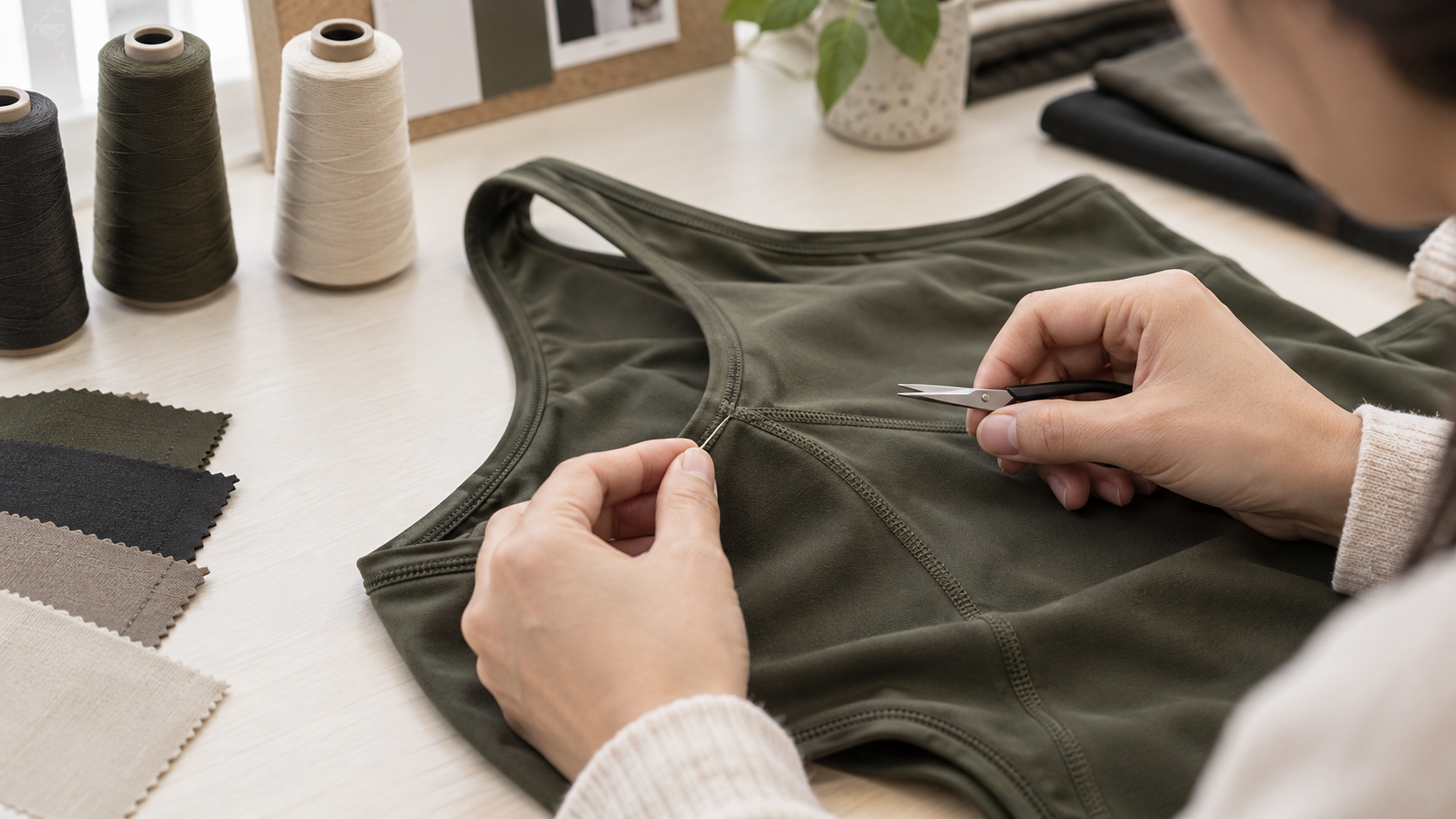
“There are loose threads everywhere. Should we cut them all?”
Loose threads on activewear are often treated as a simple finishing problem. Sometimes they are. A thread tail left on the outside of a garment is untidy, and a clean trim may be all that is needed.
But a thread end can also be the visible part of an unsecured seam. Cut it too close and the stitch can begin to run. Leave every thread untouched and the garment looks unfinished, may irritate the wearer, or may be mistaken for a serious workmanship failure.
The right question is not “Can we see a thread?” It is “What job is that thread end doing, and what happens if it is cut?”
Loose threads on activewear do not all mean the same thing
A harmless trimming tail
Some operations naturally leave a short tail at a seam transition, label edge, bartack, or cover-stitch end. If the stitch is secured and the tail is outside the functional seam, it can usually be trimmed during finishing.
An unsecured seam end
A thread tail at the beginning or end of a seam may be holding the stitch structure together. If the seam opens when the garment is gently extended in the direction of use, the tail is not merely cosmetic.
A temporary thread
Temporary basting or tacking thread is different from the permanent construction thread. Coats describes water-soluble temporary thread as a way to avoid a separate removal operation and reduce the risk of fabric damage. If a factory uses an ordinary temporary thread, it may leave more visible ends or require careful removal.
A damaged or broken thread
A thread end beside a hole, skipped stitch, or open seam should not be trimmed before the surrounding construction is checked. The trimming operation may hide the beginning of a failure without fixing it.
Where the thread is located tells you what to check
Start with location, not appearance.
- Side seam or inseam: check whether the seam opens when the garment moves.
- Waistband or hem: check the start and end of the cover or overlock operation.
- Strap or pocket attachment: check reinforcement and whether the loose end is close to a load-bearing point.
- Logo, label, or decorative stitch: check whether the thread is part of the branding or only a temporary guide.
- Inside a skin-contact area: check comfort as well as security.
A photo should show the whole seam area, not only a close-up of the thread. The surrounding stitch pattern often contains the clue.
A five-minute trimming check
Before cutting, use an approved sample or an unaffected garment for comparison. Then:
- Locate the thread’s start and end.
- Look for skipped stitches, a broken seam, or a visible knot.
- Apply gentle tension in the direction the garment moves. Do not yank the seam.
- Watch whether the stitch stays closed or begins to open.
- Trim only after the construction is stable, and leave enough security for the operation.
This is not a universal trimming tolerance. The safe distance depends on the stitch, fabric, seam, and whether the thread end is secured. The purpose is to separate a clean-up operation from a defect that requires rework.
How to classify the result
Release after controlled trimming
If the seam is secure, the thread tail is isolated, and the garment matches the approved appearance after trimming, the issue can be handled as finishing work. Record the location and show the operator a clear reference so the same tail does not remain throughout the order.
Sort and rework
If the thread is long, repeated, or visible in a customer-facing location, sort the affected units. Rework should include a security check, not just scissors. A clean-looking but unsecured seam is not a successful correction.
Hold and investigate
If the thread end is attached to a seam that opens, a reinforcement point that shifts, or a repeated skipped-stitch area, hold the relevant group. Check whether the pattern follows one operator, machine, style, size, color, or production period.
Why cutting too close can make the problem worse
Stretch garments are repeatedly extended during dressing and use. A seam end that looks secure while relaxed may start to run after the thread tail is removed. This is why trimming should happen after the seam is understood, not before.
Over-trimming can also damage the fabric. Scissors that catch a fine knit may create a small cut that grows during wear. If the same area repeatedly produces long tails, the better correction may be machine setting, thread handling, operation order, or a clearer finishing instruction.
The goal is not to make every thread disappear at any cost. The goal is a secure seam with a clean, comfortable finish.
Preventing loose-thread complaints in bulk
Include a thread-end reference in the production handoff. It should show the acceptable finished appearance, the locations that require extra care, and the locations where trimming too close is unsafe.
Check the first pieces from each important operation. Do not wait for final packing to discover that one machine or one operator is leaving the same unfinished ends across an entire lot. If temporary thread is used, record where it is removed and how the removal avoids fabric damage.
During final inspection, count the affected units and distinguish isolated thread tails from open seams. A generic “loose thread” line in a checklist is too vague to support a consistent release decision.
How Battlerobe can make the decision clearer
When the complaint is only “there are too many threads,” Battlerobe can help turn it into a practical finishing reference: which ends are cosmetic, which areas need rework, and which construction issue should be corrected before the next order. For a future style, this may be handled during bulk custom production planning once the sample and workmanship expectation are stable.
Send a full-garment photo, a close-up, the affected seam location, the number of pieces, and one approved or unaffected reference. If the seam opens under gentle movement, include that short video. Those details are more useful than a general statement that the factory’s quality is poor.
Final decision
Loose threads are not all defects, and they are not all harmless. First find out whether the end is cosmetic, temporary, or holding a functional seam together. Then trim, rework, hold, or release based on what the seam does—not only on what the thread looks like.
For loose threads on activewear, the safest habit is simple: secure first, trim second, and record the reference that tells the next operator where the line is.