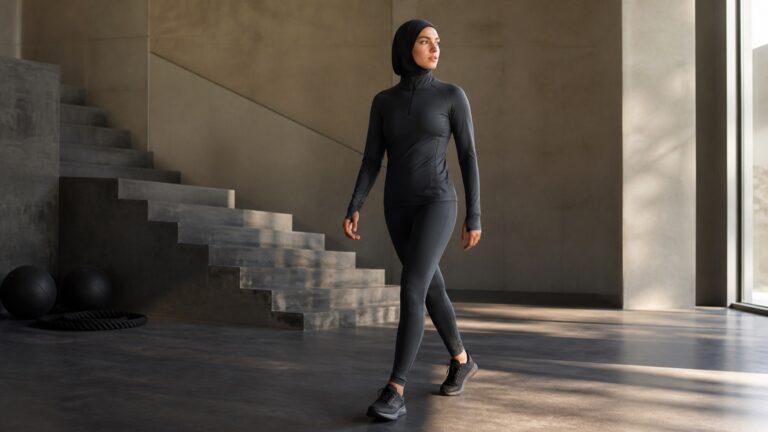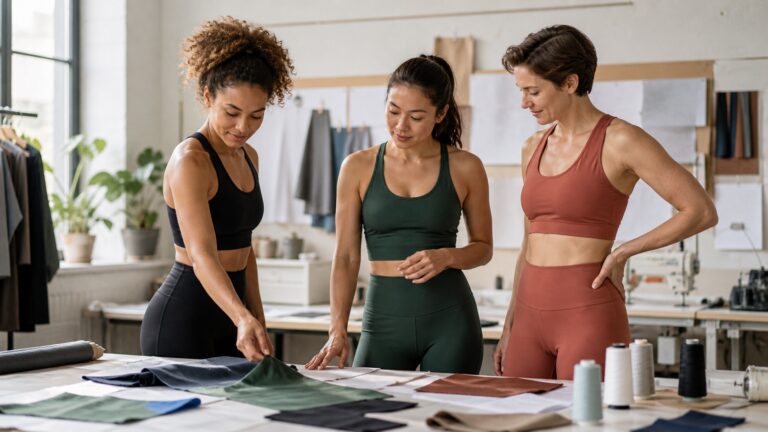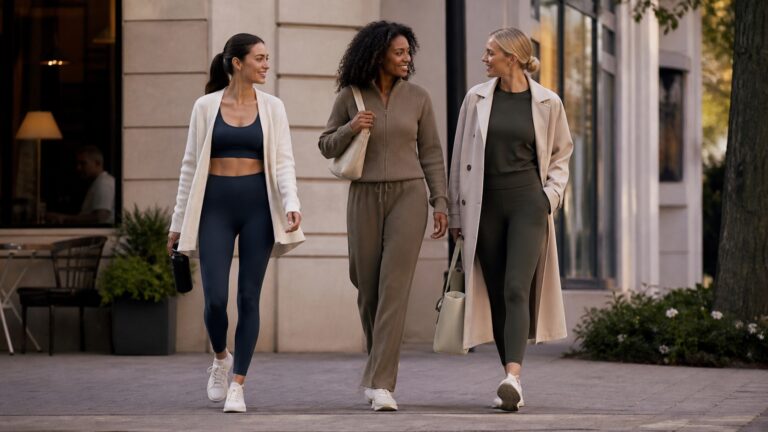


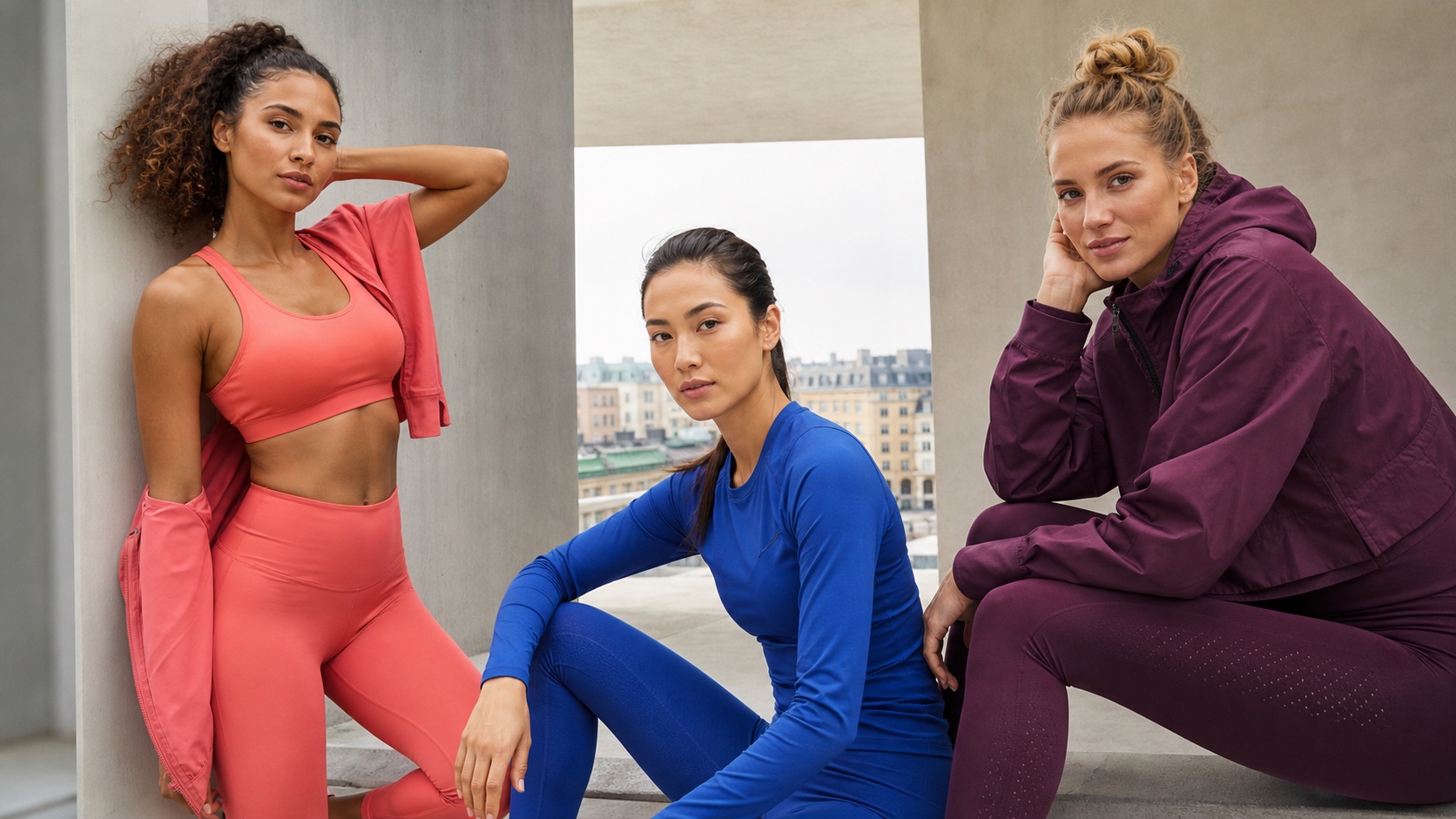
AIM’N’s growth is easy to misread as a story about colourful leggings.
The more useful explanation is a merchandising system: different fabric behaviours are named, packaged and extended into different activities and occasions. Shape Seamless promises contouring. Sense is positioned around a barely-there feel. Core is a second-skin, performance-oriented option. Ribbed Performance moves toward a lightweight, flexible feel. Alpine, Running, Outdoor, Atelier and wellness then widen the ladder.
That is the useful way to study the AIM’N brand strategy. Colour and optimistic communication create attention, but the commercial engine is the brand’s attempt to reduce a difficult shopping decision: which fabric, support level, activity and styling context is right for me?
Recent reporting makes the case more interesting. Sporting Goods Intelligence reported SEK 443m turnover and SEK 28m after-tax profit for 2024, with 60% of sales outside Sweden. AIM’N’s own press page shows a continuing expansion into concept stores, Shape, Ribbed Performance, Alpine, Running, Outdoor, Atelier and new wellness content. The evidence suggests a business with real scale, but not a risk-free one. More categories can grow the relationship; they can also multiply fit blocks, fabric commitments, inventory and channel complexity.
The lesson is not “launch more collections.” It is: turn a fabric difference into a category ladder, then expand only when each rung makes the next purchase easier.
The first problem was emotional sameness in functional clothing
AIM’N’s official materials describe a Swedish activewear brand founded by women, for women. An early founder page names Tekla and Helen and frames the original dream as inspiring and motivating women through activewear. Independent reporting places the launch in Halmstad in 2014.
The founding proposition is broad, but the early market gap was specific: activewear could be functional yet visually uninspiring, or attractive yet not convincing in movement. That tension is common enough to be unhelpful unless it becomes a product decision.
AIM’N appears to have chosen a middle route. It made the garment visibly expressive through colour and shaping while keeping the product close enough to familiar activewear categories that a customer could understand how to buy it. The brand’s current product language is not built around one universal fabric. It offers a set of behaviours, which is a more scalable answer to different workouts and body preferences.
There are competing explanations for the brand’s growth:
- Instagram and early influencer distribution may have created the initial attention.
- Swedish design, colour and optimistic brand voice may have made the products culturally distinctive.
- Named fabric families may have improved conversion by explaining why one product differs from another.
- International channel expansion and category breadth may explain the later financial scale more than the original visual identity.
Public data does not isolate these causes. But it does give founders a useful diagnostic: if a brand sells a product in many fabrics, the fabric names should not be decorative. They should reduce uncertainty.
Reader action: write down the three questions customers ask before buying your product. If the answer to all three is “choose your usual size,” you may be under-explaining the real difference between products. If the questions involve softness, support, heat, opacity, activity and styling, your merchandising should help answer them before the customer leaves the page.
AIM’N brand strategy: fabric families act as a decision architecture
AIM’N’s current product pages and independent category coverage reveal a clear vocabulary. Shape Seamless is described as sculpting and contouring, with an extra-high waist and an invisible scrunch detail. Sense is softer and more second-skin, suited to lower- or medium-intensity and everyday wear. Core is more compressive and performance-oriented. Ribbed Performance is described as lightweight and flexible for higher-intensity use.
One current Shape Seamless Core Control Tights page lists a regular price of $79.99 and a sale price of $55.99, with 92% polyamide and 6% elastane, regular length, a high ribbed waistband and moisture-wicking/squat-proof product claims. Those are brand-stated details and a time-specific promotion, not independent certification. Their strategic role is more important than the exact price: the product page makes “shaping” concrete through composition, fit, waistband and construction language.
This helps solve a common activewear problem. When every legging is described as soft, supportive, flattering and versatile, the customer cannot see why she should buy a second one. Fabric families give the second purchase a reason:
- the same customer can choose a softer product for Pilates and a more compressive one for training;
- a new customer can enter through the benefit that matters most to her;
- the brand can extend one family into bras, shorts, tops or outer layers;
- content can demonstrate behaviour rather than repeat colour and pose.
Build a “choice, not catalogue” table: for every product family, list the best activity, intensity, hand feel, support level, body concern, styling context and one limitation. If two families occupy the same row in every column, you do not have two products; you have two names competing for the same demand.

Colour is acquisition; fabric clarity is conversion
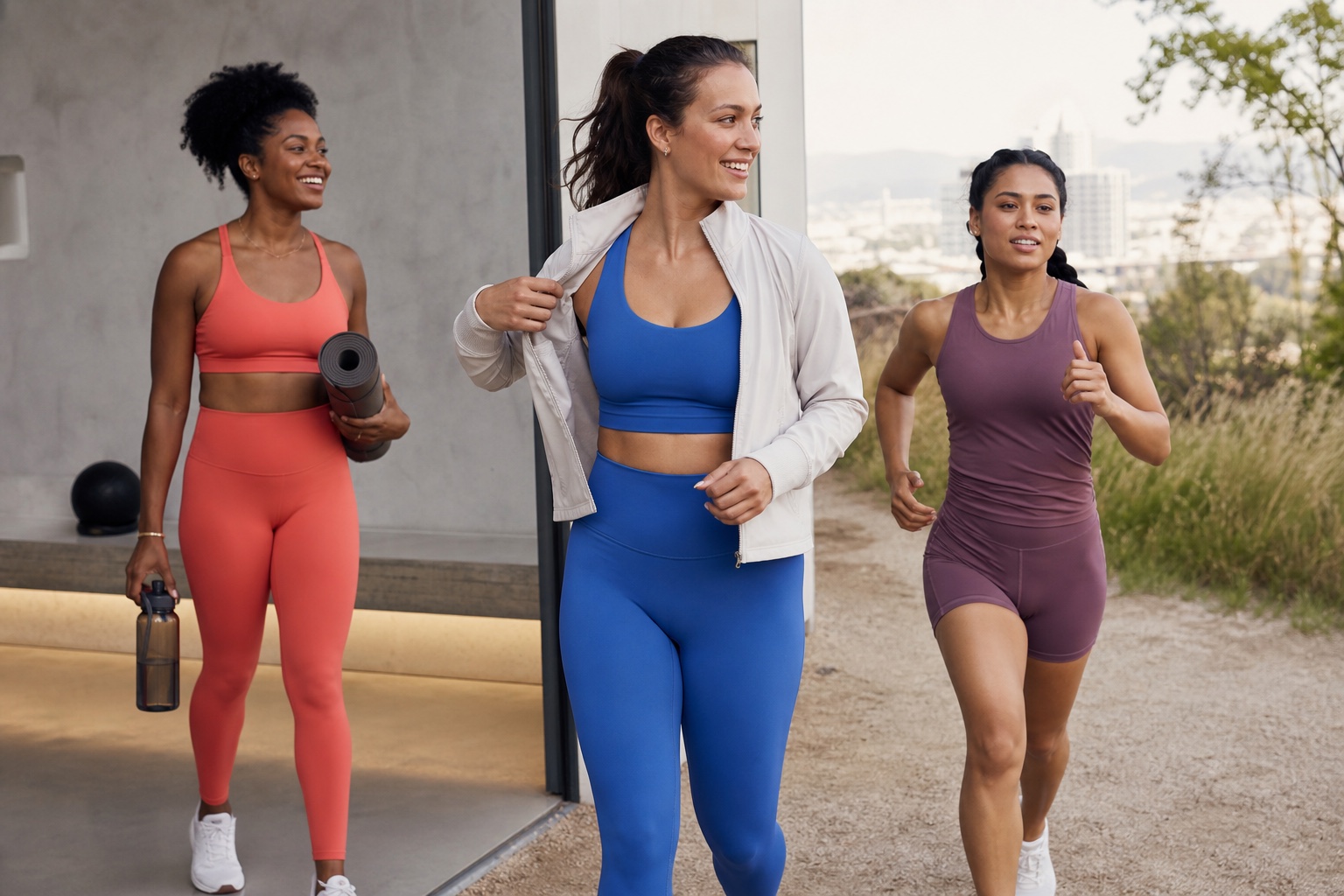
AIM’N’s colour and print language makes the product easy to notice. That matters in a category where the basic silhouette is familiar and many brands use the same black legging as their entry point. A bright set can earn the first click, the saved post or the try-on.
But attention is not the same as confidence. A customer may like a tangerine set and still hesitate because she does not know whether the fabric rolls, shines, feels hot, supports her bust, or works for her workout. This is why fabric and intensity segmentation is commercially important: it converts visual desire into a reasoned choice.
The current site also shows a deeper merchandising pattern. AIM’N sells not only tights and sports bras but also sweatshirts, jackets, Alpine pieces, outdoor products and wellness content. A colourful activewear identity can travel across categories if the product still answers the same emotional question: how do I feel capable, put together and motivated in this context?
The danger is that every adjacent category can be justified by the brand mood. A ski collection has different weather, construction, seam, insulation and protection requirements from a studio tight. Outdoor garments introduce waterproofing, abrasion and layering questions. A Running collection introduces support, sweat and visibility questions. The brand cannot let one optimistic visual language imply that all technical standards are identical.
Use an occasion ladder:
| Rung | Customer moment | Product proof | Expansion question |
|---|---|---|---|
| Studio | Yoga, Pilates, barre | Softness, stretch, opacity, gentle support | Can the same fabric move into a bra or flare? |
| Training | Gym, intervals, higher intensity | Recovery, sweat management, waistband and support | Does the family need a different construction? |
| Outdoor | Running, hiking, changing weather | Protection, pockets, visibility, layering and durability | Is this a new technical system or only a new colour? |
| Lifestyle | Commute, errands, wellness routine | Heat, hand feel, styling, care and all-day comfort | Does the garment add an occasion or just add SKUs? |
The small reward is a simple gate: if a new product does not add a new occasion, a new measurable behaviour, or a useful attach product, postpone it. A larger website is not automatically a stronger brand.
International scale made the system more impressive—and more demanding
Sporting Goods Intelligence reported that AIM’N reached SEK 443m turnover in 2024, generated SEK 28m after-tax profit, and made 60% of sales outside Sweden. That is a meaningful signal of international demand and operating maturity, but it is not proof that every product family has the same economics.
The brand’s press page shows how the growth path has broadened: a Shape collection in 2024, Ribbed Performance later that year, a concept store in Oslo, a premium Atelier collection, an Alpine line, a Running collection and an Outdoor collection. The store page names concept stores in Sweden, Norway and New Zealand, while the wholesale page provides a dedicated wholesale route.
Expansion can work because each new category gives the customer another reason to enter or return. But the product matrix grows quickly:
style × fabric × colour × size × activity × region × channel
Each dimension creates a practical obligation. More colours require colour consistency and forecasting. More sizes require grading and fit validation. More activities require different support and construction. More regions require localisation, duties, shipping and returns. More channels require availability and wholesale margin discipline.
AIM’N’s own size guide is a reminder that fit is not only a tag. It provides XXS–XXL body ranges, recommends Petite for customers at or below 162 cm and Tall for customers at or above 173 cm in tights, and advises customers to choose based on bust or hip when measurements conflict. That is useful conversion infrastructure, but it also signals the work required to maintain confidence across regions and bodies.
Inventory exercise: take your proposed launch and multiply the number of styles by colours, sizes, lengths and channels. Then mark which combinations are core, which are test-only, and which can be replenished. If the answer surprises you, the assortment is already making a financial decision before the customer has made a product decision.
The shift away from influencer dependence matters
SGI Europe’s reported headline says AIM’N was moving away from influencer marketing while reaching approximately SEK 500m in 2025 reporting language. The exact article context is not fully available here, so the cautious conclusion is not that influencer marketing stopped working. It is that the acquisition mix is being reconsidered as the brand becomes larger and more operationally complex.
That is a valuable transition for any emerging brand. Influencers can efficiently communicate colour, aspiration and social proof. They are less reliable at explaining fabric behaviour, fit limits, return friction and why a customer should buy again after the post disappears.
AIM’N’s expansion into a membership programme reinforces the shift from one-off attention to an owned relationship. AIM’N Society offers points, vouchers described as 10% back, exclusive deals and 15% off the first purchase. Those mechanics can support retention, but they can also train customers to wait for offers. The programme’s value depends on whether it increases meaningful behaviours such as replenishment, set completion, product-family migration or event participation.
Run this measurement split: track creator reach and new-customer conversion separately from member repeat rate, full-price share, product-family migration, size-guide usage, return reason and second-purchase timing. If you cannot tell whether a customer returned for a new fabric family or a discount, the loyalty system is hiding the mechanism.
Sustainability claims need dates, scope and operational detail
AIM’N’s sustainability page says the business works with suppliers aligned with its values, that most products are made in China, and that suppliers hold BSCI and SGS reports. It also says the company has an in-house production manager and quality controllers, tracks product reclamations, and ships products from China to warehouses in Sweden and New Zealand. The page reports that 95% of imported volume in 2020 moved by boat or train, with an ambition to reach 99%.
These details are more useful than a generic environmental promise, but they need time labels and careful wording. A 2020 transport mix is not automatically the current mix. A supplier audit report is not a complete guarantee of working conditions. A recycled-polyester standard addresses material traceability or composition in a defined way; it does not resolve every impact of a garment’s life.
The transferable principle is operational specificity. If sustainability is part of the brand, it should influence supplier selection, material choices, packaging, transport, product longevity and reclamations. It should also survive a product family’s growth into new regions and categories.
Make a claim calendar: attach a date, scope, source and next verification date to every public sustainability statement. When a claim becomes old, update it, narrow it, or remove it. Trust increases when the brand shows its work and its unfinished work.
What an emerging brand should copy—and what it should not
Test now
- Name two or three genuinely different fabric behaviours and show the activity each is designed for.
- Hold one fit block and one core colour stable while testing the product-family proposition.
- Create content that compares softness, support, compression, heat, opacity and recovery in plain language.
- Offer a size and length guide that recognises different body proportions, not just a generic XXS–XL table.
- Measure which family attracts, converts, attaches and earns a second purchase.
Build after proof
- Extend a proven fabric family into matching products and a new customer occasion.
- Use colour drops to create newness without rebuilding the fit and material system every time.
- Add wholesale or a concept store when physical access solves a fit, awareness or community problem.
- Build loyalty around a behaviour such as set completion, replenishment or product-family migration.
Do not copy directly
- Do not launch five fabrics because a mature site can support five navigation labels.
- Do not assume a colourful campaign proves technical performance.
- Do not copy an international channel footprint without calculating duties, returns, inventory and service levels.
- Do not present old logistics or material data as current company-wide proof.
- Do not let a first-purchase discount become the only reason customers re-enter the brand.
Where Battlerobe becomes relevant
AIM’N makes the production challenge easy to name: a fabric-led brand succeeds only if the difference between families remains consistent across colours, sizes, matching pieces and repeat orders.
For an emerging label, that means the development brief should specify more than a reference silhouette. It should identify the target hand feel, stretch and recovery, compression, opacity, waistband behaviour, length options, colour standard, branding method, care requirements, acceptable tolerances and the activity the product is meant to serve.
When that product direction has been tested and approved, Battlerobe’s bulk custom production service can support fabric and colour coordination, sampling, branding, bulk production, quality control and repeat orders. That is where a production partner can make the fabric-family promise more repeatable—not where it can decide which family customers want or guarantee a new drop will sell.
Prepare for the production conversation: send the customer occasion, activity intensity, fabric behaviour, size/length range, colour standard, branding details, target quantity, inspection points and the evidence that would make you scale. A clear family brief reduces the risk of ordering a catalogue before you have a product.
The decision: build a ladder, not a pile of launches
AIM’N is valuable because it shows how a women-focused activewear brand can grow from a recognisable emotional world into a more specific product and channel system. The financial evidence suggests real scale and profit, while the current launch calendar shows ambition. The same ambition makes the operating problem visible: every new category must earn its complexity.
The strongest transferable mechanism is fabric-led category expansion: make a real material or construction difference easy to understand, use it to solve a distinct occasion, and expand only when the customer can carry the language from one product to the next.
The first test is one fabric family, one hero product, one matching product and one occasion extension. Scale after customers can explain why the family differs, returns do not cluster around the promised behaviour, the core sizes remain available, and the next purchase is not dependent on a discount. Stop if new labels create choice confusion, if the product differences are cosmetic, or if the assortment grows faster than your ability to reproduce it.
Sources and further reading
This case study separates AIM’N’s official product, sustainability and channel claims from independent reporting and interpretation. The public evidence does not isolate the exact contribution of colour, influencer marketing, fabric families, stores, wholesale, sustainability or category expansion to the reported financial results.
- AIM’N: current press and launch timeline
- AIM’N: brand story and sizing context
- AIM’N: sustainability and ethical practices
- AIM’N: concept stores
- AIM’N: wholesale enquiries
- AIM’N Society: loyalty mechanics
- AIM’N: Shape Seamless product page
- The Active Collection: independent category overview
- SGI Europe: reported turnover, profit and marketing shift
- eEquity: historical growth and international sales context