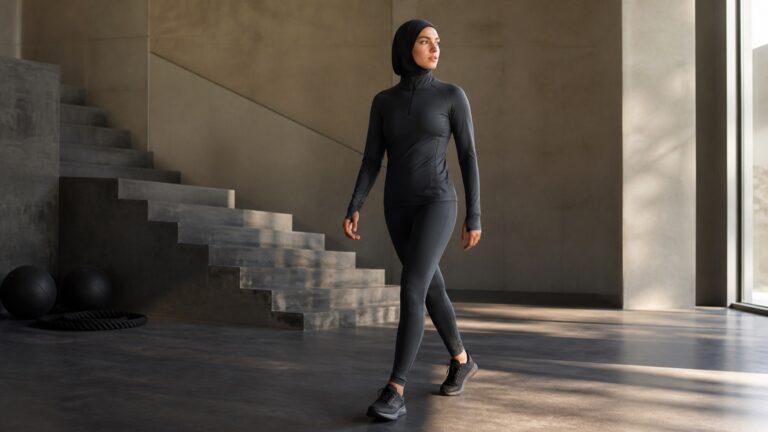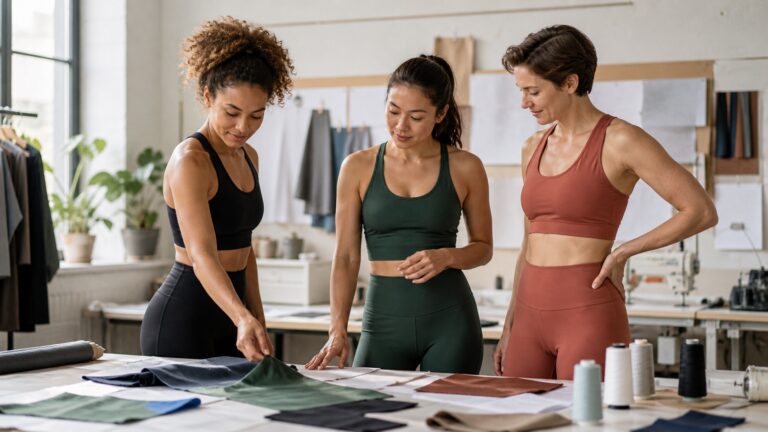


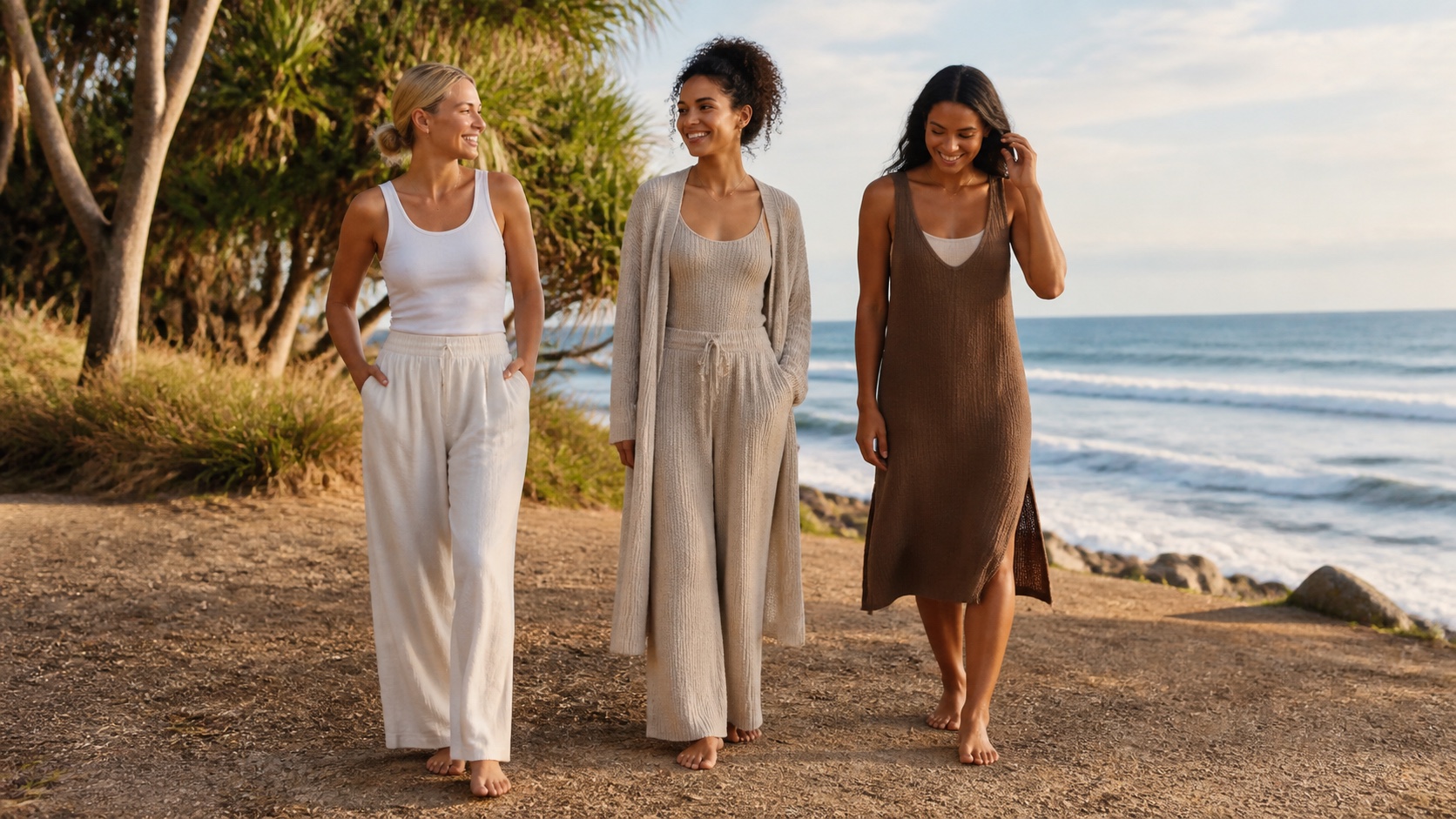
Arcaa did not stay in activewear.
That sentence sounds like a category change, but it is better understood as a change in what the customer is being asked to value. The Byron Bay label began as Arcaa Movement in 2016, around movement and everyday ease. Its current language is broader: natural textures, refined silhouettes, pieces for work, travel, motherhood and movement, and a wardrobe designed to be “worn often, lived in and returned to.”
The interesting Arcaa brand strategy is therefore not simply “make sustainable activewear.” It is a **Wardrobe Ecology**: a system in which material, construction, silhouette and occasion reinforce one another so that an activewear entry point can become an everyday wardrobe. That system creates a credible reason to buy beyond performance. It also creates a difficult operating question: can a brand release newness monthly while still asking customers to buy less and keep pieces longer?
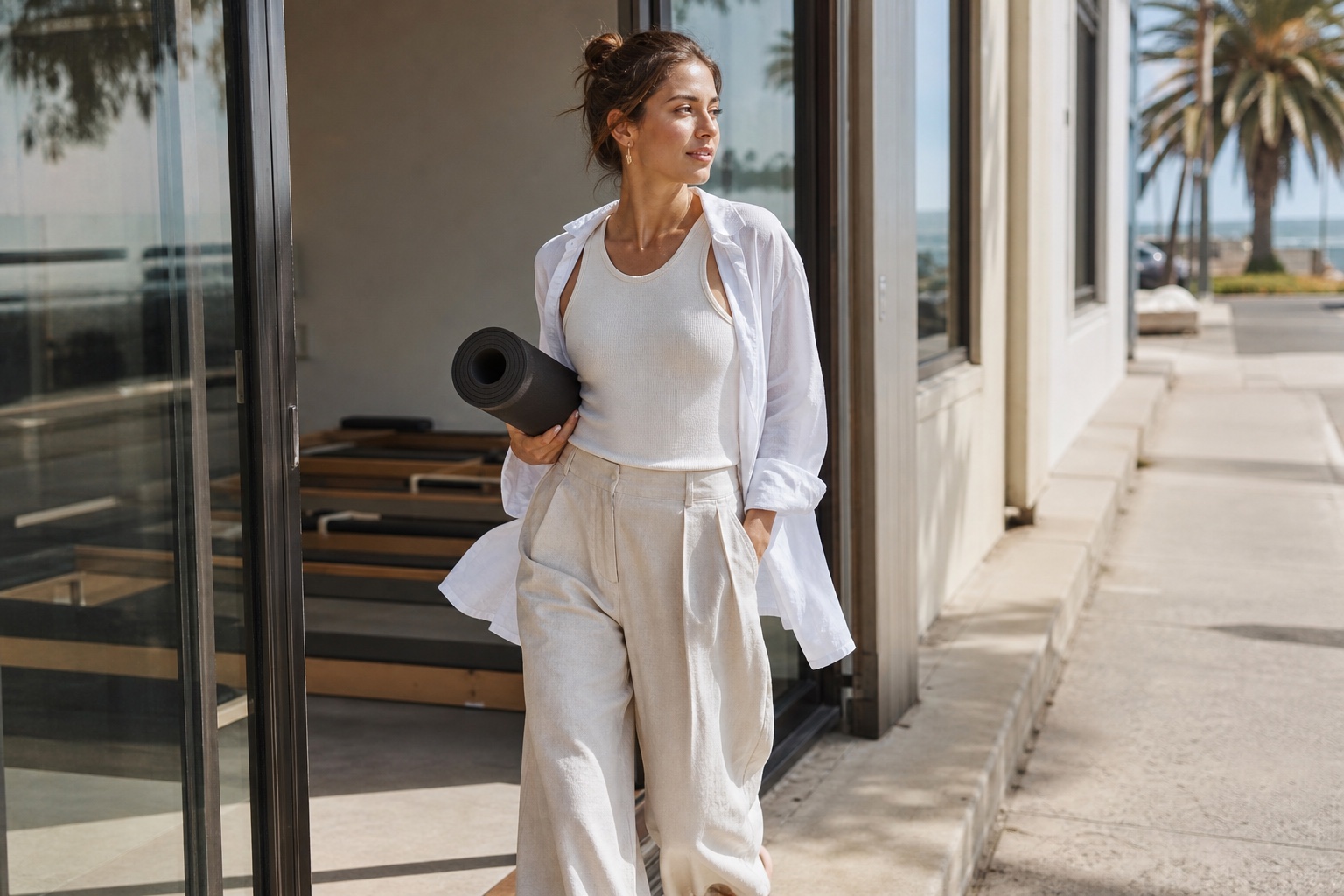
The strategic shift was from activity to frequency
A conventional activewear brand starts with an activity: yoga, running, training or Pilates. The product is then judged by whether it performs during that activity. Arcaa’s own account of its evolution points in another direction. In an independent 2024 interview, founder Gemma Stanford said the brand began with activewear but gradually found that creating all-day pieces in natural fibres aligned more closely with its values.
That is a meaningful shift. “Activewear” describes when the product is used. “Everyday wardrobe” describes how often it can be used and what else it can replace.
Arcaa’s current customer description makes the same move. It describes women who build a wardrobe slowly and choose pieces for how they feel, wear and move through daily life. The customer may still attend Pilates or yoga, but those activities are now one moment inside a wider rhythm.
The mechanism is plausible:
- Movement gives the brand an authentic reason to care about comfort, mobility and fit.
- Natural textures and relaxed silhouettes make the product relevant outside a class.
- More occasions increase the number of days on which a piece can be worn.
- Higher wearing frequency can make a premium price easier to justify.
- Once the customer trusts the material and proportion, the next wardrobe piece becomes easier to understand.
The evidence supports the sequence of positioning and product choices. It does not prove Arcaa’s actual wear frequency or repeat-purchase rate. That distinction matters: the brand has designed for frequency, but public information cannot tell us how much frequency it has achieved.
Use this test: what does your product replace?
For each proposed activewear style, list the activity it serves and the everyday garment it could replace. If the only answer is “a workout outfit,” you are competing inside a crowded category. If the answer includes travel, errands, layering, work-from-home or weekend dressing, you may have found a broader use case—but only if the fabric, opacity, care and silhouette survive those moments.
Natural fibre is not the product. It is the operating brief.
Arcaa makes materials unusually visible. Its FAQ lists organic cotton, knitted linen, cotton/wool blends, cotton/linen blends and organic cotton/elastane. The same page says the brand uses OEKO-TEX Standard 100 certified materials and is working to eliminate virgin synthetics from outerwear. Its linen page explains the appeal through breathability, texture, drape and the way linen softens over time.
These are brand claims, not independent proof of lower environmental impact. But they do show how Arcaa turns a value statement into a product vocabulary. A customer can enter through a fibre, a texture or a feeling—not only through a garment category.
That is more useful than putting “sustainable” above an ordinary product. If natural material is part of the reason to believe, it must shape the design brief:
| Material promise | Design consequence | Evidence to collect |
|---|---|---|
| Breathable and textured | Relaxed silhouettes, warm-weather layering and visible surface character | Weight, drape, transparency, abrasion and wash behaviour |
| Soft and everyday | Comfortable waistbands, flexible fit and low-friction care | Touch after washing, shrinkage, pilling and recovery |
| Made to last | Styles that can be worn across seasons rather than only in a launch image | Seam strength, colourfastness, shape retention and repeat-wear feedback |
Notice what this does to the factory conversation. “Use organic cotton” is not a complete specification. The useful questions are: what yarn or fabric construction, what weight, what stretch percentage, what shrinkage tolerance, what finishing, what wash instruction and what colour standard?
Material decision rule
Do not choose a fibre because it sounds aligned with the brand. Choose it when its behaviour solves a customer problem and can be measured across production. A material that photographs beautifully but loses shape, grows heavy or becomes difficult to care for may create a sustainability story while destroying repeat wear.
Arcaa’s hidden product capability is knit-to-shape
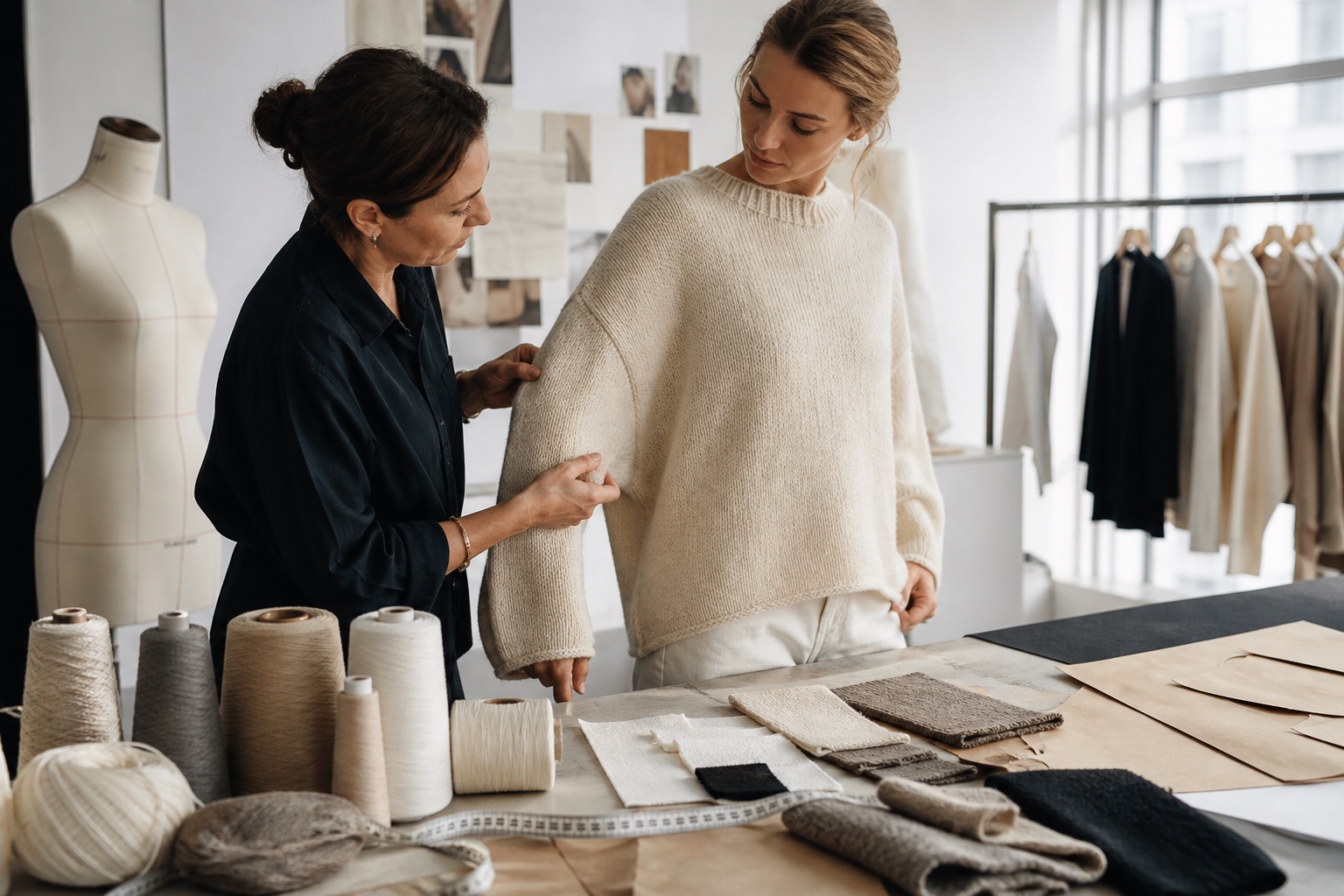
The most operationally interesting evidence sits on Arcaa’s Our Makers page. The brand says many lifestyle pieces use knitted construction, programmed to shape rather than cut from a larger piece of fabric. It presents this as a way to reduce leftover material, with small amounts of yarn repurposed for future designs.
Again, this is a brand-reported claim about its process, not an independently audited environmental result. The strategic point is still important: Arcaa has connected the material story to a construction method. The product is not only “made from a preferred fibre.” It is also shaped through a different manufacturing logic.
This creates a defensible capability if the brand can repeat it consistently. Knit-to-shape can help produce soft structure, texture, reversible forms and distinctive drape. It can also create constraints around gauge, stretch, recovery, sizing, colour matching, lead time and minimum quantities. Those constraints are not a flaw; they are the price of owning a material-and-construction language.
Arcaa’s disclosed supply chain is more nuanced than the common assumption that an Australian lifestyle brand must be Australian-made. The brand says designs begin in Byron Bay and products are made in certified, family-run factories in China, which it visits regularly; the latest stated visit was July 2024. It also says the factories undergo yearly audits. This is a useful reminder that the strategic asset is not geography by itself. It is the quality of the relationship, the specification and the control loop.
Small operational exercise: draw the material-to-method chain
For one hero garment, write five linked decisions:
- Why this fibre?
- Why this construction?
- Why this silhouette?
- What occasion does it unlock?
- What production test proves the promise survives?
If the chain breaks between fibre and construction, you are probably using sustainability as decoration. If it reaches a measurable production test, the material story is beginning to become a capability.
The wardrobe expands through texture and proportion, not louder branding
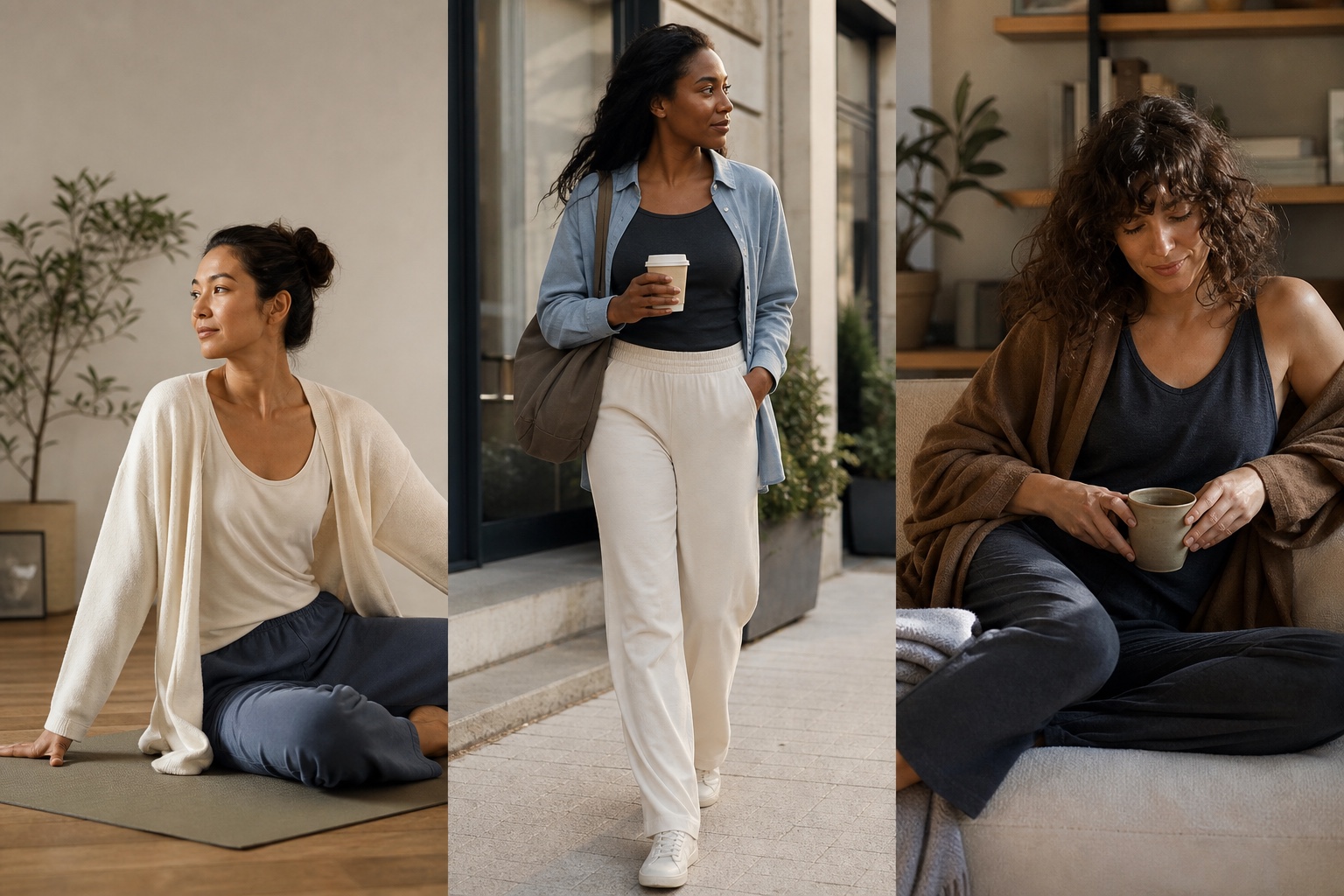
Arcaa’s current navigation is revealing. It includes jackets, sweaters and cardigans, tops, pants, skirts, shorts, dresses and sets, plus accessories. Its current new-arrivals pages show products ranging from knit tanks and organic cotton pants to dresses, crochet pieces and relaxed shirts. The assortment is no longer an “activewear collection with a few lifestyle add-ons.” It is a broader wardrobe in which movement remains part of the brand’s origin.
Independent retailer The Freedom State describes the label through coastal colours, natural textures, everyday wear and pieces that can be styled from activewear to more elevated looks. Because the retailer is commercially interested, this is not independent proof of market demand. It is still valuable as a distribution signal: a stockist understands the brand well enough to merchandise it as a lifestyle proposition, not only as gym clothing.
This is where Arcaa differs from the brands already studied in this series. SET Active uses coordinated colour and community participation to create a drop loop. Joah Brown uses fit and styling to make premium essentials recognizable. Year of Ours uses a hero construction as a product code. Arcaa’s unit of value is broader: the interaction of texture, proportion and occasion across a wardrobe.
That interaction can create a useful attach-rate logic. A soft fitted tank can make a wide-leg pant easier to style. A knit trouser can make a cropped top feel less like gymwear. A lightweight layer can turn both pieces into travel clothing. The customer is not simply buying another SKU; she is buying more combinations from the same point of view.
Build a three-layer opening range
For an early brand exploring this opportunity, the first collection does not need twenty silhouettes. It needs three roles:
- Foundation: a fitted or close-to-body piece that carries the movement credibility.
- Expansion: a relaxed pant, skirt or dress that proves the brand can enter ordinary life.
- Bridge: a layer that makes the first two products work together across temperature and occasion.
Test the combinations, not only the individual products. If each piece needs a different customer, fabric and styling explanation, the wardrobe system is not yet real.
“Less but better” meets monthly newness
Arcaa’s current About page says new pieces arrive monthly and are designed to build on what came before. This is an attractive content and merchandising rhythm. It gives customers a reason to return without abandoning the idea of a considered wardrobe.
It also creates a strategic tension. Monthly arrivals can stimulate discovery, but they can also make a “buy less, wear longer” position feel like a frequent-purchase engine. Current product and retailer pages show markdowns and final-sale conditions on some items. That does not prove financial distress; fashion brands discount for many reasons. It does show why a growing material and seasonal assortment needs inventory discipline.
The operational problem is not simply the number of styles. It is the multiplication of style × colour × size × fabric × channel. A natural-fibre knit can also require different testing and replenishment assumptions from a performance legging. A product that looks like a small variation may create a new yarn, gauge, dye, trim or care requirement.
Use a core / seasonal / experiment split
Classify every product before development:
- Core: the dependable material and silhouette that should be replenishable.
- Seasonal: the colour, texture or occasion that gives the wardrobe a reason to revisit.
- Experiment: the small test that can earn a place in the core system only after evidence.
A monthly launch calendar is healthier when monthly does not mean “new everything.” It can mean one new experiment, one new colour or one new bridge piece built on the same underlying capability.
The brand’s values create affinity—but product has to carry the purchase
Arcaa has developed a relationship layer through its Womanhood initiative, including public discussion of endometriosis and women’s experiences. The brand also describes partnerships intended to support women and communities beyond the garment. These initiatives may strengthen emotional affiliation, but public evidence does not show that they are the primary commercial engine.
This boundary is important for founders. A cause can make a brand more meaningful, but it cannot permanently compensate for poor fit, unclear care instructions or inconsistent quality. Values may win attention. Product determines whether the customer stays.
There is a similar lesson in the available customer signals. A Reddit discussion includes praise for quality alongside complaints about stretching, sizing and garments feeling large or heavy. The sample is small and platform-biased, so it cannot represent the entire customer base. It is still a useful warning because relaxed silhouettes and natural or knitted materials can change after wear in ways that a campaign image cannot reveal.
Measure the trust gap, not only the conversion rate
For each launch, track four post-purchase questions:
- Did the item fit as expected?
- Did the fabric behave as promised after washing?
- Did the customer find more than one occasion to wear it?
- Did she ask for or purchase a complementary item?
This produces better learning than asking whether the launch “performed.” A product can convert because the image is beautiful and still fail to create a wardrobe relationship.
What an emerging brand can copy—and what it cannot
Test now: the occasion bridge
Choose one movement customer and identify the next two places she already goes. Build a small outfit that works in the studio and those two places. Test it through real movement, sitting, layering and care—not only through a lookbook.
Build after proof: a material platform
Once a fibre and construction have passed wear tests, extend them to a small number of adjacent silhouettes. Record the technical standards so a new colour or style does not quietly change the handfeel, shrinkage or recovery that customers trusted.
Do not copy directly: the Byron Bay atmosphere
A coastal Australian setting, a founder’s personal health experience and an established stockist network are brand-specific advantages. Another founder can create a local world, but cannot manufacture the same cultural context by using beige colours and calling the collection “coastal.”
Do not copy directly: monthly launches without a replenishment map
Arcaa can state a monthly new-piece cadence because it has an existing wardrobe, product-development team and distribution system. A new brand should first prove which material, silhouette and occasion customers return for. Newness before proof is often just inventory wearing a marketing costume.
Where Battlerobe becomes relevant
The natural manufacturing question for this model is not “Can a factory make organic cotton?” Many factories can. The harder question is whether the same material-and-fit promise can be repeated across colour, size, construction and production runs.
For a brand that has already validated its concept, Battlerobe’s bulk custom production service can help translate that winning system into repeatable production inputs: pattern and fit development, fabric and colour selection, trims and components, branding, sampling, bulk production and quality control. The published route begins around 500 pieces per colour and style, with the correct quantity and feasibility depending on the project.
For this type of brand, the useful handoff is a complete specification: fibre composition, fabric or knit structure, weight, stretch and recovery, shrinkage, colour standard, grading, care label, trims and inspection points. If those details are not ready, the next step is still development and testing—not a large production order.
Three production gates
- Test now: validate the occasion bridge, material behaviour and fit with a small sample program and real wear feedback.
- Build after proof: formalize the material platform, grading, colour standards and quality checklist once a customer promise is clear.
- Scale only when repeatability is visible: use bulk production when demand, specifications and replenishment logic can support the order.
The decision for founders
Arcaa is not proof that every activewear brand should become a natural-fibre lifestyle label. It is a more precise case: a movement-origin brand can widen its market by changing the unit of value from “performance during exercise” to “frequency of use across a considered life.”
The strongest mechanism is the Wardrobe Ecology. Material gives the product a tactile reason to believe. Construction turns that material into a repeatable capability. Relaxed and fitted proportions move the product across occasions. Stockists and values give the system a world around it.
The first test for a new brand is small: one foundation, one expansion piece and one bridge layer, all built around one measurable material promise. Scale only when customers report that the pieces work together, survive care and find more than one place in their week.
What would kill the idea? If the natural material cannot deliver the promised comfort or durability, if the fit changes across styles, if customers need heavy discounting to accept the price, or if monthly newness creates more inventory than repeat wear. In that case, the brand does not have a wardrobe ecology. It has a moodboard with stock attached.
Sources and further reading
- Arcaa About: philosophy, origin, customer and monthly product cadence
- Worn For Good: interview with founder Gemma Stanford
- Arcaa FAQ: materials, production, returns and stockists
- Arcaa Our Makers: supply chain and knit-to-shape claims
- Arcaa Size Guide
- Rae Pant product page
- Sloane Tank product page
- The Freedom State retailer perspective
- Customer discussion: fit and quality signals