

Joah Brown is easy to underestimate.
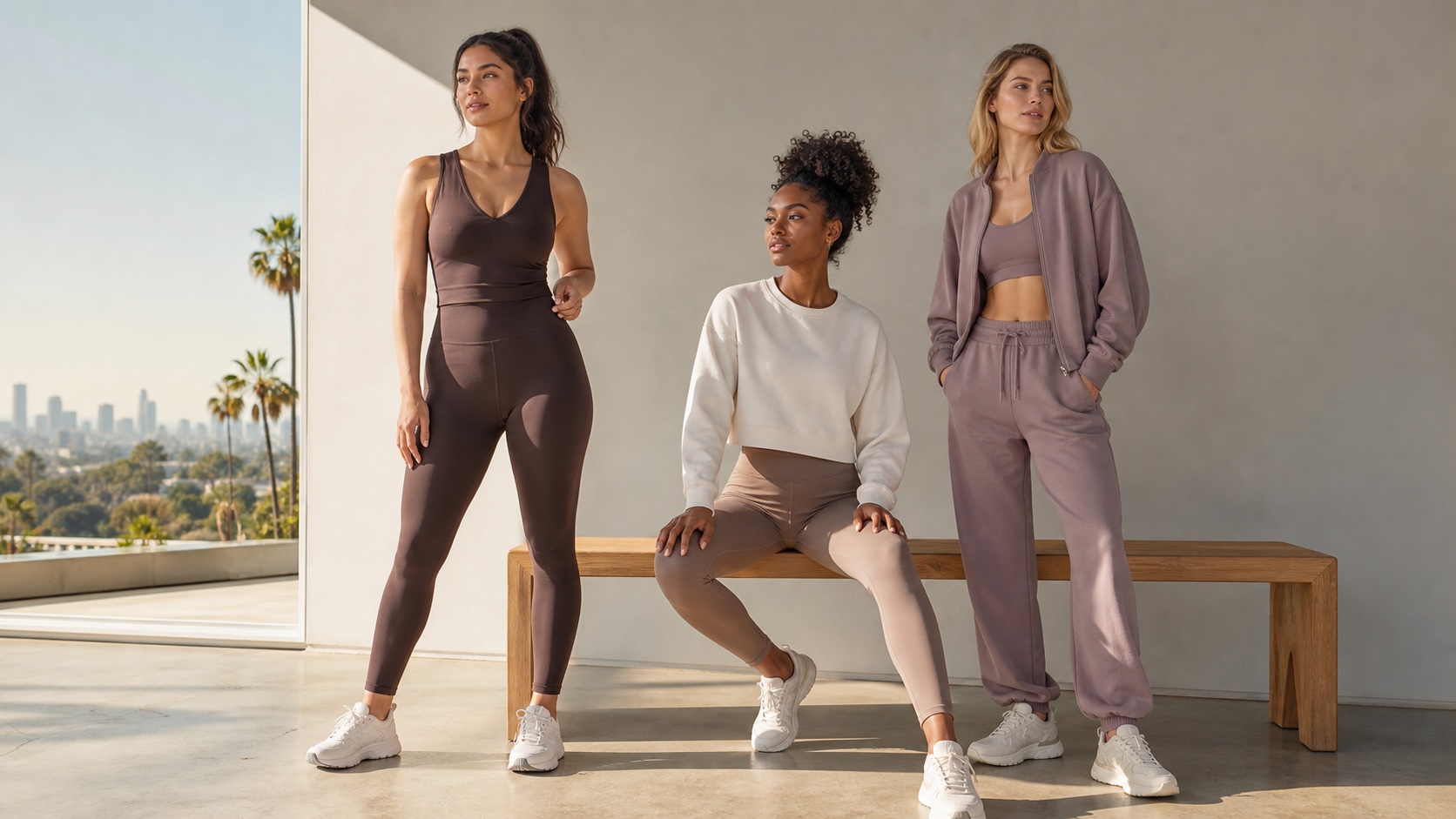
At first glance, the offer looks familiar: soft tanks, fitted leggings, cropped layers, oversized sweats and neutral colours. There is no obvious technology story to explain the brand. No giant performance claim. No loud logo doing the work for the product.
But that is precisely why the brand is worth studying. The Joah Brown brand strategy shows how a young activewear and lifestyle label can make “essentials” feel specific enough to buy, wear and buy again. The lesson is not to produce more basics. It is to make a small set of decisions about fit, fabric and styling repeatable enough that customers can recognize the system.

The visible product is simple. The underlying system is not.
Joah Brown’s current storefront is organized around more than garment categories. It gives shoppers several ways to understand the assortment: “Made in USA,” “Classic Cotton,” “The Black Edit,” “Soft Essentials” and “Sets,” alongside tanks, bras, tees, long sleeves, sweatshirts, bottoms, dresses, swim and accessories. That architecture matters because it lets the customer enter through either a product need or an identity.
A shopper can begin with a tank. She can also begin with a fabric, a colour edit, a set or a promise of softness. Once inside, the assortment suggests how the first item should connect to the next one.
This is a better mental model than “Joah Brown sells basics.” Basics are generic product nouns. A system is a set of repeatable relationships:
- a fitted base layer creates a clear body line;
- a soft or structured fabric determines how close the garment feels to the body;
- a relaxed layer gives the outfit an off-duty counterweight;
- a neutral or controlled colour system makes the pieces easier to combine;
- the same customer can use the wardrobe for movement, errands, travel and rest.
That system lowers the amount of explanation required at the moment of purchase. The buyer does not need to imagine a completely new outfit every time. She can add to a language she already understands.
Small reward: run the “three-mode” test on your own assortment
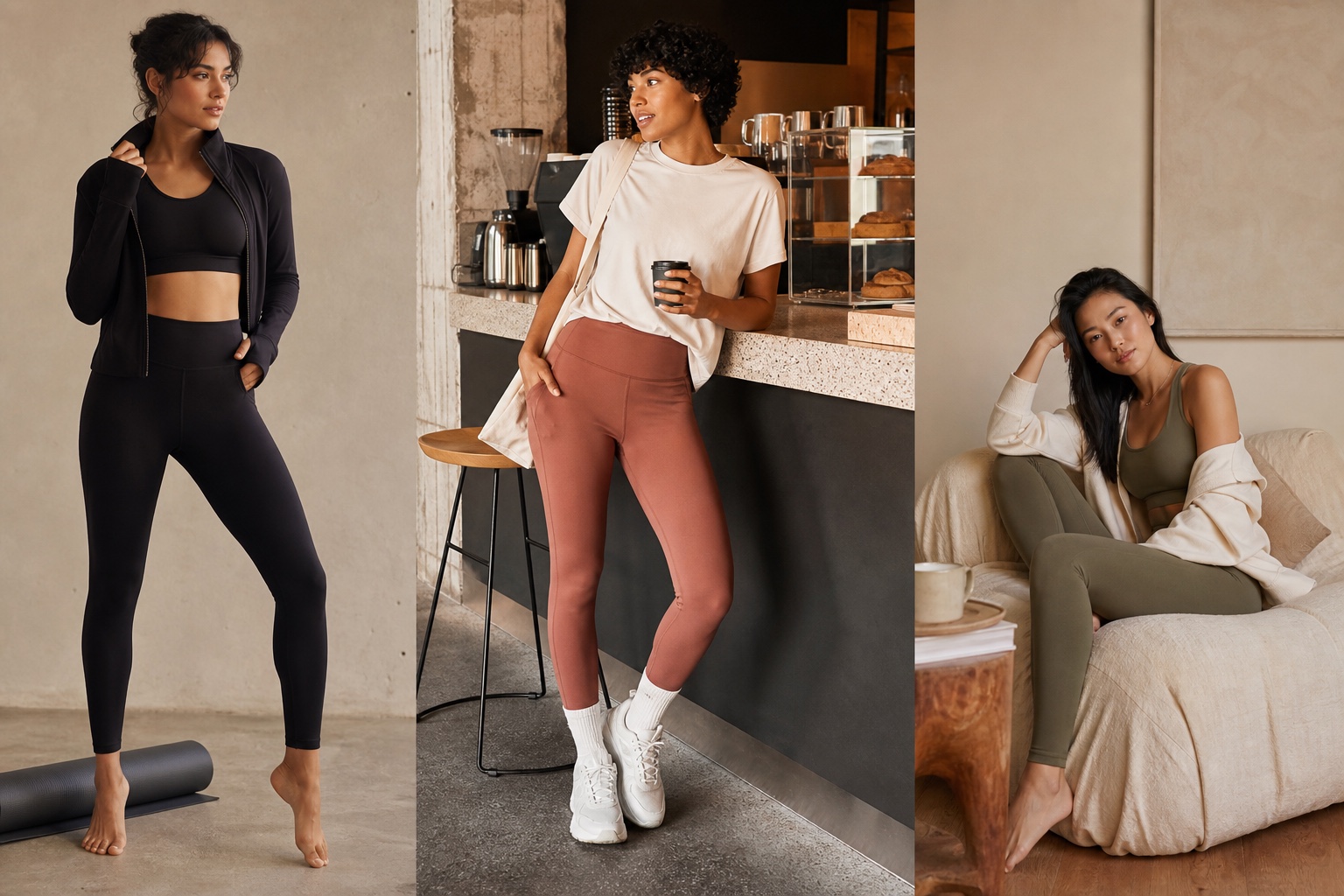
Take your proposed hero garment and style it in three situations: a studio or workout, a street or coffee run, and a quiet day at home. If the piece only works in one photograph, it may be a product. If the same fit and fabric can survive all three contexts without looking accidental, you may be building a wardrobe system.
Joah Brown’s real code is the way it frames the body
The strongest evidence is visible in the product pages. The Second Skin Legging is described as high-waisted and form-fitting, with a wide V-shaped waistband. The Body Legging keeps the body-contouring Sueded fabric but changes the construction to a high-rise legging with an elastic waistband. The V Neck Racerback Tank uses a fitted full-length silhouette, V neckline and racerback.
These are not identical products. That distinction is important. A brand code does not mean repeating the same garment until the assortment becomes boring. It means repeating a point of view while allowing the construction to change.
Here the point of view is body-aware without being dependent on decoration. The waistline, neckline, stretch, length and negative space do much of the visual work. The customer can recognize the intended effect even when the garment category changes.
This is a more defensible form of differentiation than adding a new strap, cutout or colour to every launch. Details can be copied quickly. A consistent fit philosophy is harder to copy because it lives across patterns, grading, fabric behaviour, sewing tolerances, photography and customer expectation.
Small reward: build a five-product fit-code audit
Choose five products from your own collection and record only six variables: neckline, waistband, body length, compression level, fabric handfeel and intended styling layer. Then ask:
- Which three variables repeat?
- Which variable makes the brand recognizable without a logo?
- Which variable is merely a trend borrowed from the market?
- Can a patternmaker turn the answer into a measurable specification?
If every product answers differently, you have a catalogue. If several products answer in the same voice, you may have the beginnings of a brand code.
“Soft” is not a strategy until it is organized
Joah Brown makes fabric a visible part of the shopping experience. Its About page groups the offer into Modal, Cotton, Nylon, Sueded, Rib and French Terry, with a short explanation of the intended feel or use of each. The product catalogue also uses FlexRib as a named fabric family.
This is commercially smarter than describing every garment with the same vague phrase—“premium,” “buttery soft” or “high performance.” A fabric family becomes a navigation system. It tells the customer what kind of experience to expect before she understands every construction detail.
The product pages make that promise more concrete. Sueded is presented as a body-contouring, stretchy fabric intended to hug curves and retain its shape. FlexRib is described as soft, stretchy and made to move. French Terry is positioned for layering. Whether every customer agrees with the promise is a separate question; strategically, the brand is giving materials a job to do.
That distinction is useful for founders. Fabric should not be selected after the design is finished simply because a mill has a convenient stock option. It should be assigned to an occasion and a silhouette:
| Customer job | Product decision | Proof to collect |
|---|---|---|
| Feels close and sculpted | High-stretch, shape-retaining base layer | Opacity, recovery, waistband comfort and wash test |
| Moves between workout and day | Soft fitted top with controlled neckline and length | Movement video plus styled street look |
| Creates a relaxed counter-shape | French Terry, cotton or other layering body | Drape, shrinkage, pilling and layering fit |
Small reward: write the fabric promise before you request samples
For each fabric, complete this sentence: “The customer chooses this because she wants to feel ___ while doing ___, and she expects the garment to look ___ after ___.” The blanks force you to connect handfeel, activity, appearance and durability. That is a much stronger brief than “find a soft black fabric.”
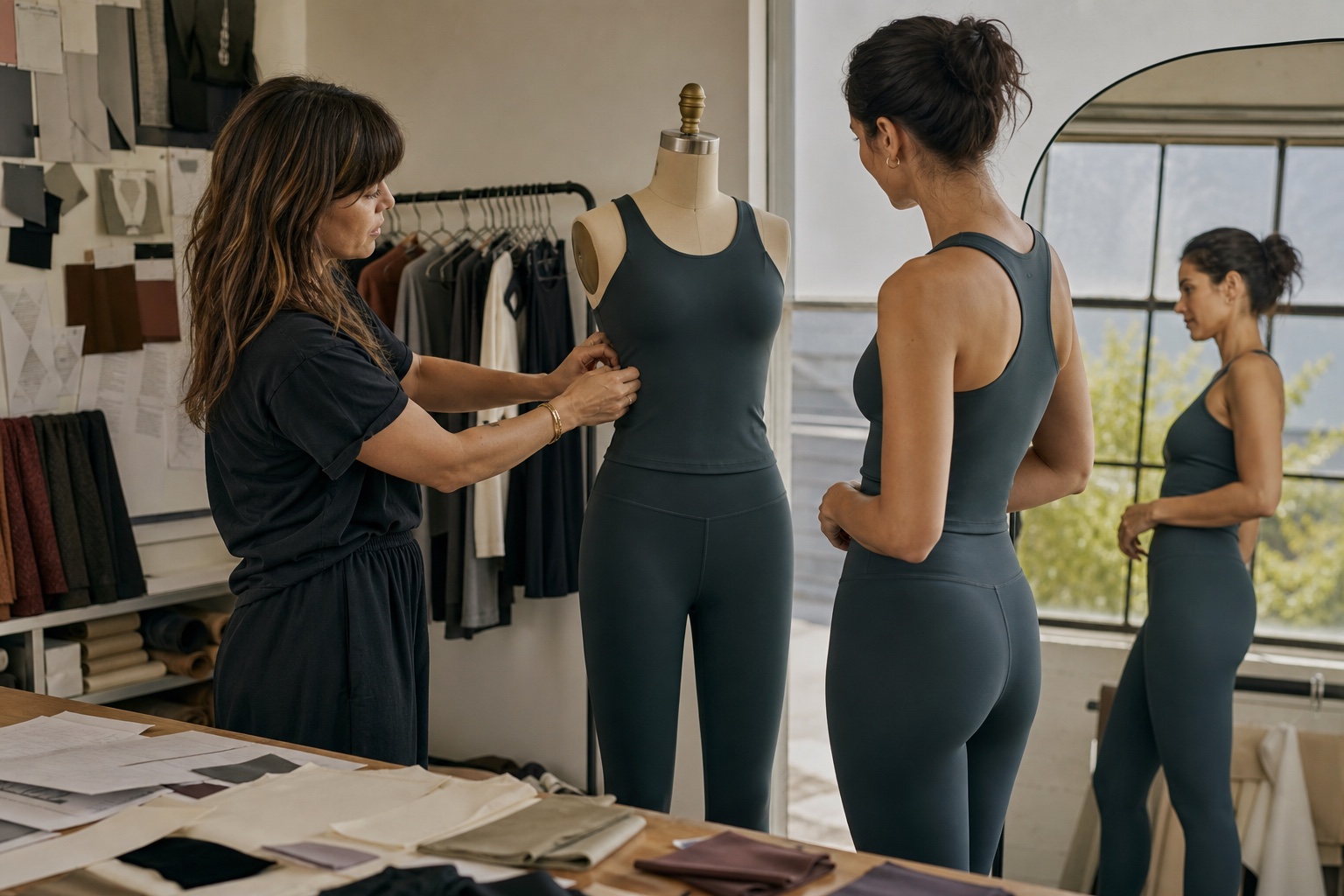
The customer is buying a wardrobe shortcut, not just a garment
The current best-seller assortment spans a wide price ladder: tanks appear around $78 to $108, leggings around $92 to $108, tees around $64, and more substantial joggers and outerwear extend well above $200. That range suggests the brand is not only selling a single entry-level activewear item. It is inviting the customer to assemble a complete, coordinated wardrobe.
But a wardrobe shortcut only works when the customer trusts the first purchase. Premium essentials are especially unforgiving because they are visually familiar. A $78 tank has to justify itself through neckline, body length, fabric, construction and the number of times it is worn—not through novelty alone.
There is also a practical constraint in the official product experience. The Second Skin Legging and other product pages show “Final sale,” while the FAQ says discounted items cannot be returned or exchanged and directs shoppers to product waitlists when sizes sell out. Those policies may protect inventory economics, but they increase the importance of accurate fit information and expectation setting.
This is where the surface lesson and the real lesson split. The surface lesson is “sell flattering basics at a premium.” The deeper lesson is “earn enough fit confidence that the customer is willing to take the risk of buying a familiar-looking item at a premium.”
Small reward: create a fit-trust scorecard
Before scaling a fitted style, score it on five pieces of evidence:
- Does the size chart describe the body measurements that actually control fit?
- Does the model information show height, size and relevant fit notes?
- Have you tested movement, sitting, bending and washing—not only a static pose?
- Can customer service explain who should size up, size down or avoid the style?
- Are returns and final-sale decisions consistent with the confidence you have earned?
Do not call a product “validated” because it photographed well. Call it validated when fit complaints become specific, predictable and manageable.
Visibility helps, but it does not explain the whole model
There is evidence that Joah Brown’s subtle designs can travel beyond its own website. In a 2026 Marie Claire roundup, Jennifer Lopez was shown wearing the brand’s $78 V Neck Racerback Tank with tailored, luxury accessories. The editorial framing is revealing: a small change in neckline and back transformed a familiar tank into a piece that worked inside a high-fashion look.
That is useful cultural distribution. It teaches the market how to read the product. The tank is not presented as gym-only; it becomes the sporty element inside an everyday outfit.
Still, celebrity visibility is a competing explanation, not a complete one. A founder cannot copy the outcome by simply sending products to famous people. Without an underlying fit and styling system, visibility creates a spike of attention with no clear second purchase. The better question is: if a creator or customer discovers one item, what adjacent item is she naturally expected to understand next?
Small reward: design the “one hero, three adjacencies” map
Pick one hero product and draw three next steps:
- a second colour or fabric for the same customer;
- a complementary bottom or top that creates a complete look;
- a relaxed layer that expands the use occasion.
If none of the three is obvious, your hero may be attractive but commercially isolated. If all three are obvious, content, merchandising and email can work harder because each customer question has a natural answer.
What an emerging brand should borrow—and what it should not
Borrow: a small, legible product grammar
Start with one body relationship you can defend. It could be a particular waist height, a proportion between cropped and full-length pieces, a distinctive neckline, or a contrast between close-fitting foundations and oversized layers. The goal is not to invent a never-seen-before shape. The goal is to make your choices coherent enough to recur.
Borrow: fabric families with different jobs
Two or three fabric families are enough for a first system if each has a clear role. One can own close-to-body movement. Another can own everyday softness. A third can own layering. This keeps the assortment understandable and makes development more disciplined.
Borrow: show the same product in more than one life
One studio image proves very little. Show the base layer moving, sitting under a jacket, paired with denim, or worn with a relaxed sweatshirt. This content does more than create aspiration: it reduces the customer’s mental work before purchase.
Do not borrow: the price without the proof
Premium pricing can work for simple products, but simplicity increases scrutiny. If your fit is inconsistent, your fabric pills, your colour changes between batches or your size chart is vague, the customer will compare you with cheaper alternatives immediately.
Do not borrow: local production as a shortcut to product quality
Joah Brown’s FAQ states that its clothing is made in Los Angeles. That is a reported production fact, not proof that local production automatically creates better products. The transferable lesson is control: the ability to communicate a fit issue, correct a pattern, protect a fabric standard and repeat the result. Those capabilities can exist in different manufacturing geographies, but they must be designed into the process.
A practical launch system for a Joah Brown-inspired opportunity
For a new brand, the most useful translation is not to launch a large collection. It is to build a controlled learning loop.
- Choose one fit promise. Define the body effect, activity level, compression and styling role in measurable language.
- Build one hero and three adjacencies. Keep the first range small enough that every piece can be tested, photographed and explained.
- Test the fabric in the life it promises. Record stretch recovery, opacity, pilling, shrinkage, colourfastness and comfort after movement.
- Publish fit evidence before scale. Use multiple body measurements, model notes, movement footage and clear size guidance.
- Measure the second decision. Track which first products lead to a second product, which pairings are clicked, and which fit issues cause returns or support requests.
The key metric is not only first-order conversion. It is whether the first product makes the next decision easier. That is the commercial test of a system.
Where manufacturing becomes a strategic advantage
This is also where an emerging brand needs to separate development from production. A factory should not be asked to rescue an unproven concept through volume. First prove the fit code, fabric role and customer response. Then turn the winning decisions into a technical package that can be repeated.
For brands that have reached the confirmed-design stage, Battlerobe’s bulk custom production service can support the transition from a validated concept to a repeatable supply standard: custom pattern and fit development, performance fabric and colour selection, trims and components, branding, sampling, bulk production and quality control. The published guidance begins around 500 pieces per colour and style, with larger programs depending on the project, so the right moment is after the demand and specification are real—not at the sketch stage.
The reason this connection is natural is simple. A fit-led brand does not primarily need “more clothes.” It needs the same customer promise to survive across sizes, colours, fabric lots and production runs. That requires a manufacturing partner who can discuss the pattern, the material and the inspection standard in the same conversation.
Small reward: use three production gates
- Test now: validate the hero silhouette, fabric handfeel and three-mode styling with a small, measurable sample program.
- Build after proof: develop custom grading, colour standards, trims, labels and inspection points once feedback identifies the winning version.
- Do not scale directly: do not place a large order merely because a reference product is trending or a supplier can offer a low unit price.
That sequence protects both the brand and the factory relationship. It turns manufacturing from a last-minute purchasing decision into part of the brand’s repeatability.
The strategic takeaway
Joah Brown’s most valuable lesson is not that the market wants soft basics. The market already has plenty of soft basics.
The stronger lesson is that an emerging activewear brand can make familiar products feel ownable by repeating a clear relationship between fit, fabric and life context. The customer should be able to recognize the logic before she recognizes the label. She should know what the next piece is likely to feel like, how it will fit into her day and why it belongs beside the first purchase.
That is the opportunity—and the burden—of an essentials brand. When the design looks simple, the hidden work becomes more important: pattern discipline, fabric testing, size communication, styling proof, inventory gates and production consistency.
Founders who can do that work are not merely selling basics. They are building a wardrobe shortcut that customers can trust.