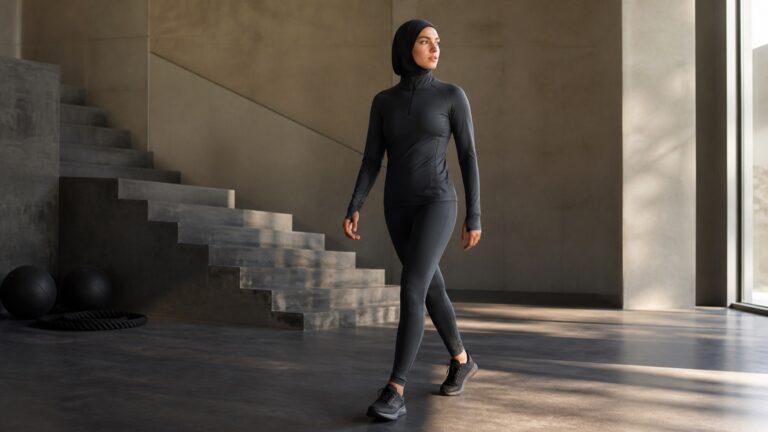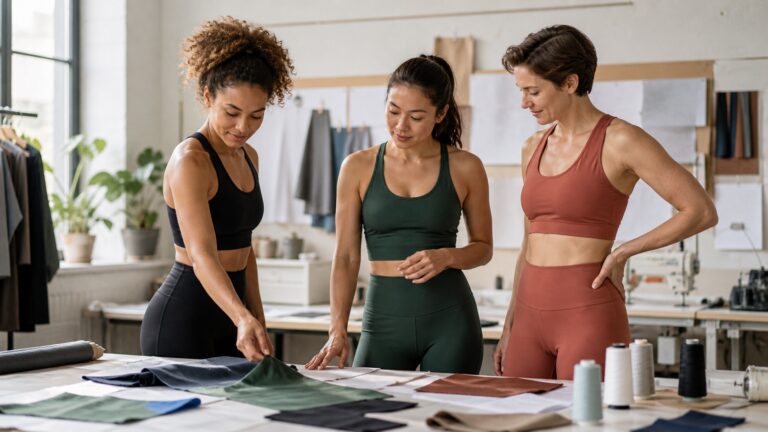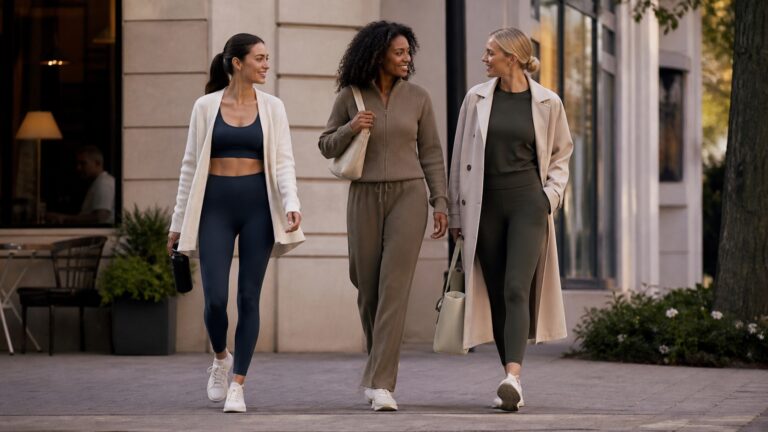


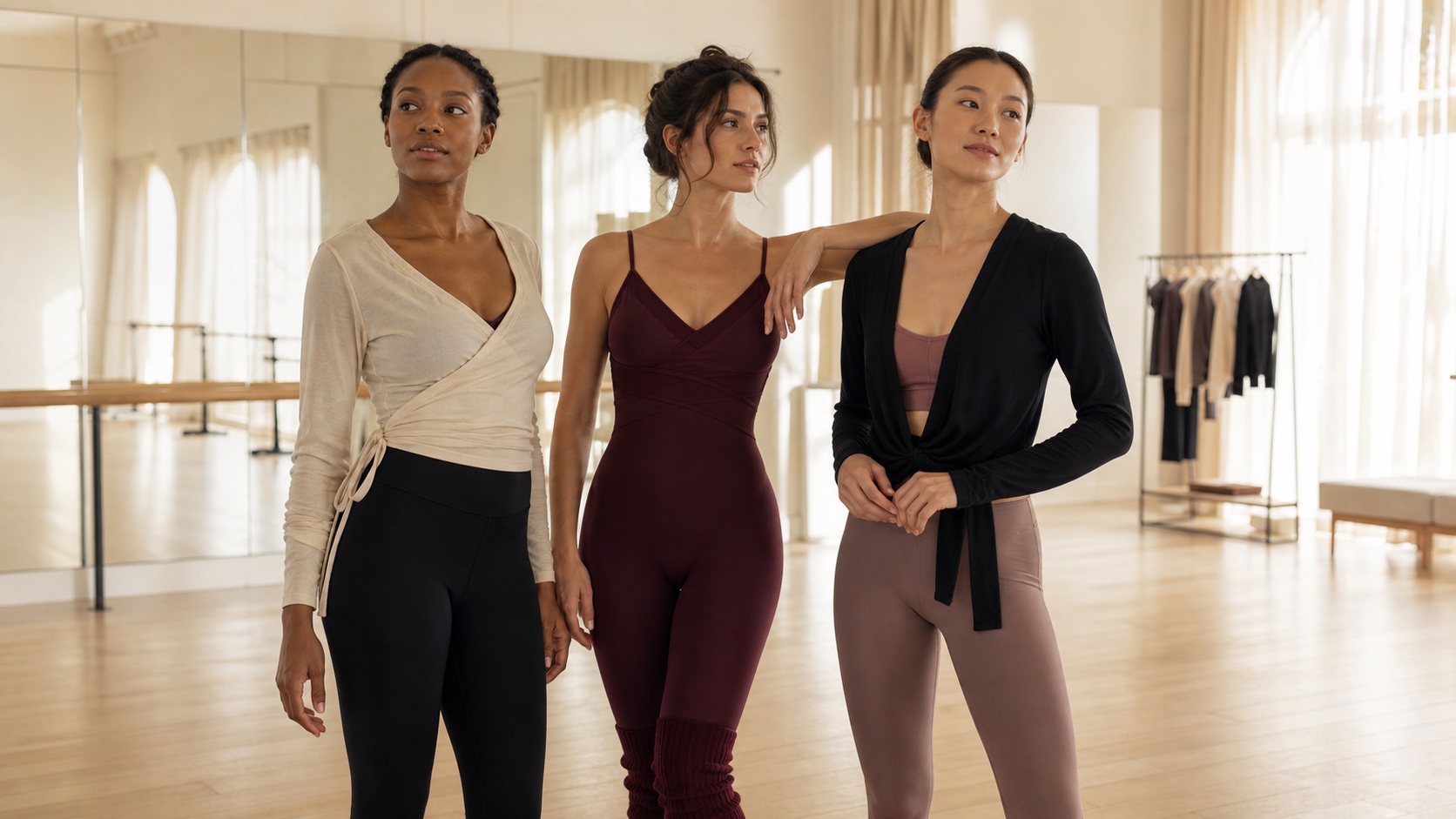
Port de Bras did not make ballet-inspired activewear interesting by putting a few graceful details on leggings.
It made movement itself into a product language.
That distinction explains why the brand can place a sports bra beside a leotard, a wave skirt, a tailored pant, a trench coat, and a dress without feeling like it has completely left activewear behind. It also explains the risk. A strong design language can justify attention and premium pricing, but it can also create more complicated patterns, narrower use cases, longer production times, and more demanding fit expectations.
The Port de Bras brand strategy is therefore not simply “ballet meets athleisure.” It is a test of whether a movement culture can become a repeatable construction system—and whether the operating model can support the promise.
The brand found a gap between performance wear and costume
Port de Bras describes itself as a luxury activewear brand “for a life in movement.” Its official positioning emphasizes a transition from office to gym and beyond, a flattering fit, ease of mobility, and a ballerina-inspired aesthetic. The language is carefully placed between two categories.
On one side is technical sportswear: engineered for a specific activity, often visually coded as gym clothing. On the other is fashion: expressive, occasion-oriented, and not always designed to move. Port de Bras proposes that a garment can borrow the line and discipline of ballet while still functioning as a wardrobe piece.
That proposition matters because the customer is not buying only for a workout. She may be buying for a Pilates class, a flight, a lunch, a rehearsal, a vacation, or the visual feeling of being composed while moving through a busy day. The brand’s founder, Clarissa Egaña, described this world in a Voyage MIA profile as a brand connected to ballet movement, women’s empowerment, sustainability, and a positive influence.
The commercial insight is subtle: Port de Bras does not need to win every high-intensity sport. It can win a more emotionally charged moment—when the customer wants to feel elegant, capable, and visibly different from a standard gym uniform.
Reader action: define the gap your brand is targeting as a conflict between two existing categories. For example: “technical enough for reformer Pilates, polished enough for a coffee meeting,” or “supportive enough for training, expressive enough for a night out.” A category bridge is more useful than a broad claim that your products are versatile.
Ballet works here because it supplies a grammar, not just an aesthetic
A theme can appear in a campaign and disappear from the product. A grammar repeats.
Across Port de Bras’s current assortment, the ballet reference appears through several design behaviours:
- Line: fitted silhouettes and body-aware seams direct the eye along the figure.
- Wrap: layering and crossing suggest the logic of warm-up clothing without requiring a literal ballet costume.
- Extension: long sleeves, elongated legs, skirts, and flowing layers make movement visible.
- Controlled exposure: cut-outs, open backs, and shaped panels create tension between coverage and reveal.
- Transition: the same piece is styled for the studio, street, office, travel, or an occasion.
These codes make the brand recognizable even when the collection changes. The effect is especially visible in products such as the Flamingo family, the Lauren active suit, the Scrunchie Top, and the Wave-related pieces. They do not all look identical, but they appear to belong to the same movement world.
This is what I call Choreographic Utility: a garment is not merely decorated with movement. Its construction changes how the body is framed, layered, or read while moving. That creates a more defensible brand code than adding a ribbon, a pastel colour, or a ballet-inspired name.
The boundary is important. A visual code becomes commercially useful only if it can survive three tests:
- Can a customer recognize it from a distance?
- Can a patternmaker express it consistently across at least three product categories?
- Does the code improve a real wearing occasion rather than only the photograph?
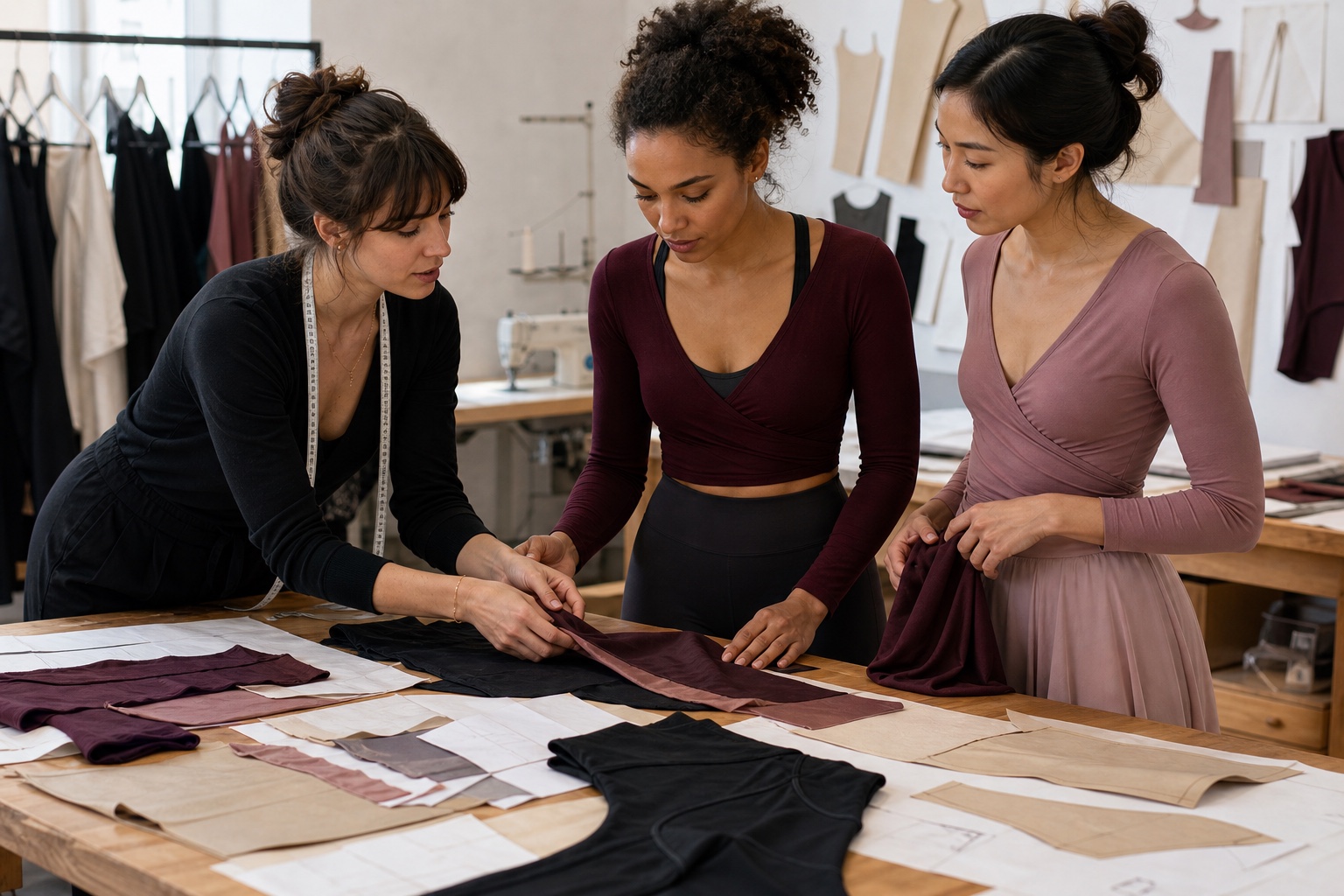
Reader action: choose three construction verbs for your own brand—such as wrap, sculpt, float, compress, frame, or layer. Then sketch one top, one bottom, and one outer layer using those verbs. If the idea works only as a logo or surface print, it is not yet a product language.
The product range expands by translating the code into occasions
Port de Bras’s current catalogue is broader than a conventional activewear menu. The official collections page includes bras, crop tops, tanks, bodysuits and leotards, leggings, shorts, skirts, pants, dresses, outerwear, swimwear, accessories, matching sets, core products, preorders, and make-to-order pieces.
That range would be confusing if every category represented a new identity. It becomes more coherent when viewed as an occasion ladder:
| Customer moment | Product role | Why the brand code matters |
|---|---|---|
| Studio movement | Legging, bra, biker, fitted top | Mobility, body line and support |
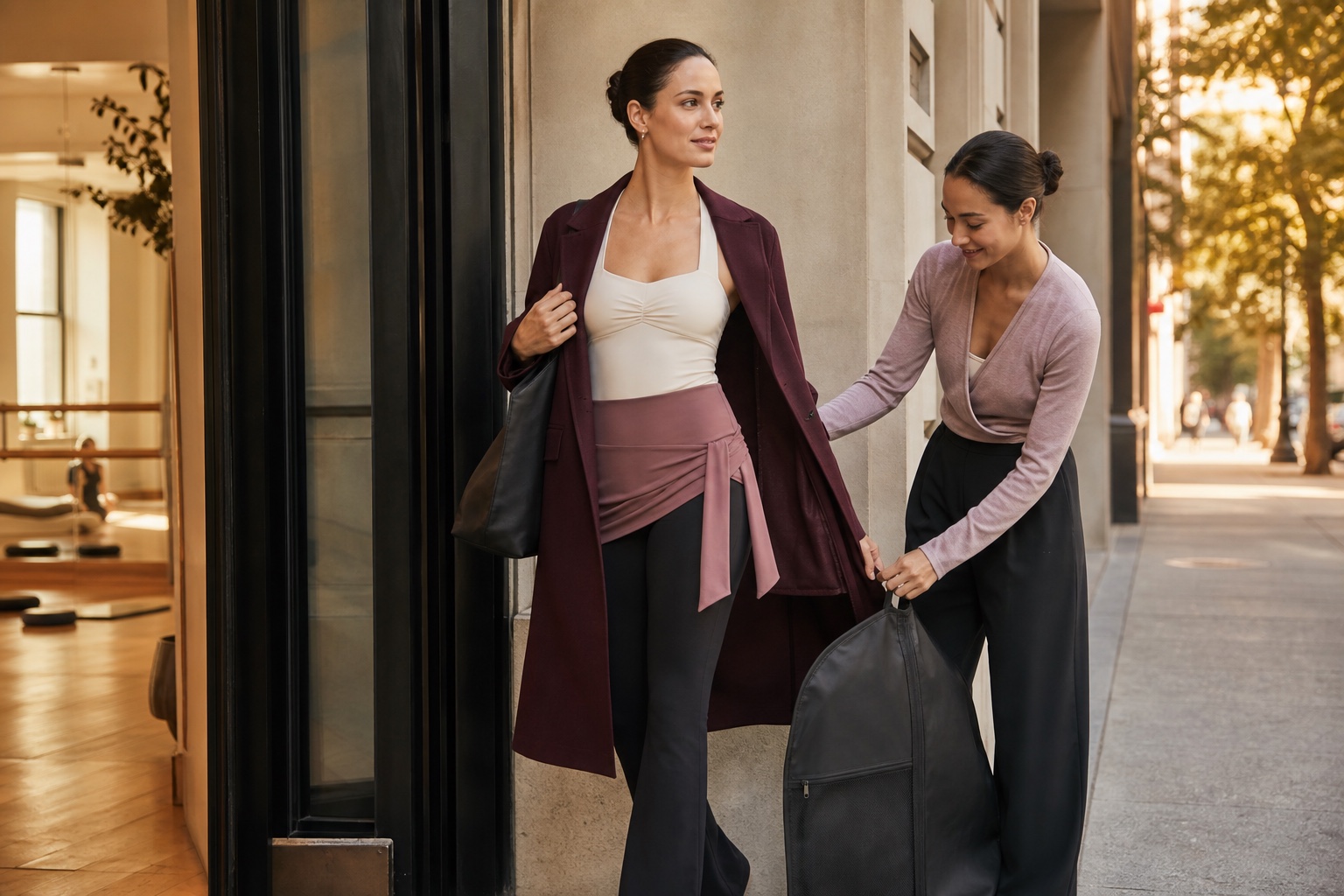
| Arrival and departure | Wrap, tank, skirt, knit or layer | Warm-up logic and immediate styling |
| City or travel | Suit, pant, dress, trench or jacket | Movement language becomes wardrobe polish |
| Occasion dressing | More sculptural or expressive pieces | Distinctive silhouette earns premium attention |
The range is not necessarily a sign of indiscriminate expansion. It can be a way to increase the number of occasions in which the customer remembers the brand. A pair of leggings may acquire a higher perceived value when it belongs to a wardrobe that also solves the layer worn over it.
But cross-occasion design creates a merchandising problem. The founder must decide whether a piece is a core product, a styling bridge, or a statement item. If the assortment is presented only as a large fashion catalogue, the customer has to do the work of understanding how everything connects.
Reader action: classify every planned style by job: anchor, bridge, or statement. Start with one anchor product, two bridge pieces that increase outfit combinations, and no more statement pieces than your content and cash can support. Versatility should be visible in the merchandising, not left to the customer’s imagination.
Material technology supports the story—but should not carry it alone
Port de Bras builds another layer of differentiation around fabric. Its official pages describe smart biodegradable fabric, the AMNI SOUL ECO certificate, and Emana yarn with far-infrared technology. Some product pages present claims about thermoregulation, circulation, and wellness.
These details help the brand make a luxury argument: the garment is not only visually special; it also contains a considered material choice. The customer is given a reason to believe that the price reflects more than styling.
However, this is precisely where editorial and product discipline are required. The brand’s own claims are not independent proof of environmental impact or health outcomes. A biodegradable polyamide claim does not automatically tell the customer how the garment behaves in use, how it is dyed, how long it lasts, what happens in a real disposal system, or whether the total production process is lower-impact. An infrared-fabric claim does not establish a meaningful wellness outcome for every wearer.
The more transferable lesson is not “find a futuristic fibre.” It is to connect material choice to a customer-visible problem:
- What hand feel makes the garment comfortable for long wear?
- What recovery keeps the line clean after repeated movement?
- What opacity protects the customer when the fabric is stretched?
- What construction lets the material move without pulling or twisting?
- What care requirements are realistic for the intended wardrobe?
Reader action: write your material proof chain as “material property → garment behaviour → customer benefit → evidence.” If you cannot complete the final step, describe it as a design intention rather than a proven performance or sustainability outcome.
Made-to-order turns scarcity into a production philosophy
Port de Bras is unusually explicit about its made-to-order model. Its official policy says many pieces are made strictly to order to avoid holding bulk stock, and that artisans may take three to five business days to complete a piece. Selected product pages state that handcrafted-on-demand garments may require two to three weeks for creation and delivery.
This model fits the brand’s luxury narrative. A customer is not being told that a warehouse is full of anonymous units. She is being invited to buy a piece that is created for her, sometimes with made-to-measure support if the standard size guide does not work.
Operationally, made-to-order can reduce the risk of producing a large quantity of an unproven statement style. It can also allow a wider creative range than a traditional ready-stock model, because demand is confirmed closer to the moment of production.
But it does not remove risk. It moves risk:
- from finished inventory into labour scheduling;
- from stock availability into lead-time communication;
- from markdown exposure into cancellation and return friction;
- from forecast error into fabric and trim availability;
- from generic sizing into measurement support and fit responsibility.
The policy makes the trade-off visible. Depending on market and stock status, Port de Bras lists 6–12 business days for receiving an order, applies a 20% restocking fee for relevant refunds, and offers 14-day returns in the United States and European Union while imposing tighter conditions in other regions. Made-to-order pieces may also be excluded from ordinary withdrawal rights in some markets.
That may be appropriate for a luxury product, but it changes the conversion equation. The customer must want the garment enough to tolerate waiting, understand the return rules, and trust the fit guidance before purchase.
Reader action: decide which products deserve made-to-order treatment. Use it for high-design, uncertain-demand, or personalization-heavy pieces. Keep proven entry products available with clear stock and delivery expectations. A single fulfilment promise for every product will usually be less honest than a visible core/atelier split.
Price is justified by a system of signals, not one fabric claim
A current Port de Bras product snapshot shows a clear premium ladder: a Movement Bra at US$95, a Flamingo Bra at US$105, Sofia Shorts at US$145, a Flamingo Tank at US$165, a Lauren Active Suit at US$325, and a Rib Trench Coat at US$345. Product pages commonly show sizes from XXS to XL, though the brand offers made-to-measure support when the standard guide does not fit.
These prices are not evidence of margin or commercial success; they are dated public observations in a particular currency locale. They are useful because they show the brand is asking customers to pay for a combined value proposition:
- recognizable design language;
- premium material narrative;
- handcrafted or on-demand production;
- cross-occasion styling;
- founder-led luxury positioning.
Remove one signal and the price argument becomes weaker. If the garment looks like generic activewear, the material story has to do too much. If delivery is slow but the product is not special, the waiting becomes a penalty. If a luxury piece fits inconsistently, made-to-order sounds less like care and more like friction.
Reader action: build a price justification stack before setting your retail price. List the three things the customer can feel or verify in the product, the two things she can understand from the story, and the one service promise that reduces purchase anxiety. If the stack is mostly invisible claims, invest in construction and proof before adding more language.
The founder’s background amplified the design system
Clarissa Egaña’s background is part of the brand’s strategic advantage, but it should not be confused with the product mechanism. The independent founder profile describes her earlier high-end swimwear business, later experience in PR and marketing at History Channel and Cartier, and the difficulty of learning fashion production, distribution, logistics, and financing while building Port de Bras.
That combination matters. A founder with a fashion and communications eye can make a niche product legible to a larger audience. She can turn a garment into a world: a name, a silhouette, a movement, a material, a setting, and a reason to care.
Yet a founder story cannot substitute for repeatable development. It can open the door; it cannot grade the pattern, approve the recovery, manage the trim, or explain an unexpectedly long delivery window. That is why Port de Bras is more instructive when read as a system rather than a personality profile.
Reader action: separate the “founder amplifier” from the “product engine” in your own business. Ask what would remain recognizable if the founder stopped appearing in every campaign. The answer should be a product code, a customer occasion, or a service experience—not only a biography.
What an emerging brand should copy—and what it should not
Test now
- Choose one movement culture or customer ritual that gives your brand a real vocabulary.
- Turn three movement verbs into repeatable construction decisions.
- Build one anchor product and two bridge pieces for a clear studio-to-street occasion.
- Test material claims through hand feel, recovery, opacity, care, and wear feedback.
- Use small-batch or on-demand production for a statement item only after defining the lead-time promise.
Build after proof
- Extend the design code into bodysuits, skirts, dresses, pants, and layers only when customers show cross-category attachment.
- Add made-to-measure support after you have a reliable measurement and alteration process.
- Use a premium fabric platform when you can explain its garment-level benefit and document the relevant evidence.
- Develop more complex pieces with a production partner that can protect the intended line across fabric, fit, trims, samples, and quality control.
Do not copy directly
- A ballet visual identity without a construction system.
- Health or sustainability language that outruns the evidence available to the customer.
- Made-to-order for every product, especially entry products that need fast conversion and simple returns.
- A large category catalogue before the customer understands the anchor product.
- Premium pricing based only on fabric novelty or founder taste.
Where Battlerobe becomes relevant
The natural manufacturing question raised by Port de Bras is not “Can someone make a ballet-looking set?” It is “Can the movement code survive the journey from reference image to a consistent, sellable garment?”
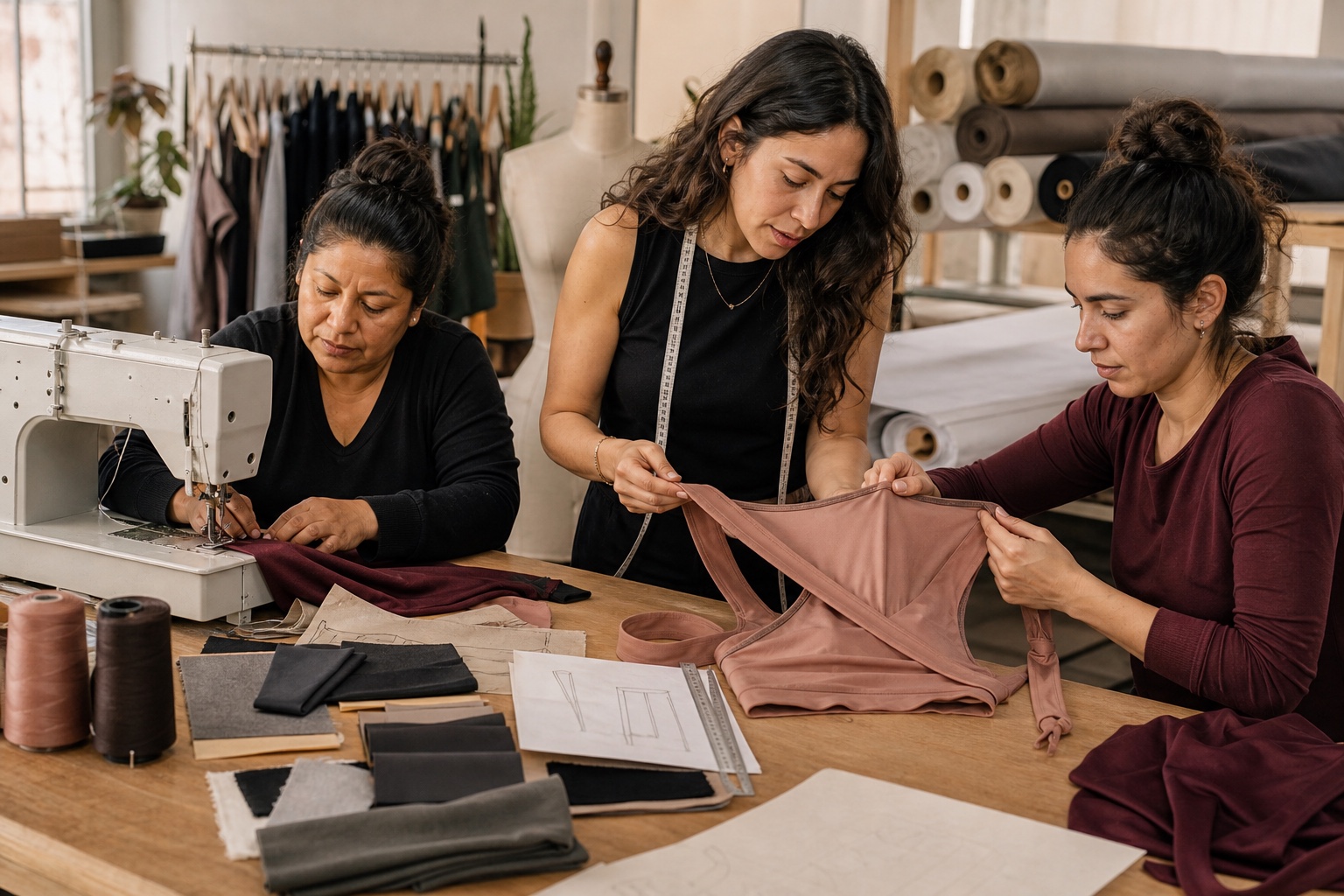
That requires decisions about pattern lines, stretch direction, recovery, seam placement, lining, support, trims, branding, colour, grading, sampling, and inspection. It also requires a founder to know which detail is essential to the brand code and which detail can be simplified without losing the idea.
This is where Battlerobe’s bulk custom production service can become relevant: after a product concept and customer occasion have been validated, the team can help coordinate pattern and fit, fabric and colour, trims and branding, sampling, bulk production, and quality control. The value is not a generic factory handoff. It is helping the design intention survive production.
The boundary should remain clear. A production partner cannot independently validate a wellness claim, create luxury demand, or decide whether a two-week wait is acceptable to your customer. Those are brand and commercial decisions. Manufacturing helps when the founder has made the decision and needs a controlled path from concept to reliable product.
Reader action: before sending a fashion reference to a factory, annotate it with three layers: non-negotiable brand code, functional requirement, and flexible styling detail. This reduces the chance that a beautiful idea becomes either an inaccurate copy or an over-engineered product.
The decision: own the movement, not the costume
Port de Bras is valuable to study because it shows how a small activewear brand can occupy a space that large technical brands often leave open. The customer is not choosing between performance and fashion in the abstract. She is choosing how she wants to feel, move, and be seen across several moments of the day.
The brand’s strongest mechanism is not its claim that a particular fibre improves wellness. It is the translation of movement into a recognizable design grammar, then the extension of that grammar across products and occasions. The made-to-order model reinforces exclusivity and reduces some stock risk, but it also makes time, fit, returns, and communication part of the product.
If we were advising a new brand inspired by this case, we would run a six-week test:
- Interview 10–15 customers who already move between studio and city in the same day.
- Select three construction verbs and apply them to one anchor product.
- Create two bridge pieces that make the anchor easier to wear outside the studio.
- Test the smallest and largest intended sizes, stretch recovery, opacity, care, and movement.
- Offer a controlled preorder or small batch with a written delivery promise.
- Scale only if customers can explain the design code, wear the product across occasions, and accept the price and lead time.
That is the Port de Bras lesson worth carrying forward: a niche becomes a brand when its cultural reference changes the garment, and the garment keeps its promise after the photograph is over.
Sources and further reading
This case study uses Port de Bras’s official brand, product, catalogue, FAQ, and policy pages together with public founder interviews and a consumer review signal. Official sustainability, material, wellness, and made-to-order statements are treated as reported brand claims. Public sources do not establish revenue, profitability, repeat purchase, independent health efficacy, or total environmental impact.
- Port de Bras: About the Brand
- Port de Bras: About and material/production claims
- Port de Bras: current catalogue and product categories
- Port de Bras: made-to-order and return policy
- Port de Bras: FAQ and made-to-measure information
- Port de Bras: Flamingo Legging product page
- Port de Bras: Flamingo Bra product page
- Voyage MIA: Clarissa Egaña founder profile
- Port de Bras: Sienna Top product page