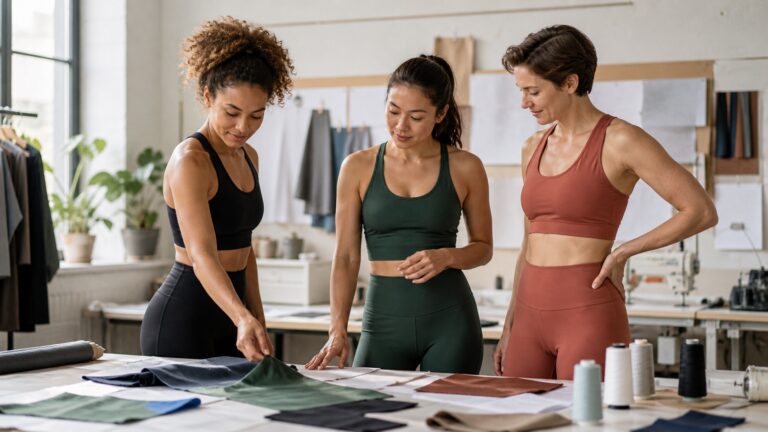



How SET Active Turned Matching Sets Into a Repeatable Community-Commerce System
SET Active is not the largest activewear brand in the market. That is exactly why it is worth studying.
The company offers a useful example of how a growth-stage activewear brand can compete without trying to outspend Nike, Lululemon, or Alo. Its model is built around a tighter system:
- recognizable matching sets;
- recurring product drops;
- a community that receives early access;
- content adapted to each platform;
- and customer participation in what the brand makes next.
In June 2025, Forbes reported that SET Active generated $1 million in sales in one hour from its first resort collection. The article described the brand as self-funded and seven years old at the time. It also reported that 72% of customers had purchased from the brand in the previous twelve months. The revenue figure was reported by Forbes based on information supplied by the company and related sources; it should not be treated as audited financial data. (Forbes, 2025)
The interesting lesson is not simply that one collection sold quickly.
The more important lesson is that SET Active built a commercial system in which product, community, content, and launch timing reinforce one another.
1. SET Active Made the Product Easy to Understand
SET Active’s product logic is unusually clear: coordinated pieces designed to be worn together.
The brand’s current site organizes its offer around activewear categories such as bras and tops, leggings, skirts, shortysuits, bike shorts, and layered looks. It also organizes products by named fabric families including Aeraline™, Luxform®, Sportbody®, and Formcloud®. (SET Active product navigation)
This does two jobs at once.
First, a customer can understand the wardrobe quickly. She does not need to decode a large collection of unrelated products.
Second, each product can lead to another product. A bra suggests a legging. A bike short suggests another top. A limited color creates a reason to return.
The brand’s “Complete Your Set” page makes this commercial logic explicit by presenting coordinated combinations and bundle pricing, including legging-and-bra and bike-short-and-bra combinations. (Complete Your Set)
The lesson for a new activewear brand
Do not begin by asking how many styles you can manufacture.
Begin by asking:
Can one product naturally create a second purchase?
A small opening range can be more powerful when it forms a system:
- one recognizable top;
- one commercial bottom;
- one alternate bottom or skirt;
- one layer;
- and a limited color story that makes the products work together.
This is more useful than launching many disconnected styles that do not share a customer, a silhouette, or a reason to be purchased together.
2. The Drop Is More Than a Launch Date
SET Active uses a drop-based model. The product is announced before launch, customers can sign up for reminders, and the most engaged community members may receive early access.
According to Forbes, nearly half of the reported $1 million resort-collection sales occurred during a fifteen-minute early-access period for rewards members and Instagram broadcast-channel followers. The same article reported thousands of sign-ups for that collection, compared with the few hundred sign-ups the team would normally regard as strong interest. (Forbes, 2025)
This matters because a drop is not simply a deadline added to an ordinary product launch. It performs several business functions:
1. It measures demand before the full launch. 2. It gives the brand a reason to communicate repeatedly. 3. It rewards the customers who are paying the most attention. 4. It concentrates traffic instead of spreading attention across an indefinite release window. 5. It creates a clear post-launch review point.
The model also exposes a risk. If a product sells out during early access, later customers may be unable to buy it. Forbes reported that this became one of SET Active’s post-launch discussion points. The company had to balance the excitement of scarcity with the frustration of insufficient inventory. (Forbes, 2025)
What a smaller brand can copy
The useful part is not artificial scarcity. It is the discipline around each launch.
Before a collection goes live, define:
- what customer problem the collection solves;
- which product is expected to lead demand;
- what evidence counts as strong interest;
- how many early-access customers can be served;
- and what happens if the product sells out or underperforms.
After the launch, record the result by style, color, size, source of traffic, and customer type. A drop should create learning, not just a sales spike.
3. The Community Is Part of the Product Development Process
SET Active describes itself as “a community first and a brand second.” Its official About page says the company uses customer communication to inform styles, colors, future releases, and returning products. (SET Active About Us)
Its rewards program goes beyond purchase discounts. The brand’s SET Rewards page describes community participation, early access to drops, challenges, gifts, and exclusive wear-testing opportunities. It also says members can help the brand create future products. (SET Rewards)
That is a stronger model than treating community as a social-media audience that only receives announcements.
The customer can play several roles:
- buyer;
- product tester;
- source of color feedback;
- creator of user-generated content;
- launch participant;
- and signal of whether an idea deserves another production run.
For a small brand, this can reduce the distance between product development and market research. Instead of waiting until a collection is finished to discover that customers dislike a color or do not understand a silhouette, the brand can collect evidence earlier.
A practical customer-feedback system
Every meaningful customer comment can be tagged as:
- fit;
- support;
- fabric feel;
- color;
- styling;
- missing product;
- price;
- sizing;
- use occasion;
- or repeat request.
The key is to count repeated patterns rather than treating every comment as a command. One loud opinion is not the same as broad demand. But a repeated request appearing in comments, direct messages, product reviews, and wear tests deserves attention.
4. One Brand Can Have Different Content on Different Platforms
SET Active’s team does not treat every social channel as a copy-and-paste distribution point. Forbes reported that the brand creates different content opportunities for Instagram, its broadcast channel, Pinterest, and TikTok rather than simply reusing identical material everywhere. The same article quoted the brand’s marketing leadership as emphasizing that creative assets should match the platform where they are produced. (Forbes, 2025)
This is an important distinction for emerging brands.
The product may be the same, but the job of the content is different:
Show the visual identity, styling, color story, fit, and finished campaign world.
Broadcast channel or close community
Show early information, behind-the-scenes decisions, launch reminders, and founder access.
TikTok
Show movement, try-ons, reactions, styling changes, and product use in a more native way.
Support longer-lived discovery through outfit combinations, color references, travel, and lifestyle inspiration.
The important principle is:
A platform should give the customer a reason to follow it separately.
If every channel repeats the same post, there is little reason to stay connected across channels.
5. SET Active Builds Momentum With Real Fans, Not Only Large Influencers
Influencer marketing is often discussed as if the only valuable creator is the one with the largest audience. SET Active’s reported approach is broader.
The Forbes article described the company gifting products not only to traditional influencers, but also to highly engaged fans who regularly comment, create unpaid posts, or show strong enthusiasm for the brand. The company reportedly focuses on engagement and genuine affinity rather than applying only conventional influencer metrics. (Forbes, 2025)
This makes strategic sense for a community-led brand. A customer with a smaller audience may still create stronger trust inside a specific studio, friend group, sport community, or local market.
The right question is not:
How many followers does this person have?
It is:
Does this person create credible product discovery among the people we want to reach?
For a new activewear brand, a Pilates instructor, a small wellness creator, or a highly engaged customer may be more relevant than a general celebrity account.
6. What SET Active Does Not Prove
A useful case study also needs boundaries.
SET Active’s results do not prove that every activewear brand should:
- use limited drops;
- manufacture scarcity;
- copy matching monochrome sets;
- build a rewards program immediately;
- or rely on influencer gifting.
The model works because several pieces fit together: a recognizable product architecture, an audience that likes collecting coordinated styles, repeated content, launch reminders, and a community willing to return.
If a brand has no product distinction, a drop simply compresses attention around an ordinary product. If there is no real community, early access becomes an empty label. If inventory planning is weak, a successful launch can create customer disappointment.
The deeper lesson is not “copy SET Active.”
It is:
Build a commercial loop in which product design creates content, content creates participation, participation improves the next product, and the next product gives the community a reason to return.
7. What This Means for a New Brand Working With a Manufacturer
For an emerging brand, the first question is usually not whether it can create a large collection. The question is how cheaply and clearly it can learn what customers will buy.
A sensible development sequence is:
Stage 1: Validate the direction
Use existing silhouettes and available colors to test whether the customer responds to the category, fit direction, and visual language. Add brand identity through approved branding elements and packaging where appropriate.
Stage 2: Identify the product worth owning
When customer evidence consistently points to a particular neckline, waist, support structure, silhouette, or fabric experience, turn that repeated signal into a proper product brief.
Stage 3: Develop the brand-specific product
Once the concept has enough evidence, invest in custom development rather than customizing everything from the beginning.
That sequence protects cash, reduces unnecessary sampling, and gives the brand a better chance of discovering which difference actually matters.
For BATTLEROBE, this is where the distinction between small-batch brand-ready production and genuine custom development matters. A brand can first test a focused product direction with existing styles, available colors, and approved branding options; a proven product idea can then move into a more specific development discussion. Exact material, sampling, price, lead time, and production feasibility still need to be confirmed for the individual brief.
Conclusion: The Real Product Is the Loop
SET Active’s most transferable achievement is not one fabric, one color, or one viral launch.
It built a loop:
matching products → recognizable content → community participation → early-access demand → launch data → better next decisions
That loop gives a growth-stage brand something larger competitors cannot automatically buy: a closer relationship between the people who wear the products and the people deciding what comes next.
For a new activewear, yoga, or Pilates brand, the practical starting point is simple:
1. Make the first product system easy to understand. 2. Give customers a reason to return before the next drop exists. 3. Collect feedback as structured product evidence. 4. Create different content for different channels. 5. Use small-batch testing to discover the product that deserves custom development.
The strongest brand is not always the one with the largest first collection.
It may be the one that learns fastest from every collection it releases.
If you are planning an activewear, yoga, or Pilates brand and need to turn a product direction into a practical development plan, BATTLEROBE can help you evaluate the right production route before you commit to a large collection.