

Most emerging activewear brands begin with a familiar problem.
They can make a good sports bra.
They can find a soft legging fabric.
They can build a clean Shopify store.
They can send products to creators.
But if the logo disappears, very little remains that tells a customer which brand made the product.
WISKII Active offers a useful alternative case.
Its public brand history dates to 2016, and today the company describes its positioning with a word of its own: “SPORTSGLAM”—technical activewear combined with fashion-led design. The brand says each product moves from sketch to store through more than four fittings, while its current product universe stretches from Pilates and tennis to resort, swim, golf, run, denim, knitwear and tweed. (WISKII About) WISKII
What makes WISKII particularly interesting is not simply that its products are fashionable.
It has built a system in which:
design creates recognition, recognition creates content, creators distribute that content, and premium cultural environments reinforce the value of the design.
That is a different growth model from a brand built around one sport, one founder or one viral product.
1. WISKII Did Not Need a Famous Founder to Become Recognizable
Many successful direct-to-consumer brands are strongly founder-led.
The founder appears in the content.
The founder tells the story.
The founder already has an audience.
The founder eventually becomes inseparable from the company.
WISKII is different.
Its public-facing brand communication is overwhelmingly about the product, the woman, the lifestyle and the aesthetic, rather than a founder personality.
Even the corporate history is less straightforward than a typical founder-led startup story. LinkedIn lists WISKII as founded in 2016 with Los Angeles as its headquarters, while Canada’s official trademark database records Meng Tian of Shenzhen as the owner on an early WISKII trademark application. Its current website terms identify the operating company as WISKII ACTIVE LIMITED, registered in Hong Kong. (WISKII LinkedIn) (Canadian trademark record) (WISKII Legal Terms) LinkedIn
For customers, however, none of that is necessary to understand the brand.
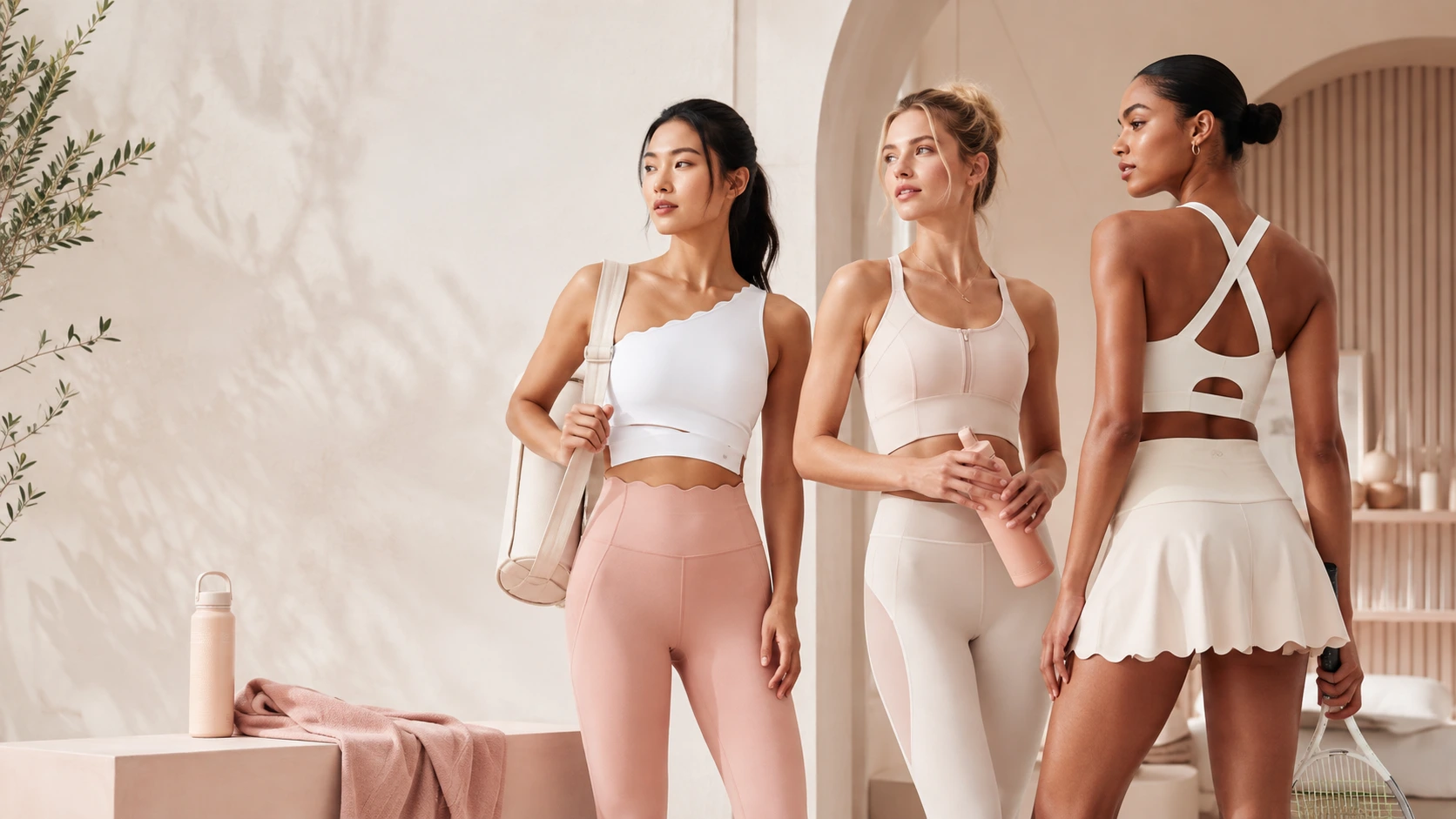
They can recognize WISKII through:
scalloped edges,
curved waistlines,
cross-backs,
one-shoulder silhouettes,
cut-outs,
layered tops,
color blocking,
and feminine studio-to-street styling.
That tells us something important.
What an emerging brand can do
You do not need to become an influencer before you can build a brand.
But if the founder is not the primary source of recognition, something else has to do that job.
A new brand should decide deliberately which of these will carry the identity:
Founder
Community
Product design
Performance specialization
Cultural positioning
Trying to be weakly dependent on all five usually produces a generic brand.
WISKII chose a route where the product itself does more of the recognition work.
For founders who do not want their personal life to become the marketing strategy, this is an especially useful model.
2. The Real Product Innovation Is Not One Design—it Is a Repeatable Brand Code
WISKII’s Elegant Scallop line makes this particularly visible.
Today, the Elegant Scallop Edit extends across bras, leggings, flares, skirts, long-sleeve tops, tanks, tennis dresses and other categories. Current products include the Cross Back Sports Bra, High-Waist Flare Legging, scalloped off-shoulder tops and multiple dresses. WISKII
The important thing is not that WISKII once designed a scalloped waistband.
It is that the company kept translating the same visual idea into different garments.
A decorative detail became:
product feature
→ recurring motif
→ recognizable collection
→ brand code.
That is much harder to achieve than launching one unusual product.
A single interesting neckline can become a bestseller.
A brand code must survive multiple products and still feel coherent.
How I would decide whether a design deserves to become a Brand Code
I would test it against three questions.
Recognition
If the logo disappears, does the detail still make the product more identifiable?
Transferability
Can the idea move from one product into several categories?
For example:
Bra → Tank → Dress
or:
Legging → Short → Flare → Skirt.
Adaptability
Can the detail evolve without looking identical every season?
A scallop can change scale.
A curved waistband can change proportion.
A cross-back can become a halter-cross hybrid.
The code stays recognizable, but the product does not become repetitive.
If a design passes all three tests, it may deserve more development investment.
If it works only on one trendy product, treat it as a seasonal feature, not the foundation of your brand.
That distinction can save a young company enormous amounts of development money.
3. WISKII Started Combining Fashion and Performance Earlier Than Its Current Image Suggests
It would be easy to assume that WISKII began as conventional activewear and later became fashion-led.
Its own older content suggests otherwise.
In January 2022, WISKII was already describing performance fabrics alongside deliberately body-shaping and fashion-oriented construction. The company emphasized squat testing, four-way stretch and moisture management, while another early product article described a multi-cross sports bra developed after research and try-ons. (WISKII leggings article) (WISKII sports bra article) WISKII
Today WISKII formalizes that philosophy as SPORTSGLAM, saying it combines technical fabrics with fashion trends and that garments go through more than four fittings. WISKII
This is useful because it shows that fashion differentiation was not merely a campaign idea.
It was embedded in product development.
What I would change in a new brand’s product meeting
Most product meetings ask:
Is it comfortable?
Does it fit?
What does it cost?
What colors should we make?
I would add a fifth question:
What does this product contribute to the brand that a basic product does not?
There are only a few acceptable answers.
It improves performance.
It creates a recognizable silhouette.
It creates a new wearing occasion.
It reinforces an existing brand code.
It dramatically improves fit.
If the answer is only:
“It looks nice.”
that is usually not enough reason to develop another SKU.
4. WISKII Shows That Product Development Can Also Be Media Development
This may be the most valuable lesson in the entire case.
Traditionally, companies treat product and marketing as two separate processes.
Product team: makes something.
Marketing team: figures out how to make people notice it.
But certain WISKII products partly solve the second problem during the first process.
Consider the Scallop Colorblock Long Sleeve Top.
It combines:
an off-shoulder outer silhouette,
a built-in halter-bra structure,
scalloped detailing,
and contrasting colors.
The product gives a creator multiple visual moments before any marketing message is added. WISKII
That became particularly visible in February 2026, when Hailey Bieber was photographed wearing the WISKII colorblock top. Cosmopolitan’s shopping editor explicitly said what caught her attention was the two-in-one construction—an off-shoulder long-sleeve layer with an integrated halter sports bra. The product itself created the curiosity. (Cosmopolitan) Cosmopolitan
That is a powerful idea for a young brand:
A good visual product can reduce the amount of explanation required to market it.
Add a “Content Test” before approving a sample
When reviewing a new sample, I would not only put it on a fit model.
I would put it in front of a phone camera.
Then test:
Front view.
Back view.
Walking.
Turning.
Layering.
Close-up.
Before/after styling.
Movement.
If the garment gives you only one interesting photograph, its content value may be limited.
If one garment naturally generates ten useful pieces of content, its commercial value may be larger than the gross margin calculation suggests.
This does not mean every product should look complicated.
A collection still needs commercial basics.
But one or two content-native products can carry disproportionate marketing weight.
5. The Taylor Swift Moment Shows Why Distinctive Products Benefit More From Unexpected Exposure
In August 2024, Taylor Swift appeared in WISKII’s Beyond Denim Dress and High Waist A-Line Tennis Skirt in footage used for the I Can Do It With a Broken Heart video. Glamour specifically highlighted the denim-looking exercise dress as one of the surprising pieces in the rehearsal wardrobe. (Glamour) Glamour
A later PopSugar review reported something even more valuable.
According to WISKII’s own figures provided to the publication, the Beyond Denim Dress sold more than 400 units within 24 hours after the appearance, total site traffic and sales doubled, and online conversion increased dramatically. These are brand-reported figures rather than audited company data, so they should be treated as directional evidence rather than financial disclosure. (PopSugar) PopSugar
The interesting part is not:
Get Taylor Swift to wear your brand.
That is not an actionable strategy for a startup.
The useful lesson is that the product receiving the attention was unusual enough to create a second story.
It was not simply:
celebrity wears leggings.
It was:
Is that a denim workout dress?
That curiosity gives editors and consumers something to talk about.
A better question than “How do I get celebrity exposure?”
Ask:
If someone influential unexpectedly wears my product tomorrow, is there anything about the product that makes the appearance newsworthy?
That is within a founder’s control.
You cannot manufacture Taylor Swift.
You can manufacture a product worth asking about.
The Beyond Denim Dress combines the appearance of denim with stretch construction, built-in shorts and athletic functionality. WISKII
That is a much more defensible reason for media curiosity than attaching a logo to a familiar dress.
6. WISKII Has Built More Than an Influencer List—it Has Built a Creator Ladder
WISKII says more than 8,000 influencers have shared their experience of the brand across social media. That figure comes from WISKII itself, so it should not be treated as independently verified reach. (WISKII Influencer Program) WISKII
Independent influencer-tracking company Modash analyzed 945 pieces of sponsored WISKII creator content during the previous 12 months in its June 2026 review, giving outside evidence that creator marketing remains an active part of the brand’s current strategy. (Modash WISKII analysis) Modash
But the more interesting part is the structure behind the numbers.
WISKII operates several overlapping programs.
Its general Ambassador Program pays 5%–10% commission per sale through referral links and codes. (Ambassador Program) WISKII
Its Campus Ambassador system does not require a minimum follower count. Participants can earn 5%–15% commission, and strong performers can progress toward VIP status, monthly gifting, campaigns and other collaboration opportunities. (Campus Ambassador Program) WISKII
Its Pro Program targets certified fitness professionals and gives eligible instructors and trainers 25% off full-price apparel. (WISKII Pro Program) WISKII
Most revealingly, WISKII’s own influencer-collaboration guidance says the company prefers long-term creator relationships rather than one-off partnerships, and even shows a structure where a creator may begin with product plus commission before receiving paid collaboration budget after proving performance. (WISKII Creator Collaboration Guidance) WISKII
That is not random gifting.
It is a funnel.
How I would build a smaller version with only 100 creators
A startup does not need 8,000 people.
I would structure the first 100 like this.
Stage 1 — Seed
Send product to 100 carefully selected micro-creators.
The purpose is not immediate sales.
The purpose is to discover:
who genuinely wears it,
who photographs it well,
whose audience asks questions,
and who actually produces content without constant chasing.
Stage 2 — Repeat
Take the best 15–20.
Send new products again.
Track:
usable content,
clicks,
sales,
comments,
save rate,
and whether they continue wearing old pieces after the campaign ends.
Stage 3 — Convert
Give the strongest sellers affiliate incentives.
Give the strongest content creators paid briefs.
Do not assume the same creator must be good at both.
Stage 4 — Concentrate
Choose perhaps three to five people who genuinely look like the brand.
Use them repeatedly.
That creates recognition.
One creator appearing six times can sometimes build more brand memory than six unrelated creators appearing once.
That is a system a small company can actually run.
7. WISKII Does Not Always Build Community From Scratch—it Borrows Existing Cultural Context
“Build a community” has become one of the most repeated pieces of advice in consumer branding.
But building a real community from zero is difficult.
WISKII appears to use another method extensively.
It enters communities and environments that already have:
an audience,
trust,
an activity,
a venue,
and cultural meaning.
Its published event history includes Pilates, Lagree, yoga, padel, retreats and wellness events across Miami, Shanghai, Hong Kong, Dubai, Costa Rica, Phoenix, Dallas, Monaco and Barcelona during 2025–2026. (WISKII Events) WISKII
These are often organized with studios, wellness groups, retreat operators and other community hosts rather than existing entirely as standalone WISKII events.
The strategy became even more visible in June 2026 when WISKII joined the inaugural Vogue Singapore Wellness Day as an official activewear partner. It dressed participants across yoga and padel sessions rather than merely buying a logo placement. (WISKII Vogue Wellness Day) WISKII
I would call this:
Borrowed Context.
The product enters an environment that already means something to the target customer.
What a small brand can do with a much smaller budget
You do not need Vogue.
Imagine a Pilates-oriented startup.
Instead of trying to create 5,000 followers and a “community” from nothing, it could identify:
five respected Pilates studios,
three instructors with strong local trust,
two wellness retreats,
and one café or lifestyle space used by the same audience.
Then offer:
studio instructor outfits,
small event gifting,
limited capsules,
creator days,
member trials,
or co-branded sessions.
The existing partner contributes:
people + trust + place.
The brand contributes:
product + visual identity + content.
That is much more achievable than trying to manufacture an audience from zero.
8. Its First Global Pop-Up Shows How Physical Retail Can Come After Digital Identity
WISKII announced its first global pop-up in Saint-Tropez in July 2026.
The two-month residency with ONIRIQ Wellness at Bagatelle St. Tropez runs from July 20 to September 20 and combines retail with Pilates, yoga, meditation and lifestyle gatherings. (Saint-Tropez announcement) GlobeNewswire
The sequencing is interesting.
WISKII did not need a large physical retail footprint in order to first become globally visible.
Creators, ecommerce, celebrity exposure and events built recognition before a flagship-style physical experience appeared.
And even the pop-up is not positioned as:
a shop where you buy leggings.
It sits inside:
Saint-Tropez + Bagatelle + wellness + Riviera lifestyle.
The location itself tells part of the brand story.
The lesson for a growing brand
Do not ask only:
Can I afford a pop-up?
Ask:
Will the location add meaning to the brand?
A badly chosen temporary store is just expensive inventory surrounded by four walls.
A well-chosen physical environment can create:
content,
PR,
customer experience,
creator activity,
and positioning
at the same time.
For a small brand, one highly aligned three-day activation may be more useful than six months in a generic mall.
9. WISKII Is Expanding From Activewear Into a Wardrobe—But This Is Also Its Biggest Strategic Risk
WISKII’s current collections extend far beyond conventional leggings and bras.
Its website now includes:
Elegant Scallop
Knitwear
Color Block
Denim Super Stretch
Flora’s Finest
Heritage Tweed
Mesh
Laser Cut
Faux Leather
alongside activity categories spanning Pilates, tennis, golf, resort, swim, ski, training and running. (WISKII Collections) WISKII
Knitwear alone currently contains dozens of products, while denim includes dresses, shorts, skirts and performance-oriented pieces. (WISKII Knitwear) (WISKII Denim) WISKII
That suggests WISKII is attempting something larger than becoming an activewear specialist.
It is moving toward a lifestyle wardrobe built around the same woman.
This strategy can significantly increase the brand’s ceiling.
The woman who originally bought a sports bra can now buy a tennis dress, resort knit, denim dress or tweed piece.
But there is a problem.
Every new category creates an identity test.
I would only expand a young brand when the new category passes three conditions
Same Customer
Would the existing customer naturally buy it?
Same Identity
Does the product still look and feel like the same brand?
New Occasion
Does it give the existing customer another reason to wear the brand?
That is good adjacency.
For example:
Pilates Tank
→ Knit Layer
→ Travel Trouser
may serve the same woman across more of her day.
But:
Pilates Legging
→ Technical Cycling Jersey
→ Snowboard Jacket
→ Formal Blazer
could eventually require four entirely different customers and four different product competencies.
The danger is not “too many products.”
The danger is too many reasons for existing.
10. WISKII’s Strength Is Also Its Weakness: Visual Design Can Be Understood Quickly
Highly visible differentiation is commercially powerful.
But once competitors understand why a product looks distinctive, visual ideas can spread quickly.
Scalloped edges are visible.
One-shoulder construction is visible.
Color blocking is visible.
Cut-outs are visible.
That means the long-term moat cannot simply be:
We were the first brand I saw using this detail.
A fashion-activewear brand has to keep moving.
WISKII’s real capability therefore may not be any single design.
It may be the ability to keep producing new products that feel recognizably related to earlier ones.
That is a much harder capability to reproduce.
A new brand should think in systems, not secrets
Do not build the business plan around:
“Nobody else has this neckline.”
Eventually somebody will.
Instead build:
a design process that keeps producing recognizable products.
a fit system customers learn to trust.
a creator system that repeatedly distributes new products.
a customer base that returns for the next interpretation.
a brand code competitors can imitate superficially but cannot completely own.
A design can be copied.
A brand’s accumulated relationship with its customer is much harder to copy.
11. The Production Strategy Should Change as the Brand Code Becomes Clearer
There is an important production lesson inside the WISKII story.
A startup should not confuse:
customization
with:
meaningful differentiation.
If a founder is still discovering:
which silhouettes the customer prefers,
which colors work,
whether the target market responds,
and what price is acceptable,
then putting a large amount of capital into completely original patterns may answer the wrong question.
At that stage, a solution such as Battlerobe’s Small-Batch Ready-to-Custom can be useful for testing an aesthetic, customer and assortment with lower development commitment.
But once the founder discovers:
customers repeatedly respond to this particular waist, back, neckline, fit or construction,
the situation changes.
That feature may now be becoming a brand code.
At that point, Small-Batch Custom Development becomes more valuable because the brand is no longer customizing simply for the sake of originality.
It is investing in something customers have begun to associate with the brand.
And when those products demonstrate repeat demand, stable reorders and clearer size/color curves, Bulk Custom Production starts solving a different problem:
consistency,
unit economics,
replenishment,
quality control
and scale.
This progression can be summarized simply:
Use flexibility while you are discovering the code.
Invest in development when the code begins to matter.
Scale production when customers have proven the code works.
That is a much healthier way to think about manufacturing than beginning every brand with the largest possible collection.
What WISKII Actually Built
It would be easy to look at WISKII and conclude that its success comes from fashionable activewear.
That is too shallow.
The more useful interpretation is that WISKII built several systems that reinforce one another.
Product design creates visual recognition.
That recognition makes creator content easier to notice.
A broad creator network distributes the product repeatedly.
Professional instructors and campus ambassadors add different forms of credibility and reach.
Events place the clothes inside communities the target consumer already trusts.
Celebrity exposure amplifies products that were visually interesting before the celebrity wore them.
And category expansion attempts to take the same aesthetic identity beyond the workout into a broader wardrobe. WISKII
The key lesson is therefore not:
Make scalloped leggings.
It is:
Build a design language that can survive beyond one product, then create a distribution system capable of making that language repeatedly visible.
That is what turns design from decoration into an asset.
The Question WISKII Still Has to Answer
WISKII’s current expansion makes the next stage especially interesting.
The brand is now moving through activewear, tennis, resort, denim, knitwear, tweed and broader lifestyle categories while also increasing its presence in premium wellness environments. WISKII
The opportunity is obvious:
become more than an activewear company.
But so is the risk:
become a fashion store with too many unrelated ideas.
The next test is therefore not whether WISKII can launch more products.
It is whether its design language can expand as fast as its category count.
If a customer can continue recognizing the same WISKII woman across a sports bra, denim dress, resort layer and tennis outfit, the brand may have created something much larger than a successful activewear collection.
If that recognition weakens, assortment growth could begin to dilute the thing that made the brand valuable in the first place.
That tension makes WISKII one of the more interesting emerging activewear brands to keep watching.