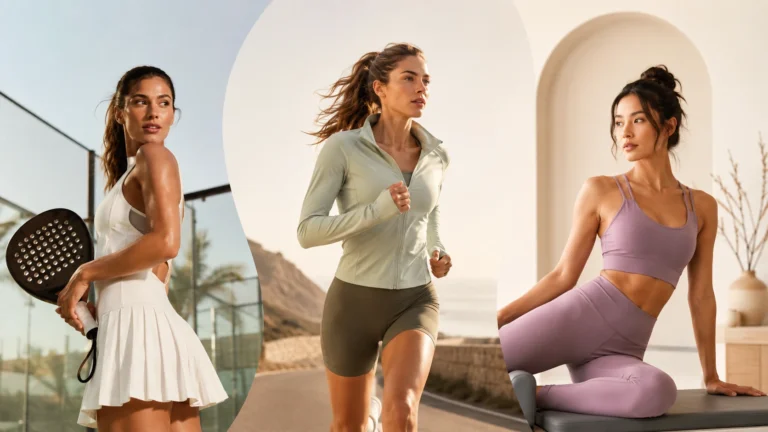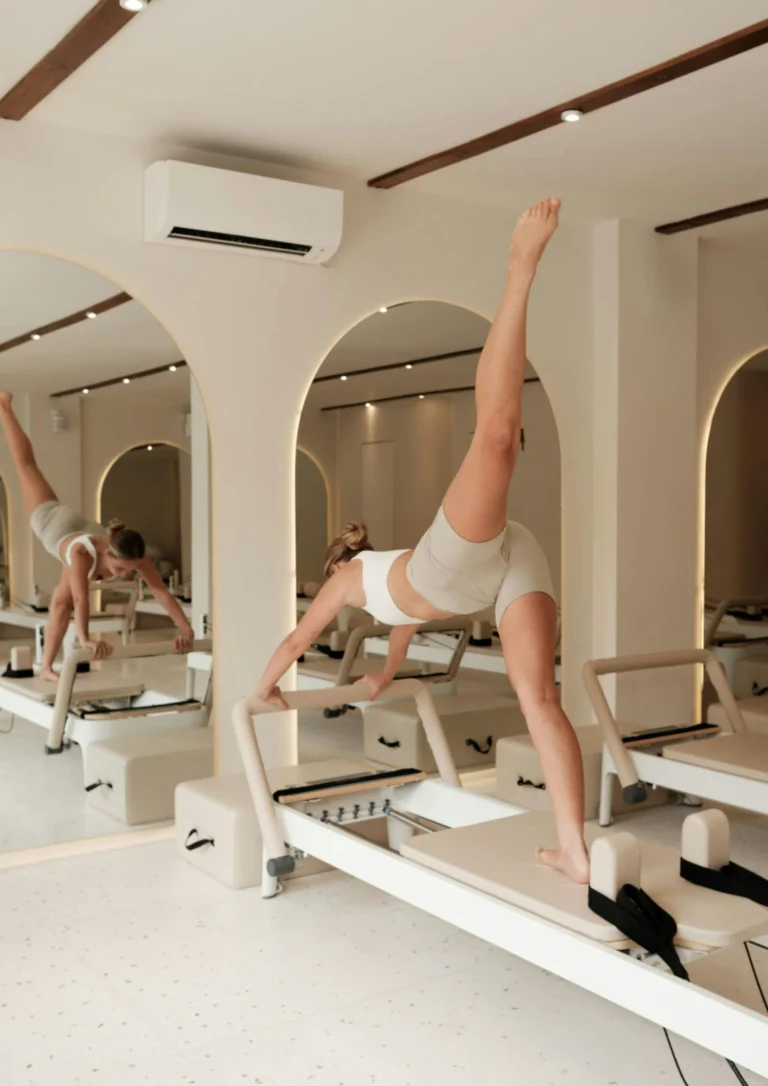


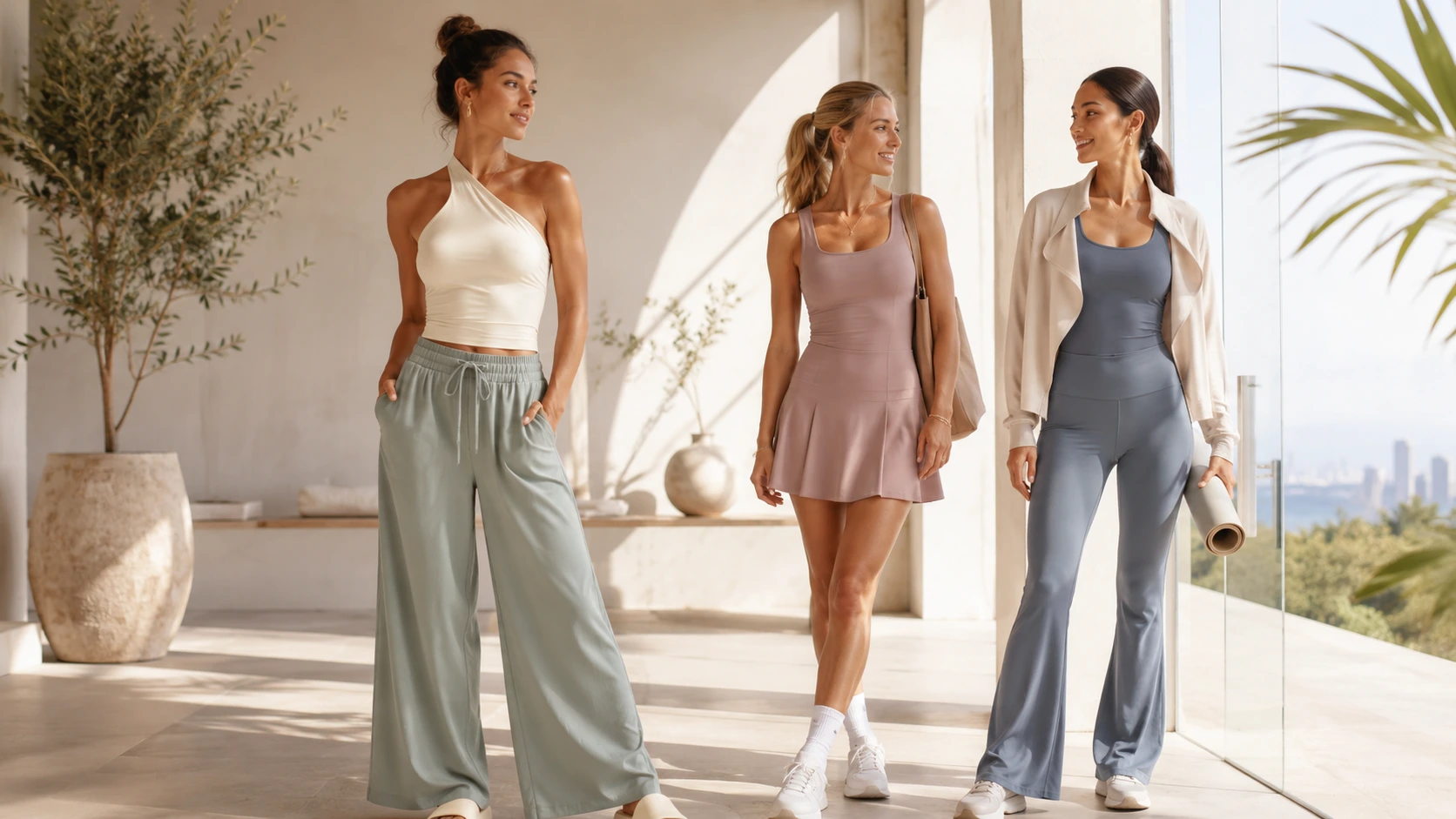
For more than a decade, the default activewear collection has been remarkably predictable.
A sports bra.
A high-waisted legging.
A short.
Perhaps a cropped jacket.
Then the same products return in several new colors.
That formula built enormous businesses, and it is not disappearing. Leggings, bras and shorts remain essential commercial products.
But they are becoming a difficult place for an emerging brand to build its entire identity.
The more interesting question for the next few years is not:
What will replace leggings?
It is:
What happens when performance clothing begins occupying more of a customer’s wardrobe?
WISKII Active provides one clue. As explored in our WISKII Active brand strategy case study, the brand has progressively moved beyond conventional bras and leggings into dresses, denim-look products, knitwear, skirts, resort pieces and fashion-oriented layering while preserving many of the stretch and movement characteristics associated with activewear.
But WISKII is not an isolated example.
NikeSKIMS now explicitly describes its Spring 2026 proposition as a “head-to-toe system of dress”, combining footwear, apparel and accessories for everyday performance and style. Vuori sells dresses and jumpsuits with four-way stretch and moisture-wicking properties. Cycling specialist Pas Normal Studios has expanded its Off-Race line into technical trousers, merino knitwear, wool, outerwear and everyday clothing intended for commuting, travelling and life away from the bike. NIKE, Inc.
Together, these signals suggest something larger than another short-lived athleisure trend.
Performance clothing is gradually becoming a wardrobe system.
For emerging brands, that creates several product opportunities that are very different from simply launching more leggings.
1. The Biggest Opportunity May Be More Wearing Occasions, Not More Sports
A useful way to think about activewear growth is to count wearing occasions.
Imagine a Pilates customer who trains three times a week.
If your brand only sells workout bras and leggings, you compete for perhaps three moments in her week.
But that same customer also:
commutes,
works,
travels,
meets friends,
shops,
goes for coffee,
walks,
spends weekends away,
and moves between exercise and ordinary life.
If your product can enter some of those moments, the addressable opportunity inside the same customer becomes much larger.
This is exactly why NikeSKIMS’ language is interesting. Its Spring 2026 collection is not presented as a collection of individual gym products. Nike calls it a head-to-toe system of dress, with five apparel collections built around everyday performance and style. NIKE, Inc.
Vuori offers another example. Its women’s dresses and jumpsuits combine silhouettes associated with casual clothing with performance characteristics such as four-way stretch and moisture management. One current jumpsuit uses performance rib knit, includes a built-in bra and is explicitly positioned for casual days rather than only exercise. Vuori
Perhaps the clearest example comes from a completely different sport.
Pas Normal Studios built its reputation in cycling, yet its 2026 Off-Race collection now includes technical corduroy trousers, merino knitwear, boiled wool, jackets, fleece, shirts and technical skirts. The company describes products such as its Japanese technical corduroy pants as suitable for everyday wear both on and off the bike. Pas Normal Studios
The opportunity therefore is not simply athleisure.
It is:
Extending the relationship between a performance brand and the customer’s day.
What I Would Actually Build
If I were running an emerging Pilates, yoga or lifestyle-activewear brand, I would not suddenly jump from leggings into handbags, denim jackets and formal clothing.
I would expand in rings.
Ring 1: Closest to the Workout
Start with products that still clearly belong to the activewear system:
- Straight-leg performance pant
- Wide-leg active trouser
- Lightweight fitted jacket
- Long fitted tank
- Layering long sleeve
These are low-risk because the existing customer already understands why they belong.
Ring 2: Movement Wardrobe
Once the customer is buying beyond the workout:
- Active dress
- Performance skirt
- Jumpsuit
- Technical knit top
- Lightweight travel trouser
- Refined wrap or cardigan layer
Now the brand is no longer only dressing exercise.
It is dressing movement.
Ring 3: Everyday Wardrobe
Only after the first two are working would I consider:
- Soft tailoring
- Technical outerwear
- Travel sets
- Lifestyle knits
- More fashion-led trousers
The logic is:
Workout Wardrobe → Movement Wardrobe → Everyday Wardrobe
rather than:
Leggings → Random Fashion Categories
That difference matters enormously.
Who Is This Opportunity Best For?
This is strongest for brands that already have a clearly defined woman.
If your customer is:
28–40, urban, Pilates-oriented, fashion-conscious, travels regularly and wants to look polished without constantly changing clothes,
then expanding her wardrobe makes sense.
If your customer identity is still vague, adding twenty new categories will usually create more confusion, not more growth.
What Could Kill the Idea?
Category expansion without customer continuity.
A brand sees another category trending and adds it because it can.
The result is a website containing:
gym leggings,
tennis dresses,
denim,
ski jackets,
office trousers,
swimwear,
and knitwear,
but no clear reason why the same woman needs all of them.
A simple filter can prevent this.
Before adding a new category, ask:
Same Customer?
Would the existing buyer naturally want it?
Same Identity?
Does it still look like the same brand?
New Occasion?
Does it let the existing customer wear the brand somewhere new?
If all three are true, the category may be a useful adjacency.
If not, you may simply be multiplying SKUs.
2. The Next Hero Product May Be a Top, Not a Legging
The second opportunity is much more product-specific.
For years, activewear has been extremely bottom-led.
Leggings became the category-defining hero product.
Then came:
bike shorts,
flare leggings,
wide-leg yoga pants,
scrunch leggings.
But there is a practical limitation.
A bottom has fewer visually obvious areas in which a new brand can create distinction without making the product difficult to wear.
A top gives designers much more visual territory:
neckline,
shoulder,
back,
bra architecture,
layering,
straps,
sleeves,
cut-outs,
asymmetry,
color blocking.
That matters particularly in a social-first market.
A customer scrolling a short video can recognize an unusual neckline much faster than she can understand a technically improved black legging.
WISKII provides an unusually clear example.
Its current Off-Shoulder Colorblock Long Sleeve Top combines an off-shoulder silhouette with integrated support, color blocking and performance stretch. When Hailey Bieber was photographed wearing the product in early 2026, Cosmopolitan specifically highlighted the two-in-one concept—an off-shoulder top with an integrated halter sports-bra structure—as the element that made the garment immediately interesting. WISKII
The product did not need a large visible logo to create curiosity.
The construction was the content.
Nike is also moving more aggressively into this intersection of sport and visible fashion expression. Its 2026 First Sight project explicitly says it is experimenting with shape and form to create unexpected style propositions for women, blending athletic DNA with more expressive fashion codes. NIKE, Inc.
That suggests a useful opening for smaller brands.
What I Would Actually Build
For a fashion-oriented activewear startup with limited capital, I would seriously consider a five-product opening architecture:
1 Signature Top
This carries the strongest visual brand code.
Examples could involve:
- distinctive halter construction
- asymmetric neckline
- unusual back
- layered bra system
- recognizable curved seam
- proprietary strap language
1 Commercial Bra or Tank
Less risky.
Easy to understand and easy to wear.
1 Core Legging
A dependable commercial product.
1 Secondary Bottom
Perhaps:
- short
- flare
- skirt
- straight-leg pant
depending on the customer.
1 Layer
A long sleeve, shrug, lightweight jacket or fitted layering piece.
That gives a small brand enough products to create combinations without creating fifteen untested styles.
Why the Hero Top Is Especially Interesting for Startups
A hero top has several advantages.
It can create recognition without requiring an entire custom collection.
It works with bottoms customers may already own.
It photographs well.
It creates obvious front, back and movement content.
It is easier for creators to style in multiple ways.
And if the product has a strong enough visual code, the design language can later migrate into other products.
For example:
Signature neckline
can become:
Bra
→ Tank
→ Long Sleeve
→ Dress
→ Jumpsuit.
Now the brand is not simply launching products.
It is building a recognizable design system.
A Product Test I Would Add Before Approving Any Hero Style
Most companies conduct:
Fit Test.
I would add:
Content Test.
Put the sample on a model and film it with a phone.
Check:
Front.
Back.
Turn.
Walking.
Movement.
Layering.
Close detail.
Different styling.
Then ask:
Can this one garment naturally generate five to ten visually different pieces of useful content?
If yes, the product may be contributing to both:
merchandising
and
customer acquisition.
That means its commercial value is greater than its garment margin alone suggests.
This is an important shift in thinking.
Product development and marketing should not always begin as separate processes.
What Has to Be Customized?
This is where I would distinguish very carefully between a trend product and a brand product.
If you simply want to test whether your customer responds to:
halter,
flare,
wide-leg,
or fitted long sleeve,
there is little reason to invest heavily in completely original pattern architecture before obtaining any market feedback.
Battlerobe’s Small-Batch Ready-to-Custom route is designed around existing silhouettes and lower starting quantities, which can make sense when the main question is still which direction customers respond to. Battlerobe
But if customers have already shown strong response to a particular:
neckline,
back construction,
waist,
support structure,
or visual code,
then that difference begins to deserve ownership.
At that point, Small-Batch Custom Development is more relevant because the product itself—not just the branding—is becoming part of the company’s identity. Battlerobe
3. Performance Fabric No Longer Has to Look Like Performance Fabric
This may be one of the most underdeveloped opportunities.
For a long time, consumers learned what activewear was supposed to look like:
smooth nylon,
matte leggings,
ribbed seamless,
mesh,
technical polyester.
Those materials still have obvious advantages.
But the next opportunity may lie in products that look like fashion materials while behaving more like performance materials.
WISKII’s Beyond Denim Dress is an easy example to understand. It visually references denim, but the garment incorporates four-way stretch, built-in shorts and nylon-spandex lining designed to support movement. WISKII
Pas Normal Studios is taking a similar idea in another direction with its Off-Race collection.
Its latest assortment includes technical Japanese corduroy, merino knits, boiled wool and Japanese seersucker alongside details inherited from cycling performance garments. T3
The broader fabric market is also shifting.
Taiwan-based performance textile supplier Eysan identifies two notable 2026 directions: brands are moving away from simply stacking technical claims toward evaluating how a material feels over hours of real wear, while athleisure is expanding performance textiles into commuting, work and casual social situations. Eysan Fabrics Co,. Ltd
Meanwhile, knitwear is experiencing renewed fashion interest. Vogue Business reports growing investment in experimental knitwear and highlights technical developments such as seamless knitting and Wholegarment construction, which allow more complex structures with fewer seams and greater precision. Vogue
Put those trends together and an interesting category starts to appear.
I would call it:
Fashion-Surface Performance
The garment looks like fashion.
But underneath the surface it still solves movement, comfort and wearability.
What Products Could Come From This?
Not all of these should be made immediately, but these are directions I would investigate:
Denim-Look Stretch
For:
- active dresses
- skirts
- fitted shorts
- structured-looking trousers
Performance Knit
For:
- fitted tanks
- dresses
- layering tops
- soft jackets
- studio-to-daily sets
Technical Seersucker
Potentially useful for:
- resort activewear
- travel sets
- lightweight summer trousers
- racquet lifestyle
Double-Knit / Suiting-Look Performance
For:
- wide-leg trousers
- commuter pants
- clean jackets
- travel sets
Fashion Mesh
Not simply ventilation panels.
Instead:
- layered tops
- dresses
- visible design panels
- evening-to-studio styling
Textured Performance Surfaces
Rib, jacquard, subtle bouclé-like structures or other tactile surfaces that visually move the product away from ordinary gymwear.
But This Is Where Many Brands Could Make Expensive Mistakes
A beautiful fabric is not automatically an activewear fabric.
If you attempt this direction, appearance is only the first question.
You still need to test:
Recovery
Does it return after stretching?
Opacity
What happens under movement and bending?
Pilling
What happens after repeated friction?
Colorfastness
What happens with sweat and washing?
Dimensional stability
Does it shrink or distort?
Weight
Does the garment become uncomfortable after prolonged wear?
Moisture behavior
Does the surface become visibly wet?
Seam compatibility
Does construction damage the fabric or distort its appearance?
This is why Fashion-Surface Performance has greater differentiation potential—but also higher development risk.
It is a much better fit for brands willing to invest in real sampling and material testing than brands looking for the fastest possible logo-based launch.
4. Premium Activewear Is Increasingly About Cultural Context, Not Just Premium Fabric
The fourth opportunity is a positioning opportunity.
Many founders believe “premium activewear” means:
use expensive fabric,
add beautiful packaging,
increase the price.
That is incomplete.
Consumers also interpret value through where a brand appears.
Alo provides a strong current example.
By 2026, its Atelier collections have moved well beyond traditional yoga apparel into stretch linen, silk, cashmere and evening-oriented pieces. Harper’s Bazaar reported that the brand launched its latest summer Atelier capsule with a yacht experience in the South of France combining Pilates, wellness treatments, dinners, swimming and luxury travel. Harper’s BAZAAR
This is not simply product marketing.
The environment tells customers:
who this product is for and what kind of life surrounds it.
Running is experiencing a similar crossover.
Vogue Business reported in July 2026 that performance brands such as Satisfy, District Vision and Literary Sport are increasingly participating in Paris Fashion Week and building relationships with fashion retailers such as Mr Porter. The publication notes that performance labels are increasingly entering affluent consumers’ everyday wardrobes rather than remaining isolated inside specialist sports retail. Vogue
Lyst’s Q2 2026 data makes the shift even more measurable.
Lyst describes sport as one of fashion’s increasingly powerful discovery engines and identifies Toronto activewear label Literary Sport—known for combining art-world sensibility with understated sportswear—as one of its fastest-moving brands, with demand rising 231% quarter over quarter. Lyst
This is not evidence that every startup should become a luxury brand.
It points toward something more useful:
Performance products can borrow value from cultural worlds outside sport.
Four Different Premium Positions Are Emerging
Instead of saying:
“We make luxury activewear,”
which means very little on its own, I would choose a more specific premium context.
Wellness Luxury
Associated with:
Pilates
Retreats
Spa
Recovery
Resort
Travel
The customer values:
calm,
health,
body care,
and aspirational leisure.
Cultural Performance
Associated with:
art,
design,
architecture,
fashion,
music,
creative industries.
This is closer to what brands such as Literary Sport and certain design-led running brands are exploring.
The product says:
I care about sport, but I also care deeply about taste.
Travel Performance
Products built for consumers moving between:
airport,
hotel,
city,
studio,
walking,
and leisure.
Here the value comes from:
comfort + polish + packability + long wear.
Club Lifestyle
Tennis.
Padel.
Golf.
Wellness clubs.
Private studios.
Resort activities.
The clothing communicates participation in a social environment as much as athletic performance.
What I Would Not Do
I would not begin by deciding:
“Our leggings need to cost $150.”
Premium price is an outcome.
Not a positioning strategy.
First define:
What environment should this product naturally belong in?
For example, imagine two brands selling technically similar dresses.
One is photographed entirely in a generic white ecommerce studio.
The other repeatedly appears in:
premium Pilates studios,
design hotels,
resort locations,
wellness retreats,
and on creators who naturally inhabit that world.
Consumers are not evaluating only the fabric.
They are evaluating the context around the fabric.
That does not mean brands should fake luxury.
The product still has to justify repeat purchase.
But context can help a brand explain why it belongs at a higher value level.
So Which Opportunity Would I Choose?
These four opportunities are not equally suitable for every startup.
I would match them to the company’s existing advantage.
| Opportunity | Best Fit | Difficulty | My View |
|---|---|---|---|
| Performance Wardrobe | Brand already understands a clear female customer | Medium | ★★★★★ |
| Hero Tops & Layering | Social-first startup with limited initial budget | Medium | ★★★★★ |
| Fashion-Surface Performance | Product-focused brand with stronger development capability | High | ★★★★☆ |
| Cultural / Wellness Premium | Founder with strong aesthetic and access to the right communities | Medium–High | ★★★★☆ |
The easiest to test is probably Hero Tops.
The largest long-term customer-value opportunity may be Performance Wardrobe.
The strongest potential for genuine product differentiation is Fashion-Surface Performance.
And the strongest potential for premium pricing is probably a combination of good product with the right Cultural or Wellness Context.
A Better Way to Build the First Collection
Suppose I had USD 20,000–30,000 available to launch a fashion-led activewear concept today.
I would not begin with:
10 styles × 5 colors.
I would probably build something closer to:
1 Signature Top
The visual hook.
1 Commercial Tank or Bra
The easier product.
1 Core Bottom
The dependable legging or short.
1 Adjacent Bottom
Perhaps flare, straight-leg, skirt or wide-leg.
1 Lifestyle Layer
Something that begins to expand the wearing occasion.
Then choose perhaps:
one commercial neutral
one brand-defining color
one seasonal visual color.
That gives the brand enough material to create a recognizable collection while limiting the number of variables it has to learn.
Then I Would Ask Three Different Questions After Launch
Do not judge the collection only by total revenue.
Question 1: What Sells?
This identifies commercial products.
Question 2: What Gets Attention?
This identifies content and brand-recognition products.
Question 3: What Gets Reordered or Reworn?
This identifies products that might become long-term brand assets.
Those answers may be different.
Your best-selling black legging may pay the bills.
Your distinctive top may bring customers to the site.
Your everyday trouser may eventually create the highest repeat purchase.
A strong product strategy understands the role of each one.
Production Should Follow What You Have Learned
This is also where manufacturing decisions become much easier.
If you still do not know whether the customer prefers:
halter or scoop,
flare or straight-leg,
Pilates or lifestyle,
neutral or fashion color,
then flexibility matters more than having the lowest theoretical unit cost.
That is the stage where smaller ready-developed collections can help a brand learn faster.
Once customer response tells you:
this specific construction is becoming part of what people remember us for,
the economics change.
Original pattern development, material testing and fit refinement become more valuable.
And once those products generate consistent reorders, the priority changes again toward:
cost,
quality consistency,
repeatable color,
delivery,
and production scale.
That is why Battlerobe structures its production solutions around different levels of certainty rather than forcing every brand into the same development and MOQ model. Battlerobe
The manufacturing decision should follow the question the brand is trying to answer.
Still discovering demand? Preserve flexibility.
Building meaningful product differentiation? Invest in development.
Scaling a proven winner? Optimize production.
The Bigger Opportunity: Activewear Is Expanding From a Category Into a Design Language
The most important conclusion is not that leggings are becoming less relevant.
They are not.
The bigger change is that the rules activewear helped normalize—
stretch,
comfort,
body movement,
easy care,
support,
technical materials—
are increasingly migrating into clothes that no longer look obviously athletic.
At the same time, fashion is increasingly borrowing the cultural energy of sport.
Nike is talking about systems of dress.
Cycling brands are selling technical corduroy.
Running brands are appearing during Paris Fashion Week.
WISKII is selling stretch denim-look dresses.
Alo is putting performance fabrics into luxury travel wardrobes.
Literary Sport is bringing an art-world sensibility into activewear and seeing rapidly rising demand on Lyst. NIKE, Inc.
For emerging brands, this opens a second growth axis.
The first axis—the one we explored in our previous market-opportunity research—is:
Find new sports, communities and consumer identities.
The second is:
Find new products and wearing occasions for customers who already live an active lifestyle.
The next important activewear company may not invent a better pair of leggings.
It may simply understand earlier than everyone else that the woman wearing those leggings wants the rest of her wardrobe to feel just as comfortable, functional and expressive.
That is a much larger product opportunity.