

Natural fiber activewear is usually presented as a moral upgrade: remove the synthetics, choose the cleaner material, and the customer will follow.
That framing creates attention, but it is a weak product brief. A fibre label cannot tell a founder whether a top will cling when damp, whether a knee will bag, whether a waistband will recover, or whether the garment will still look intentional after repeated washing.
There is a more credible opportunity. It sits between cotton lifestyle clothing and high-synthetic performance kits: natural-forward, next-to-skin activewear for Pilates, walking, mobility, travel, and other low-sweat movement.
This is not permission to launch a five-piece “non-toxic activewear” collection. It is a reason to investigate one fitted studio top, with one customer and one controlled material test. Our judgment is that founders can act now at discovery and sample stage—but should not begin with leggings or broad production. Prove that one material system deserves one occasion; then earn the right to attempt bottoms.
The signal is visible, but the category is not empty
Several brands already show different versions of the idea. Our analysis of Nagnata’s brand strategy found that the brand treats natural fibres as part of a distinctive engineered-knit system, not a substitute dropped into a conventional legging. Nagnata’s own seamless-knitwear explanation describes the technical difficulty of using natural yarns in stretch and compression knitting.
Our Arcaa case study shows a different route: a calm, natural-fibre wardrobe can connect movement with daily life rather than competing on maximum gym performance. Arcaa currently makes organic cotton, linen blends, knitted cotton, and wool part of how customers navigate its broader collection.
Reprise currently sells a legging made from 93% TENCEL Lyocell and 7% spandex, while its Luna Tank uses 92% TENCEL and 8% spandex. Icebreaker sells merino and merino-blend tights across base-layer and outdoor occasions.
In August 2026, Smartwool introduced a women’s merino movement collection. Its legging is 28% merino wool, 28% TENCEL Lyocell, 25% recycled nylon, and 19% elastane.
Those products do not prove a large underserved market. Product pages reveal neither sales nor repeat purchase, and brand performance language is not independent testing. They do prove that the material problem is being approached by technical outdoor labels, fashion-knit brands, and smaller natural-forward players.
They also expose the real design question. Smartwool’s legging is 44% nylon and elastane. Reprise uses spandex. Nagnata discusses engineered and core-spun yarns. The commercial problem is not how to achieve fibre purity. It is how to reduce reliance on synthetics without removing the stretch, recovery, durability, and care behavior the chosen occasion requires.
Founder action: audit products by fibre percentage, knit structure, garment type, intended activity, care instruction, price, and customer complaint. Do not create a spreadsheet with one column called “sustainable.” The useful comparison is what each material system enables—and where it fails.
“Natural” is not a performance specification
Natural-fibre conversations often collapse wool, cotton, TENCEL, modal, and blended fabrics into one supposedly healthier category. That is not technically precise.
Lenzing defines TENCEL Lyocell and Modal as regenerated cellulosic fibres: wood-derived cellulose is processed and regenerated into fibre. Lenzing claims softness and moisture-control benefits, but the final garment’s behavior still depends on yarn, knit, weight, finishing, blend, pattern, and construction.
Certification language needs equal care. OEKO-TEX STANDARD 100 means a certified article has passed tests against specified harmful-substance limits. The standard itself explains that the mark does not certify every quality, safety, construction, labelling, or legal characteristic.
A founder should therefore avoid three shortcuts:
- “wood-derived” does not mean unprocessed;
- “certified” does not mean every competing fabric is unsafe;
- “natural-forward” does not guarantee activewear performance.
This restraint is commercially useful. Fear may generate clicks, but it also forces the product to defend a health claim that the garment cannot prove. A more durable promise is observable: softer next-to-skin feel, less slick handfeel, acceptable damp comfort, repeat-wear freshness, and enough recovery for one named activity.
The useful unit of comparison is not fibre purity. It is Occasion–Material Fit: the relationship between a material system, a garment, and the job a customer expects it to perform.
| Material direction | What it may help test | Failure to expose early | Lower-risk first product |
|---|---|---|---|
| Merino-forward blend | Repeat-wear freshness, thermal buffering, soft technical handfeel | Heat in warm studios, pilling, care burden, price | Long-sleeve studio or travel top |
| Lyocell/TENCEL-forward blend | Smooth skin feel, drape, moisture absorption | Damp cling, drying, shape recovery, surface change | Fitted tank or long-sleeve top |
| Organic-cotton-forward knit | Familiar feel, lifestyle crossover, low-sweat comfort | Wet weight, drying, bagging, shrinkage | Studio-to-street top or relaxed layer |
| Natural/synthetic engineered blend | Balance of handfeel with stretch, recovery, and durability | Promise becoming vague, added cost without a felt difference | Selected after the purest prototype reveals its failure |
This table is a hypothesis map, not a sourcing specification. Fabric construction and finishing can make two textiles with similar fibre percentages behave very differently.
Positioning test: remove the words clean, toxic, eco, sustainable, and natural. Can the customer still understand the wearing improvement? If not, the idea is still a material story looking for a job.
The evidence supports trade-offs, not a winner
Peer-reviewed studies provide useful clues, but no universal fibre ranking.
In a study involving 26 people after a spinning session, polyester T-shirts were rated as more intense and less pleasant in odour than cotton shirts after the researchers’ incubation protocol. Another sensory study of 13 fabric samples found wool and cotton smelled less intense than treated and untreated polyester under its test conditions.
That evidence can justify measuring odour perception. It does not justify “antimicrobial,” “odour-free,” or “wash less” promises for a new garment without relevant testing.
Moisture and temperature are equally contextual. A 2023 controlled study of 12 men found that a 100% wool full-sleeve shirt buffered post-exercise cooling better than cotton, viscose, and polyester at 15°C. That result may matter for cool studios, travel, and the transition after movement. It does not prove wool is the most comfortable choice in hot Pilates or summer running.
Durability adds another trade-off. A 2026 industrial study of wool/polyester sportswear fabric identifies pilling as a performance limitation in the tested blend and investigates finishing treatments.
The practical model is an occasion ladder:
- Lowest technical demand: travel, recovery, walking, mobility, and daily studio wear.
- Moderate demand: Pilates, yoga, and controlled strength work.
- Higher demand: repeated floor abrasion, heavy strength sessions, hot yoga, and long wear while damp.
- Highest demand: running, HIIT, high compression, and fast sweat transport.
A natural-forward product does not have to climb the whole ladder. The opportunity becomes more credible when the founder deliberately stops at the rung the first fabric can serve.
Collection rule: write the excluded activities on the product brief before selecting fabric. “Not for running or high-compression training” can be a sign of product intelligence, not weakness.
The first customer is already making a compromise
Do not begin with “women who care about sustainability.” Begin with behavior.
The most useful first customer already checks fibre labels, dislikes a slick synthetic feel against the skin, and still wants a fitted silhouette for Pilates, walking, mobility, travel, or studio-to-street wear. She may currently use a cotton lifestyle top, a merino base layer that looks too outdoors-oriented, a loose T-shirt that hides the body, or synthetic activewear she does not actually like.
Recent Reddit discussions provide directional—not representative—evidence. Users describe interest in natural-forward activewear while also reporting thinness, leggings that do not stay up, less stretch, warmth, price, demanding care, and the difficulty of finding a bottom that performs like nylon. One commenter in an Australian fashion discussion said natural fibres lack several qualities she needs in activewear; another said she keeps synthetics for bottoms while using cotton tops.
Those comments do not measure demand. They are valuable because they identify the questions an interview should challenge:
- Which garment did the person reject after reading the label or feeling the fabric?
- What does she wear instead, and what does that workaround sacrifice?
- For which activity would she refuse natural-forward fabric?
- Does she care about fibre percentage, skin feel, odour, wash frequency, appearance, or a broader belief?
- What care instruction or price would make her return to a synthetic option?
Discovery gate: interview eight to twelve directional users. Continue only if at least one repeated occasion, failed substitute, and switch behavior appear. Before the interviews, write down what evidence would make you stop. Compliments about a natural-fibre mission are not enough.
Why the first product should not be leggings
Leggings look like the obvious hero product because they define the activewear category. They are also the most expensive place to learn whether a new material proposition works.
A legging asks one fabric system to solve several problems at once:
- opacity across deep stretch;
- waistband stability without excessive pressure;
- seat and knee recovery after sitting and bending;
- inner-thigh and floor abrasion;
- pilling and surface change;
- dimensional stability after repeated washing;
- enough stretch and return across multiple body shapes;
- a handfeel and appearance worth a likely material premium.
If the sample fails, the founder may not know whether customers rejected natural-forward material, the waistband, opacity, compression, pattern, or silhouette. The learning is expensive and muddy.
A fitted long-sleeve studio top is a cleaner first experiment. It still tests the proposition where it matters—next to skin, during movement, heat, dampness, repeat wear, and washing—but reduces the opacity, lower-body abrasion, and squat-recovery burden. It also creates a visible studio-to-street product rather than another merino base layer.
The first top should not be technically empty. A considered neckline, flattering seam placement, thumbhole or cuff decision, and a hem that stays in place can make it feel like activewear rather than underwear. But every feature must preserve the material experiment.
MVP decision: one fitted long-sleeve silhouette, one colour, and two candidate fabrics. Hold pattern and styling constant. Do not compare a beautiful natural-forward sample with a badly fitted synthetic control.
Run a material trial that a small founder can actually afford
The first useful test is not a laboratory programme or a 500-unit order. It is a controlled wear-and-wash comparison that makes uncertainty visible.
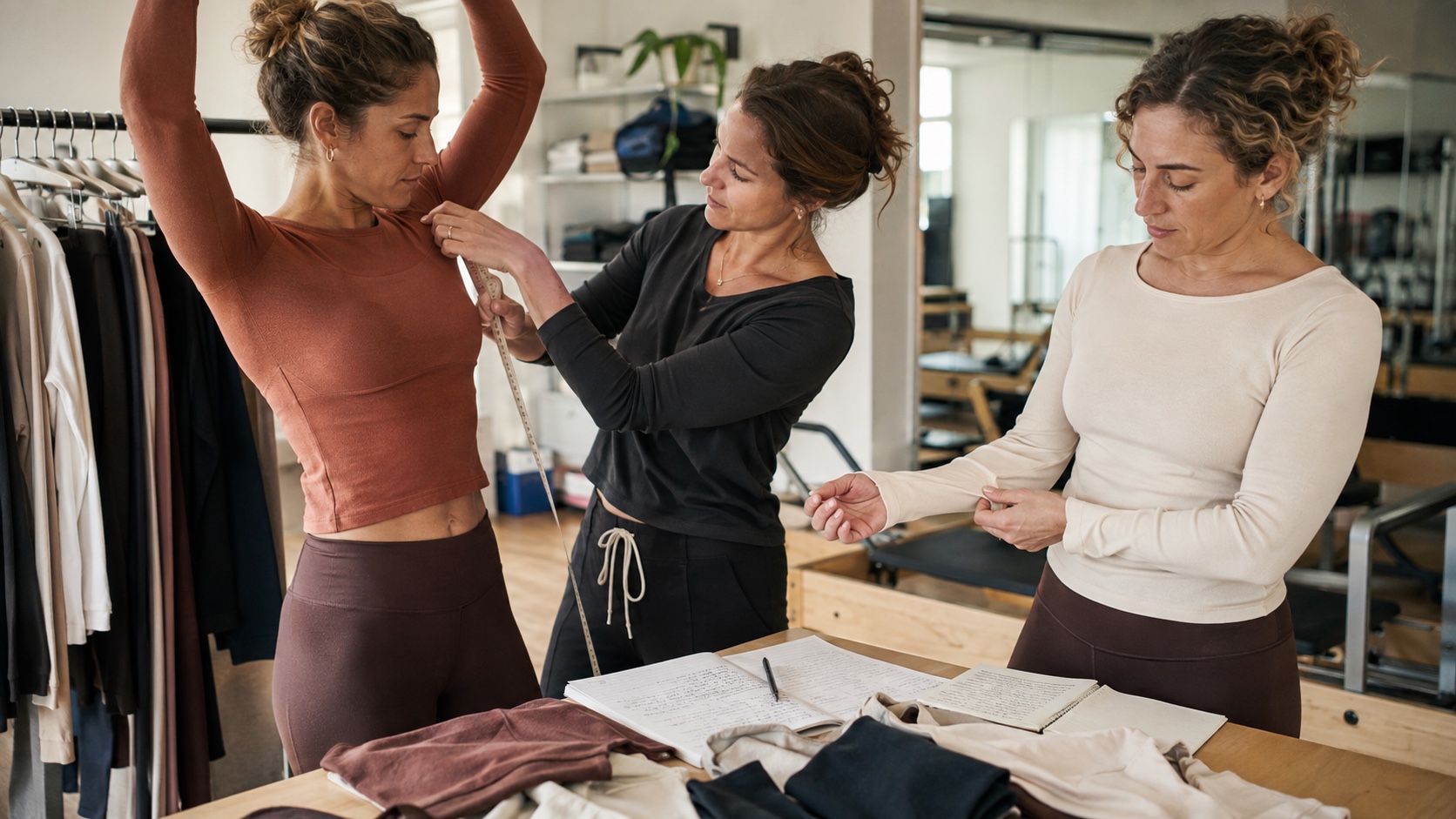
Start with six to ten testers drawn from the discovery group. Give each person the same top in two candidate fabrics, labelled A and B without environmental or health language. Ask them to use both in three contexts:
- a low-sweat movement session such as Pilates or mobility;
- a longer walking, travel, or daily-wear period;
- a deliberately excluded or borderline activity to expose the limit.
After each wear, capture:
- next-to-skin feel at the start and after warming up;
- damp cling, perceived heat, and time until the garment feels dry enough to keep wearing;
- odour perception before washing—without claiming antimicrobial performance;
- hem movement, cuff stretch, neckline change, and seam distortion;
- whether the tester would replace her current garment for that exact occasion.
Then run repeated care cycles using the instruction a real customer is expected to follow. Record dimensional change at fixed garment points, surface fuzz or pilling, twisting, colour change, seam appearance, and recovery after wear. Photograph the same locations under the same light.
There is no honest universal pass number for this article to prescribe. Acceptable shrinkage, recovery, drying, and appearance depend on fabric, pattern, care instruction, price, and customer expectation. The brand must set thresholds before seeing the final results, then decide whether a failure can be fixed without destroying the original promise.
Continue when one fabric repeatedly wins the named occasion and testers show replacement intent. For a small directional panel, a practical precommitted gate could be that a clear majority chooses the candidate over both the control and her current garment for the named occasion, while no care or construction failure repeats across the group. This is a founder decision rule, not statistical proof or a universal benchmark.
Revise when the handfeel wins but wash stability, pilling, or shape retention fails. Stop when users praise the idea but consistently choose the control garment for the activity.
The business is built on a boundary customers can trust
A small brand cannot outspend global sportswear companies on performance claims. It can be more precise.
Instead of saying “better activewear,” the brand can say: designed for the customer who wants less synthetic material against the upper body during Pilates, walking, travel, and the hours around movement. It can publish the fibre blend, care method, intended activity, excluded activity, wash-test record, and what changed between samples.
This creates a stronger form of founder-led marketing. The founder does not need to perform certainty. She can show why the first 100% natural sample lost shape, why a small stretch component remained, how two knits behaved after washing, and which customer complaint changed the pattern.
That content makes the brand part of the product-development process. It can recruit the next testers before inventory and give customers a reason to care beyond a generic sustainability statement.
But transparency must not become ritual. If the founder has no genuine connection to the material problem, product evidence is stronger than a manufactured personal story. Show the decision because it changes the garment, not because every brand is expected to film a journey.
Preorder gate: ask testers to commit to the final product at a realistic price after they have seen the care requirements and limitations. A waitlist collected through fear-based messaging is not equivalent to willingness to keep and use the garment.
When Battlerobe becomes relevant
The customer interviews and competitor wear tests should happen before factory development. A manufacturer cannot decide whether “natural” means fibre content, skin feel, odour behavior, environmental values, or avoidance of a slick handfeel for the intended customer.
Once the founder has a repeated job and a material hypothesis, development becomes a garment-system problem. Fabric weight, stretch direction, recovery, shrinkage, pilling, seam choice, neckline stability, hem behavior, pattern ease, and care instructions interact. Changing the material without rechecking the pattern can produce a product that technically contains the preferred fibre but fails in use.
Battlerobe’s Ready-to-Custom route is not the right proof if the central hypothesis requires a new fabric, new pattern behavior, or controlled material comparison. It is built around existing patterns and stock-ready options.
After discovery evidence, Small-Batch Custom Development is the more relevant route. Battlerobe can help translate one selected wearing occasion into pattern, fit, fabric-sourcing, and sample decisions. For small-batch work, fabrics and colours still depend on the stock-ready material pool; high-MOQ mill-run fabrics and fully custom dyeing may require a different production stage. Exact availability, development fees, unit price, MOQ, and timeline must be confirmed for the project.
Battlerobe is not valuable here because a factory can declare a fabric natural, safe, or superior. It is valuable when the founder needs to keep the experiment controlled: preserve one silhouette, compare candidate materials, tune the pattern to the selected fabric, document wear-and-wash failures, and avoid ordering inventory before the garment earns its promise.
Bring this development brief:
- one customer, one named occasion, and excluded activities;
- three rejected garments and the exact failure in each;
- the minimum acceptable fibre direction without purity language;
- required handfeel, stretch, recovery, opacity, care, and price constraints;
- one fixed top silhouette and two material hypotheses;
- tester recruitment and wear/wash protocol;
- claims the brand will not make without evidence;
- the result required before preorder or small production.
The Battlerobe product-development guide explains why material, pattern, fit, and sampling cannot be separated. If a selected fabric and pattern later move into repeat production, quality control matters because a small change in yarn, weight, shrinkage, or seam behavior can change the customer experience.
The expansion path should follow failure, not ambition
If the long-sleeve top proves the occasion, the next product should answer the most repeated adjacent job. That may be a tank for warmer studios, a wrap layer for the commute, or a relaxed pant for travel.
Leggings should come later, after the brand can state exactly which compromise customers accept. A natural-forward bottom may use more elastane, a reinforced high-abrasion zone, a different knit structure, or a looser flare silhouette. Each choice changes the promise. A founder who treats the synthetic percentage as a moral failure may end up making a purer product that customers stop wearing.
A useful expansion sequence is:
- prove next-to-skin upper-body preference;
- prove repeat wear and care behavior;
- prove customers will pay for the difference;
- add the adjacent upper-body or layering occasion;
- only then test a lower-body silhouette with explicit recovery and abrasion requirements.
The aim is not to become a natural-fibre version of every existing activewear brand. It is to own a credible boundary where the customer wants a different relationship with the material.
This opportunity is ready for a small test—not a large claim
Natural fiber activewear is a real product question surrounded by exaggerated language. Brands, current assortments, technical papers, and customer discussions all suggest interest. The same evidence also shows why synthetics remain dominant: stretch, recovery, abrasion resistance, compression, fast care, and price are difficult to replace simultaneously.
That tension is the opportunity.
Begin with eight to twelve discovery interviews. Select one low-sweat occasion. Build one fitted long-sleeve top in two candidate fabrics. Test both without telling wearers which story they are supposed to prefer. Wash them as customers will. Continue only when one material system wins real replacement behavior, not just approval of the mission.
Do not begin with leggings. Do not sell “non-toxic” certainty. Do not force one fabric to serve every workout. A focused founder can win by being honest about where natural-forward material feels better, where it performs well enough, and where it should not be used.
The first move is small: find ten people who already make this compromise and ask them to bring the garment they wish they did not have to wear. If the same occasion and failure keep appearing, make the top—not the collection.
Sources and further reading
- Smartwool: Merino Movement collection and fabric composition
- Nagnata: Movements seamless knitwear
- Reprise Aspen leggings and Luna Tank
- Lenzing: What TENCEL Lyocell and Modal fibres are
- OEKO-TEX STANDARD 100 scope
- Applied and Environmental Microbiology: cotton, polyester, microbes, and post-exercise odour
- Fashion Practice: odour-control and sweat in sportswear
- Ergonomics: fibre type and post-exercise comfort
- Journal of Industrial and Engineering Chemistry: wool/polyester sportswear and pilling