

Low pressure activewear may sound like a contradiction. Leggings are sold through hold, sculpting, compression, and the promise that a waistband will not move.
Those benefits are real for many customers. They can also become the problem for a narrower group: people who experience recurrent abdominal bloating, pelvic tenderness, period-related changes, or other fluctuations and still choose fitted, fashionable bottoms for walking, Pilates, gentle strength work, or the hours around those activities. The first customer is not everyone with a diagnosis. It is a wearer who needs abdominal pressure to change within one day but does not want to change the whole outfit.
The current fallback is often to size up, fold the waistband, wear maternity products, switch to loose joggers, or avoid the garment. Each workaround sacrifices something—leg fit, stability, style, identity, or the ability to adjust as the body changes through the day.
The opportunity is not “medical leggings.” It is an activewear bottom that lets the wearer reduce or redistribute abdominal pressure without losing a deliberate silhouette.
The first useful product is not a full condition-specific collection. It is one studio-to-street flare or straight legging with two controlled waistband constructions.
DFYNE shows that pressure can be a product language
Our earlier analysis of DFYNE’s brand strategy found that the company’s product families do not promise one universal fit. Current product language distinguishes firmer sculpting, higher or lower waistbands, more visible contour, softer handfeel, and non-compressive options.
That brand case does not prove demand for low-pressure activewear. DFYNE serves a body-conscious gym customer, and public information does not reveal style-level sales or why each customer buys.
It does reveal an important mechanism: compression and waistband behavior can be named choices rather than invisible specifications. Customers can learn which relationship with the body they want today.
The adjacent opening is to build around a wearing state mainstream sculpting stories rarely center: “I want this garment to stay visually fitted while my tolerance for abdominal pressure changes.”
A positioning test: remove every medical term and every generic comfort word. Can the product promise still be described through waistband movement, adjustment, pressure distribution, stability, and occasion? If not, the idea is still a cause-marketing concept rather than a garment brief.
The signal is meaningful, but it is not permission to make medical claims
The World Health Organization estimates that endometriosis affects about 10%—approximately 190 million—of reproductive-age women worldwide. Its symptom overview includes severe pain, chronic pelvic pain, heavy bleeding, abdominal bloating, and nausea.
That figure establishes health context. It does not mean 190 million people want specialist activewear, cannot tolerate leggings, or should exercise through pain. A clothing brand must not turn prevalence into a market-size claim.
Smaller studies make the apparel tension more concrete. A case-control study of 26 women with laparoscopically diagnosed endometriosis and 25 controls found that loose-clothing use during bloating was more common among participants with endometriosis. The study was small and published more than a decade ago, so it is directional evidence, not a demand forecast.
A later qualitative study of 40 people recruited through endometriosis consumer organizations described clothing pressure, changed clothing choices, bloating, body-image stress, and the tension between physical comfort and feeling attractive. Its sample is also self-selected and cannot represent everyone with endometriosis.
Together, the studies support a narrower conclusion: for some people, abdominal change affects both clothing comfort and self-presentation. That is enough to investigate a product; it is not enough to claim treatment, pain relief, or universal need.
Research rule: ask about clothing moments, not diagnoses. “When does your current waistband become unacceptable, what do you do next, and what do you lose with that workaround?” is more useful than “Would you buy endometriosis leggings?”
The low pressure activewear customer is a wearing state, not one condition
A condition-led segment can create trust when a founder genuinely understands it. It can also stigmatize the wearer, over-medicalize normal fluctuations, or imply benefits the garment cannot deliver.
A more useful opening customer may be defined by five elements:
- State: recurrent abdominal bloating, tenderness, or pressure sensitivity.
- Occasion: low-impact movement and the hours around it.
- Failed solution: conventional high-compression or narrow elastic waistbands.
- Desired identity: fitted and fashionable rather than visibly clinical or improvised.
- Required control: the wearer can change pressure without changing the whole outfit.
This definition may include some people with endometriosis, adenomyosis, IBS, period-related bloating, postpartum body changes, or no diagnosis at all. It does not assume they have the same symptoms or want the same support.
Recruiting decision: begin with one recurring occasion and one pressure problem. Mixing severe pain, pregnancy, medical compression needs, casual bloating, and high-impact training in the same first fit panel will produce contradictory requirements.
Start with a seven-day waistband diary, not a “would you buy?” poll
Before sampling, recruit a directional group of eight to ten people who already wear fitted bottoms for the selected occasion and report recurring abdominal pressure sensitivity. This is not a representative market sample and should not be used to estimate prevalence.
For seven days, ask each person to record:
- the garment and waistband construction worn;
- the activity, sitting period, meal, commute, or other wearing context;
- when pressure became noticeable and where it was felt;
- whether she folded, rolled, loosened, changed, or removed the garment;
- what the workaround cost in stability, appearance, movement, or confidence;
- whether she would choose the same garment again for that occasion.
At the end, map moments rather than diagnoses. The sample gate is a repeated sequence: a fitted garment is desired, abdominal tolerance changes, the available adjustment fails, and the wearer still wants that silhouette enough to test a replacement.
If participants simply prefer loose trousers or are satisfied by folding an existing waistband, the problem can be real without being a custom activewear opportunity.
Existing products prove several solutions—and expose the unresolved trade-off
The apparel market is already experimenting. Femwear currently sells a flare legging whose expandable waistband is claimed to flex across multiple sizes and is positioned for bloating and several conditions. Nyssa’s VieWear legging combines a wide, no-cinch waist, gentle compression, a cotton gusset, and a pocket for a lower-abdominal heat pack.
Outside activewear, Apéro Label and Kuratd Studio sell adjustable-waist trousers or denim aimed at bodies that fluctuate through the day.
These pages verify that products and positioning exist. Their performance, medical language, review displays, and commercial outcomes are brand claims unless independently tested. Their greater value is showing that founders are trying different answers:
- expand the waist;
- spread pressure across a wider band;
- use gentler overall compression;
- add a treatment-access pocket;
- preserve tailored or fashion-led leg shapes while the waist changes.
The unresolved trade-off is stability. A waistband that exerts less pressure may slide, roll, gape, add bulk, or require a tie that looks casual. A wide elastic can feel gentle to one wearer and intolerable to another. A high rise can move pressure above a tender area or cover more of it.
Competitive audit: compare at least one fold-over yoga pant, one wide seamless waistband, one drawcord or adjustable waist, and one condition-led product. Record not only comfort, but how each solution fails during sitting, bending, walking, and repeated adjustment.
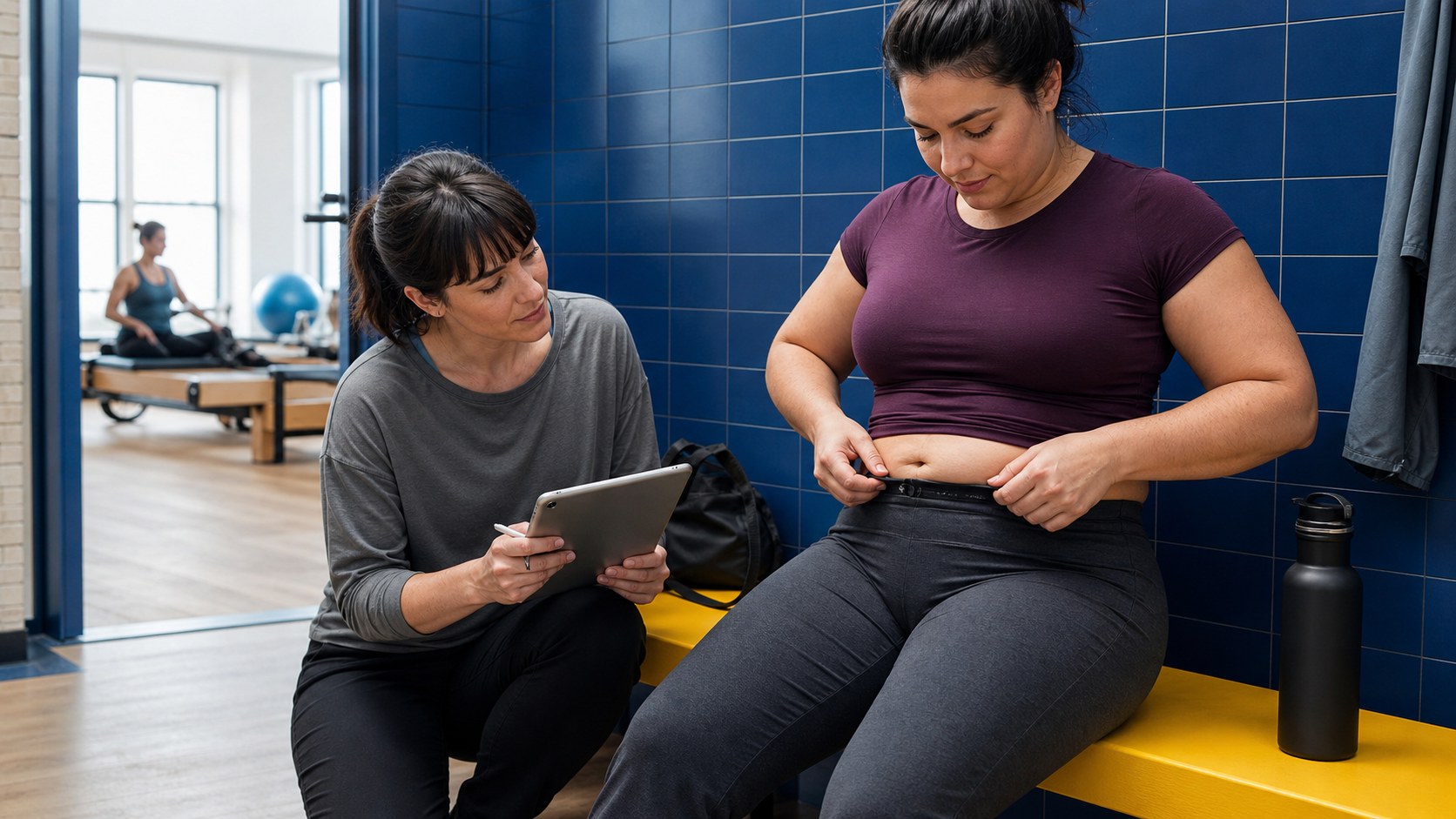
Do not turn a pressure study into a universal waistband number
A peer-reviewed experiment on abdominal clothing pressure asked nine young women to adjust a narrow elastic band to “perfect-fit” and “tight-fit” sensations. The researchers reported that pressure sensitivity varied by body location and proposed ranges for the experimental conditions.
The sample was tiny, the participants were not recruited for abdominal conditions, and a 2.5-centimeter test band is not a finished legging. The study is useful because it challenges the assumption that pressure is experienced uniformly. It is not a specification sheet for a commercial waistband.
A founder should therefore resist statements such as “the perfect pressure is X” unless product-specific testing supports them. Fabric modulus, band height, pattern reduction, seam position, posture, body shape, time, heat, and movement can all change the experience.
Development reward: map pressure as a relationship, not a single number. Ask where the wearer feels contact, where the fabric anchors, where it rolls, and what changes after twenty minutes. Objective measurements can support the process, but wear behavior and the intended customer remain central.
This opportunity can fail even when the discomfort is real
A founder can conduct empathetic interviews, hear painful stories, and still discover that no new product should be made. The job may already be solved by a loose pant, maternity band, lower rise, fold-over yoga pant, larger size, or the decision not to wear activewear during a flare.
The commercial question is not “does pressure bother people?” It is “does one specific group want to preserve a fitted movement-and-daily-wear silhouette badly enough to adopt an unfamiliar waistband, tolerate its trade-offs, and replace an existing workaround?”
Look for behavior stronger than praise: participants repeatedly adjusting during the diary, returning for fittings, comparing settings without prompting, asking to keep a prototype, or agreeing to a realistic preorder after seeing the limitations. Do not treat comments such as “someone should make this” as product proof.
Stop before sampling if the desired silhouette is weak, the problem occurs too rarely for the wearer, or a common garment already performs the job. Stop after sampling if reducing pressure causes unacceptable movement or the adjustment mechanism advertises the problem more than the customer wants.
The MVP should test adjustability against stability
The first development round should use the same leg block, fabric, color, inseam, and intended activity. Change only the waistband system.
Two feasible concepts might be:
- Version A: a wide fold-over or double-layer waistband whose height and pressure can be changed by the wearer.
- Version B: a distributed-pressure waistband with a concealed adjustment method that changes circumference without a narrow elastic cutting into the abdomen.
The exact construction should be chosen through feasibility and sampling; neither example is guaranteed to work. The test is not “which sample feels softer when first touched?” It is whether control can increase without stability collapsing.
Ask wearers to evaluate the product in at least two body states they naturally experience, without inducing symptoms. During a seated period, walk, gentle movement session, and transition back to daily activity, record:
- where pressure is felt and when it becomes distracting;
- whether the waist can be changed discreetly and quickly;
- slipping, rolling, gaping, twisting, or drawcord marking;
- skin marks and perceived pressure after wear;
- whether the garment still looks intentional at each setting;
- whether it replaces the wearer’s current workaround.
Continue when one construction reduces unwanted pressure for the selected fit panel while remaining stable. Revise when comfort improves but appearance, security, or movement deteriorates. Stop when existing fold-over pants solve the problem, adjustment is rarely used, or the required solution becomes too complex for the founder’s price and production stage.
One flare can test more than a five-piece “wellness collection”
A flare or straight leg is strategically useful because it can move between gentle training and daily life. The customer may not want to advertise a condition; she may simply want a polished bottom that remains wearable when her body changes.
The opening system should stay small:
- Hero bottom: adaptive waist plus a leg shape the customer already wants.
- Optional top later: only if the same panel repeatedly reports underband or lower-abdominal conflicts.
- Treatment-access feature later: only if customers specifically value a pocket and the brand can discuss it responsibly.
Do not combine adjustable waist, leak protection, heating technology, maternity use, severe-pain relief, and high-performance training in one first product. Every added promise introduces a new user, test, construction, and potential claim.
Assortment decision: start with the smallest product that proves “pressure can change while style remains.” Let observed behavior—not a broad women’s-health mission—earn the second function.
The right founder story is product evidence, not borrowed vulnerability
This opportunity can benefit from a founder or co-designer who genuinely experiences the problem. The strongest content is not a polished speech about empowerment. It is the visible development loop:
- what she wears on a high-tolerance day and a low-tolerance day;
- where the current waistband fails;
- how the first adjustment method created bulk or slipped;
- what another wearer experienced differently;
- why the team removed a claim or narrowed the occasion.
That record can attract testers and build trust before inventory. It also shows that the brand is not treating a diagnosis as an aesthetic niche.
If the founder does not live the problem, build a paid or fairly compensated co-design group and make its boundaries clear. Do not manufacture a medical origin story, expose private health details, or imply that clothing replaces professional care.
When Battlerobe becomes relevant to low-pressure activewear
The first interviews, product audit, and visual concept test should happen before factory development. A manufacturer cannot decide whether the pressure problem repeats or whether customers prefer a condition-specific or general comfort position.
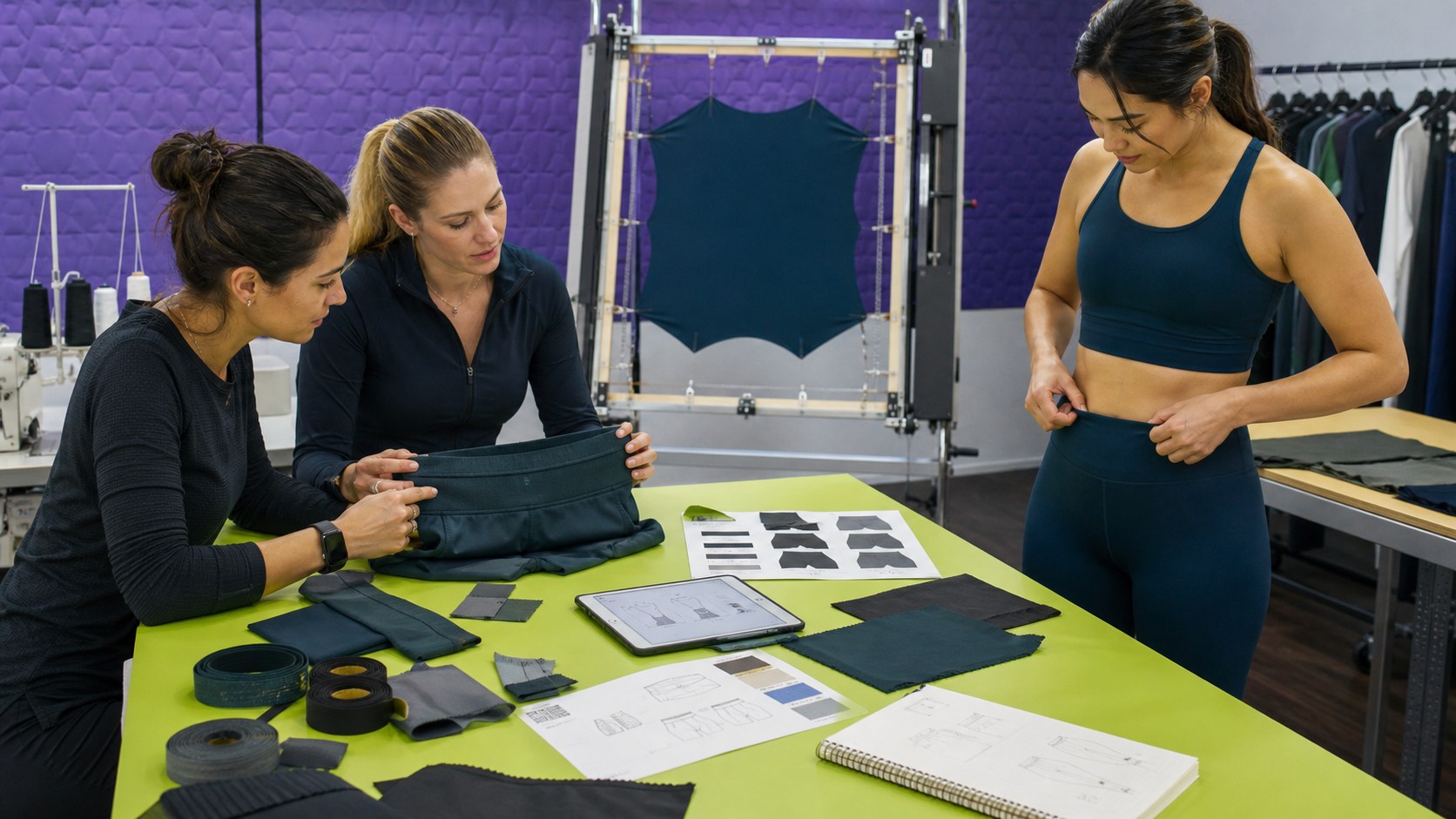
Once the problem earns a sample, the execution becomes unusually interconnected: waistband height, elastic or laminated structure, pattern reduction, seam placement, fabric modulus and recovery, rise, anchoring, rolling, opacity, and grading can all change comfort and stability.
Small-Batch Ready-to-Custom cannot validate that promise because it uses existing silhouettes, predefined sizes, and available colors rather than custom waistband, pattern, fit, or construction changes. Bulk production would be premature before the pressure–stability trade-off is proven.
After discovery evidence, Battlerobe’s Small-Batch Custom Development is the stage-correct route for turning the waistband hypothesis into controlled samples. Battlerobe can help separate the variables, assess feasibility, and iterate fit and construction; material, MOQ, price, timeline, and final claims still require project-specific confirmation and real testing.
The capability is useful not because a factory can certify “bloat friendly.” It is useful because the garment must make a subtle promise measurable: less unwanted abdominal pressure without slippage, rolling, opacity loss, or visual compromise.
Bring this preparation brief:
- selected wearing state and activity;
- three rejected products and the exact pressure/stability failure;
- preferred rise and areas where pressure is tolerated or avoided;
- the control leg block and fabric requirements;
- the two waistband concepts to compare;
- fit testers available across relevant body shapes and states;
- language the brand will not use without evidence;
- the result required before a second sample or small production test.
The Battlerobe activewear product-development guide shows why concept, fabric, pattern, fit, size planning, and sampling must be resolved together. If one waistband later becomes commercially proven, production quality control matters because small changes in elastic, seam, recovery, or tolerance can change the pressure customers feel.
The opportunity is adjustable dignity, not therapeutic leggings
Low-pressure activewear should not promise to treat endometriosis, eliminate bloating, relieve pain, or serve every fluctuating body. Those claims exceed the evidence and can turn a humane product idea into irresponsible marketing.
The credible opportunity is narrower: a fashionable activewear bottom for a selected group whose tolerance for abdominal pressure changes, designed so the wearer—not a fixed waistband—can decide what feels acceptable during the day.
This opportunity is ready for a bounded discovery and prototype test. Begin with the seven-day diary, then audit existing fold-over, wide-band, adjustable, and condition-led options. Hold the leg block constant. Compare two waist systems. Measure both comfort and stability.
If wearers repeatedly use the adjustment and replace an existing workaround, continue. If the product slides, rolls, looks medical, or only works in one body state, revise. If a common fold-over pant already solves the job, stop and avoid expensive complexity.
The founder best suited to this opening is not the person with the loudest wellness language. It is the person willing to respect the boundary between product comfort and medical care, show the failures honestly, and develop one small piece around how real bodies change.
Sources and further reading
- World Health Organization: Endometriosis
- Journal of Obstetrics and Gynaecology Canada: Abdominal bloating and endometriosis
- International Journal of Behavioral Medicine: Body image in people living with endometriosis
- International Journal of Clothing Science and Technology: Comfortable pressure and abdominal clothing pressure
- Femwear expandable-waist flare
- Nyssa VieWear Period Comfort Leggings
- Apéro Label adjustable pants
- Kuratd Studio adjustable-waist denim